


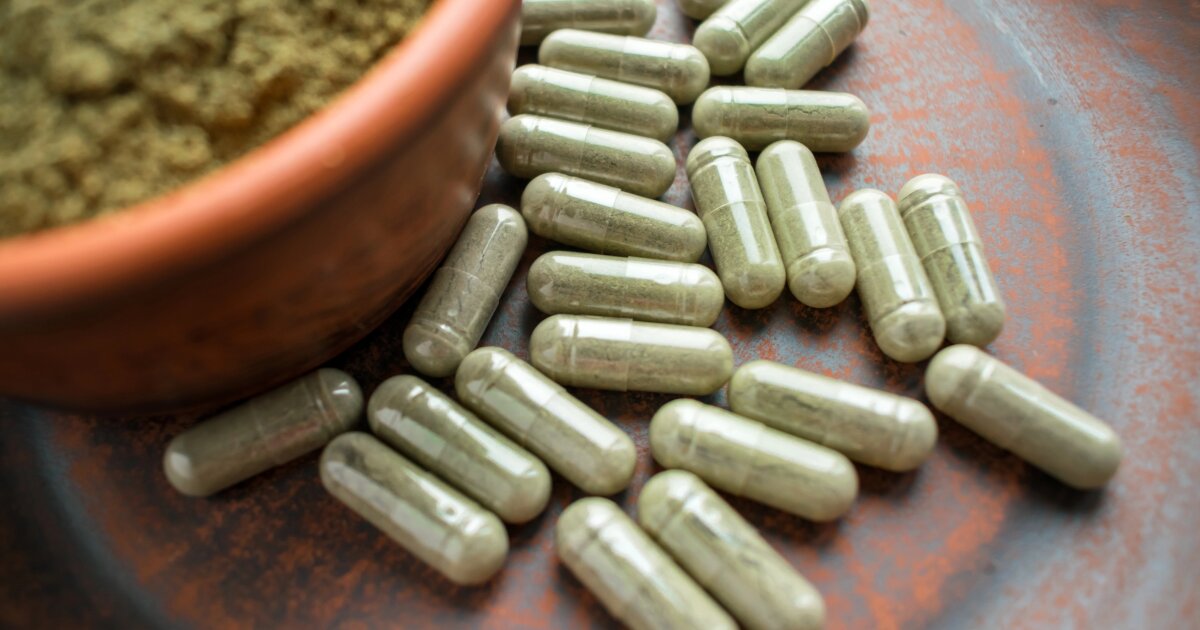
The US Drug Enforcement Administration (DEA) has petitioned to temporarily classify an over-the-counter supplement referred to as a “gas station heroin” drug as a Schedule I substance under the Controlled Substances Act (CSA), in an effort to counter an emerging health crisis across the country.
The substance 7-hydroxymitragynine (7-OH) is an alkaloid found naturally in low concentrations in the Southeast Asian plant kratom (Mitragyna speciosa). The issue isn’t the plant or its associated low-7-OH extracts, but a synthetic version (most commonly known as kratom) of it that drastically increases the concentration.
In its concentrated form, this psychoactive substance is very effective at acting on the μ-opioid receptor, the same one that’s targeted by morphine, oxycodone, and heroin.
Because it isn’t derived from the opium poppy, kratom isn’t officially classed as an opioid. Yet its primary alkaloids, mitragynine and 7-OH, are atypical opioids (also known as partial opioid agonists), due to their interaction with the opioid receptor.
According to a study published in May this year, more than five million people in the US have taken kratom, including more than 100,000 children aged 12-17 years.
In a majority of states, kratom is easily purchased at gas stations and convenience stores, in the form of capsules, tablets, powder, liquid, and more. Here, kratom is commonly marketed as an “energy booster, mood lifter, pain reliever, and remedy for the symptoms of quitting opioids”.
The data that’s beginning to emerge, however, paints a different picture.
According to a new report from the Centers for Disease Control and Prevention (CDC), kratom-related emergencies have surged by 1,200% between 2015 and 2025, with a rapid increase in the last year alone, with 3,400 reports of poisoning in the US.
Kratom has no federal regulations applied to it, but more than a dozen states have restricted access to products by prohibiting sale to minors. These products are still readily available online and on shelves at gas stations, convenience stores, and smoke shops in many formats, with no oversight of dose or ingredients.
As of this week, just eight states – Alabama, Arkansas, Indiana, Louisiana, Vermont, Wisconsin, Connecticut and Tennessee – have banned these kratom products completely. It was nine, but advocates pushed lawmakers in Rhode Island to reverse the ban in April.
If you’ve never heard of kratom, it’s understandable; what health data we do have indicates that use really spiked in 2025. Now, if you do a Google News search on “kratom”, you’ll find an enormous list of local news outlets reporting on kratom-related overdoses, addiction, withdrawal, and deaths (Oklahoma registered 58 fatalities between January 2025 and May 2026). And it’s also increasingly appearing in toxicology reports.
But there are a lot of gray areas in terms of where “gas station heroin” sits in terms of regulation – especially when scientific research looking into its adverse effects is still in its infancy.
“Kratom is not appropriate for use as a dietary supplement,” the US Food and Drug Administration (FDA) noted in December last year. “FDA has concluded from available information, including scientific data, that kratom is a new dietary ingredient for which there is inadequate information to provide reasonable assurance that such ingredient does not present a significant or unreasonable risk of illness or injury.”
The impending temporary scheduling order will make the manufacture, distribution, sale and possession of the flagged 7-OH substances subject to criminal, civil and administrative “provisions” under the CSA. It’s unclear as to what these provisions entail, however.
“Temporarily scheduling these substances underscores the emphasis this Administration has put on the safety, health and well-being of the American people,” said DEA Administrator Terrance Cole in a statement on July 1. “This action gives law enforcement and public health partners the tools needed to address this emerging threat.”
Although temporary, this new scheduling puts kratom in the same group as Schedule I substances like heroin, lysergic acid diethylamide (LSD), 3,4-Methylenedioxymethamphetamine (MDMA), and mescaline (peyote).
In the US, Schedule I substances are considered to have a high potential for abuse, no present-day accepted medical use, and no accepted safety for use under medical supervision.
It’s worth noting that the temporary scheduling action does not impact botanical kratom products, which contain a low amount of 7-OH.
While it remains to be seen what the DEA’s intervention can impact, it has highlighted the complexities that come with trying to curb a new but rapidly escalating public health crisis, especially while the science is still catching up.
A 2024 study highlighted widespread “insufficient evidence” regarding kratom’s effects, and the World Health Organization (WHO) has kept it as “on the list of substances under surveillance” since 2021.
That said, kratom is currently being studied for its potential as a pain-reliever and for opioid use disorder. Both teams cite a lack of existing data as a challenge.
Source: Drug Enforcement Administration
Fact-checked by Mike McRae

