


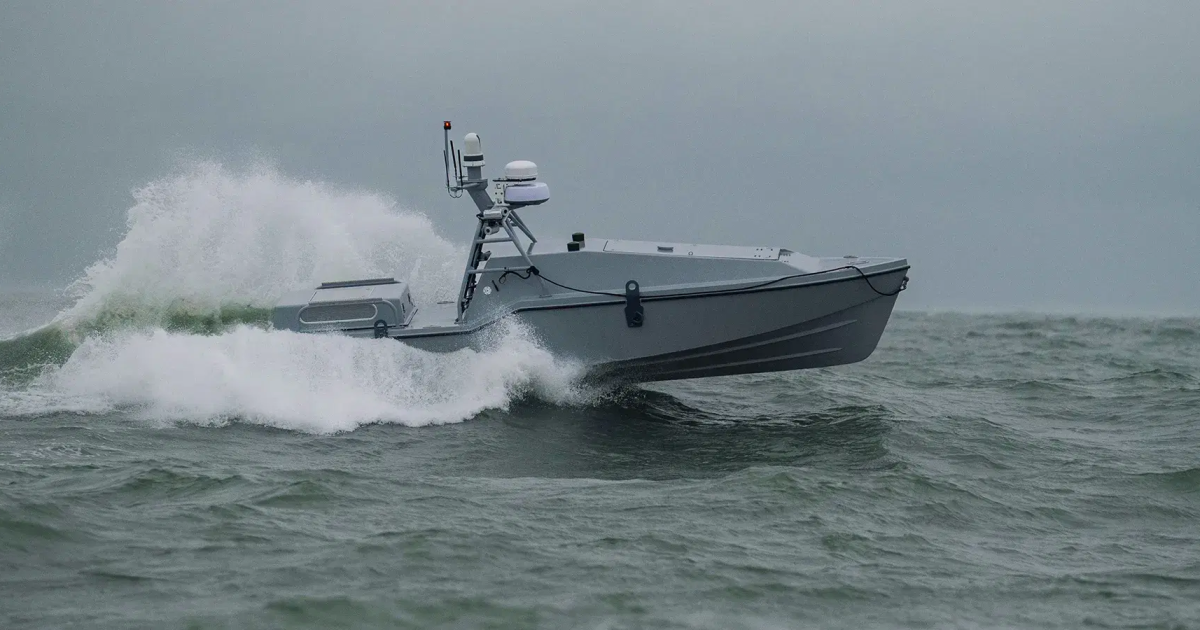
The US has racked up another historic drone warfare first as US Central Command (CENTCOM) announces that a trio of Corsair autonomous surface boats successfully carried out a simultaneous attack against the Bandar Abbas Naval Base in Iran.
From the looks of things, the shift from conventional to hybrid drone warfare is a bit like Ernest Hemingway’s description of how one goes bankrupt: “Two ways. Gradually, then suddenly.”
It wasn’t that long ago that drone warfare meant a handful of remote-controlled reconnaissance planes and recreational quadcopters with grenades strapped to them by improvising Ukrainian soldiers. Today, they are rapidly becoming a major component of land, sea, air, and space forces, with much more to come in the next decade.
The July 12, 2026, attack by the US 5th Fleet’s Task Force 59 Unmanned Systems Unit marks a paradigm shift in naval warfare. Though Ukraine has used drone boats to destroy Russian shipping, the American strike is the first time such a mission has been carried out by a major naval power.
Yesterday, using multiple one-way attack surface drones, CENTCOM forces successfully struck a submarine and ship maintenance facility in Iran. Three Corsair unmanned surface vessels hit the port at Bandar Abbas Naval Base, marking the first time American forces have employed sea… pic.twitter.com/bOM2kmgRxz
— U.S. Central Command (@CENTCOM) July 13, 2026
According to CENTCOM, three Saronic Corsairs were sent to attack a raised dock used by Iran for ship and submarine support. The 24-ft (7.3-m) composite-hull craft approached the dock from different directions under autonomous control, rendezvousing next to a laid-up Iranian Ghadir-class midget submarine before detonating.
The attack represents more than just the increasingly sophisticated use of mass-produced, low-cost autonomous attack vessels in place of conventional naval vessels and crewed fast-attack craft. It also shows a remarkable evolution – if not an outright flipping – of tactics.
For decades, advanced military powers have suffered at the hands of weaker forces employing asymmetric warfare, relying on hit-and-run tactics to inflict damage at low cost. It is the very basis of the Iranian Navy’s “swarm” doctrine, which uses small, high-speed patrol boats armed with lightweight anti-ship missiles, rocket launchers, and limpet mines to strike at shipping and even enemy naval vessels.
Using the Corsairs to strike a fortified naval port directly without risking human operators turns that tactic on its head. This tactical advantage is heightened by the US’s ability to utilize stealthy hulls and exploit purpose-built, military-grade AI guidance systems and sensors instead of commercial components, making the attacks incredibly precise. It is officially turning Task Force 59 from an experimental reconnaissance unit into an active, offensive combat element.
This combat debut comes on the heels of another historic milestone. Just last month, a Task Force 59 Corsair completed the first-ever autonomous search-and-rescue mission in history, successfully recovering a pair of downed Army Apache helicopter crewmen off the coast of Oman.
Source: Centcom

