


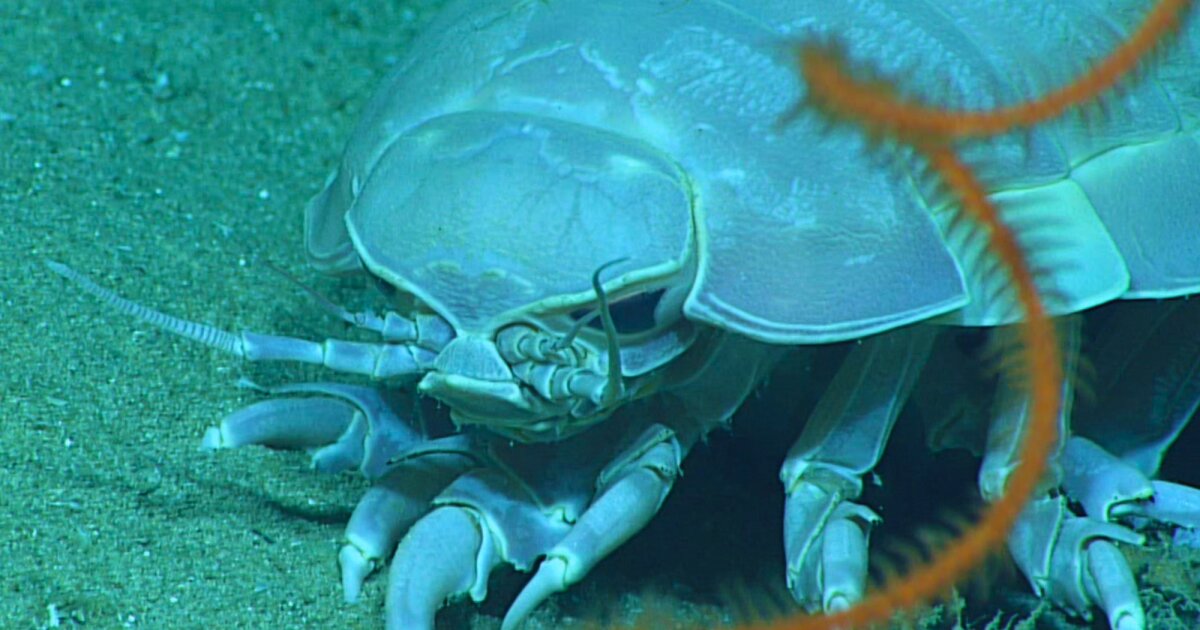
About a kilometer deep beneath the ocean surface, where sunlight disappears and food becomes scarce, lives a giant creature that can wait out starvation and survive more than five years without eating.
Researchers have now traced one of the primary mechanisms responsible for this extraordinary endurance – a gene stolen from bacteria. Over millions of years, the isopod Bathynomus has incorporated the ND1 gene from bacteria living in its body, aiding survival by significantly slowing its metabolism.
“This study shows that animals can evolve in unexpected ways by borrowing genes from microbes and using epigenetic tricks to control them,” the lead author of the study, Chinese Academy of Sciences researcher Jianbo Yuan, tells Refractor.
Isopods are a diverse group of crustaceans that live in oceans, freshwater, and damp terrestrial environments. In the oceans, Bathynomus lives at depths ranging from 300 meters (about 1,000 feet) to about 1 kilometer below the ocean surface. Despite the immense water pressure and nutrient-deficient conditions, some Bathynomus display a pronounced size of about half a meter, a quirk that requires a substantial amount of energy.
To understand their survival mechanism and what fuels their gigantic size, Yuan and his colleagues studied two isopod species living at different oceanic depths: B. jamesi, found nearly 900 metres down, and B. doederleini, which lives in shallower water around 300 metres.
The deeper-dwelling species is a lot larger than its shallower relative and has a stomach that can expand to fill two-thirds of its body cavity. This allows B. jamesi to overeat massive amounts of food during rare feeding events and retain the meal for long periods.
The researchers already knew that B. jamesi has a severely reduced metabolic rate, which limits energy expenditure. The team sequenced the genomes of both Bathynomus species and found that the low metabolism of the deeper-dwelling species is guided by the ND1 gene.
“The most interesting and important finding is the discovery of a key energy‑regulating gene, ND1, in deep‑sea isopods,” Yuan told us. He adds that this gene was not inherited from the isopod’s own ancestors; instead, it was acquired from the genome of a symbiotic bacterium through horizontal gene transfer.
To find out what ND1 actually does, the researchers bioengineered a zebrafish with high ND1 expression and tested their starvation tolerance under different temperatures.
At normal temperatures, fish carrying the gene burned energy faster and struggled more under starvation. But in cold conditions that mimic the deep-sea environment, the fish survived starvation 37% longer than fish without it. Yuan says that under cold conditions, ND1 suppresses mitochondrial activity, slows down overall energy consumption, and promotes more efficient use of nutrients and energy stores.
“We found that ND1 acts as a conditional “valve” for energy metabolism,” Yuan says. “This allowed the fish and isopod to survive much longer without food. So, this HTG helps the isopod go longer periods without food by fine‑tuning energy expenditure.”
The team also found that the isopod’s stomach harbors Chlamydiae. Chlamydiae is a phylum of bacteria that contains species known to be pathogenic in many animals, including humans. Here, the microbes synthesize and store fat. Yuan told us that since these bacteria have been synthesizing fatty acids for isopods for millions of years, they may not be pathogens to deep-sea isopod hosts and may have been adapted to the unique stomach environment.
The researchers have “done a great job of bringing together evolutionary aspects of anatomy, metabolic physiology, genomics, and epigenetics to understand adaptations to life in the deep sea,” says Erik Thuesen, a marine biologist at The Evergreen State College in Olympia, who was not involved in the study.
The study “may inspire new ideas in human health – for example, how to manage obesity (by slowing metabolism) or how to protect cells during extreme conditions (like cold storage for transplants),” Yuan concludes.
The study has been published in the journal Cell.
Fact-checked by Mike McRae.

