


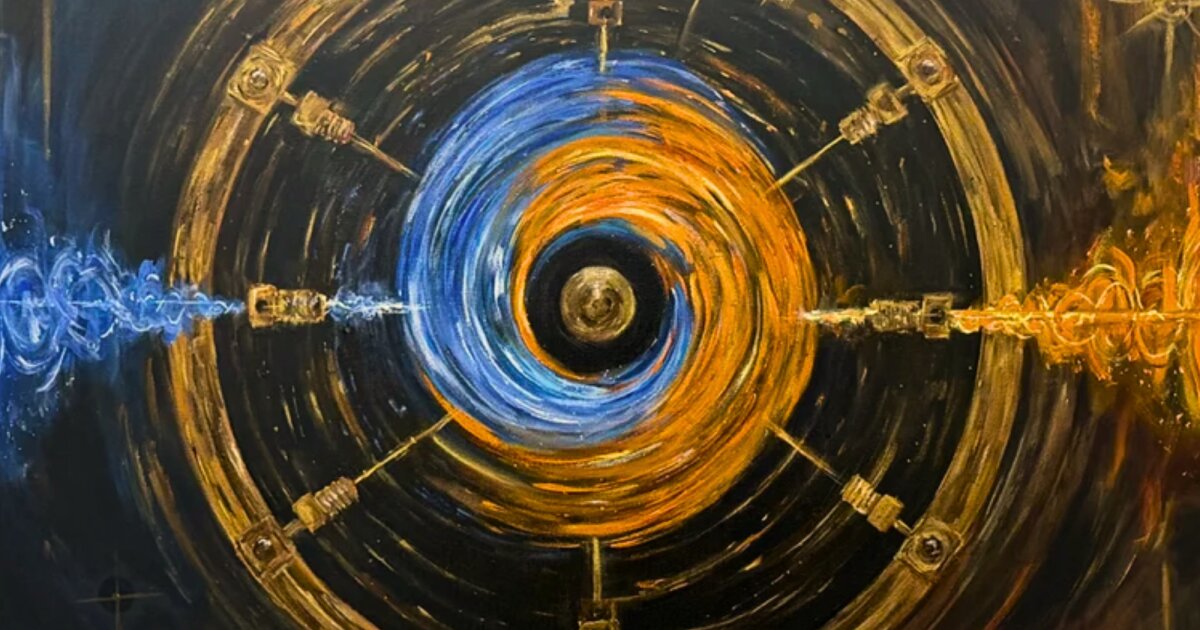
If you happen to have an uncharged black hole handy, you may be able to power your house with it. Just set it spinning.
This suggestion comes courtesy of renowned 20th-century physicist Sir Roger Penrose, who did some back-of-the-envelope calculations to show the twisting of spacetime surrounding a rotating black hole can generate energy.
Since none of us have a black hole that we’re willing to spare, it’s a little hard to test his idea. So researchers at the City University of New York (CUNY) went looking for something to take the place of a whirling abomination of cosmic destruction.
What they delivered suggests good old Sir Penrose was onto something. And, perhaps more importantly, we can experimentally test the space-mangling effects of black holes from the safety of our own laboratory.
“This successful experiment moves ideas about extreme rotational dynamics from theory to practice and creates a versatile experimental platform for exploring a broad range of phenomena at the intersection of astrophysics, wave physics, and quantum science,” says Hadiseh Nasari, lead author and physicist at CUNY.
The “Penrose mechanism”, as it’s called, makes use of the properties of a part of a black hole called the ergosphere. This region of spacetime skirts the more famous line of no return, the event horizon, and superficially resembles bath water before it’s about to go down the plughole.
Technically, all rotating masses exert a similar swirling effect, tugging on the fabric of reality in what is referred to as frame-dragging. But black holes take this twisting to a whole new level, taking any particles within it for one hell of a ride regardless of their relative motion.
Penrose pictured a mechanical system of something akin to a rocket dipping into the ergosphere, firing its thrusters, and shooting back out with more energy than it went in with. All thanks to the dragging effects of a spacetime twister.
We don’t even need rockets. Pop a particle into the ergosphere and its decay could drive a similar gain in energy. Or, according to physicist Yakov Zel’dovich, bounce some waves from an object spinning fast enough.
It all works on paper, but being a little short on black holes within easy access, researchers have had to find analogues to test their calculations.
So Nasari and her team used modulated radio waves to mimic the spinning of space, effectively generating a level of rotation that no mechanical system could hope to achieve.
To analyze their radiowave “black hole”, they applied Floquet theory. While the word might not be familiar, we’ve all performed similar mental calculations when we’ve pushed a child on a swing, timing each nudge with a series of natural oscillations.
In this case, interactions with the rapid rotations of changing radiowave frequencies could be treated as a parent pushing a child, only gaining a small amount of energy from every shove.
“Waves with the appropriate rotational characteristics extracted energy from the system and became amplified, reproducing the essential physics of the Penrose-Zel’dovich process,” says co-lead author Hady Moussa, a PhD student at CUNY.
While it might not be the black hole power supply we all dream of plugging our blender into, it does give astrophysicists another tool to understand some of the most extreme objects in the known Universe.
This research was published in Nature
Source: CUNY
Fact-checked by Bronwyn Thompson

