


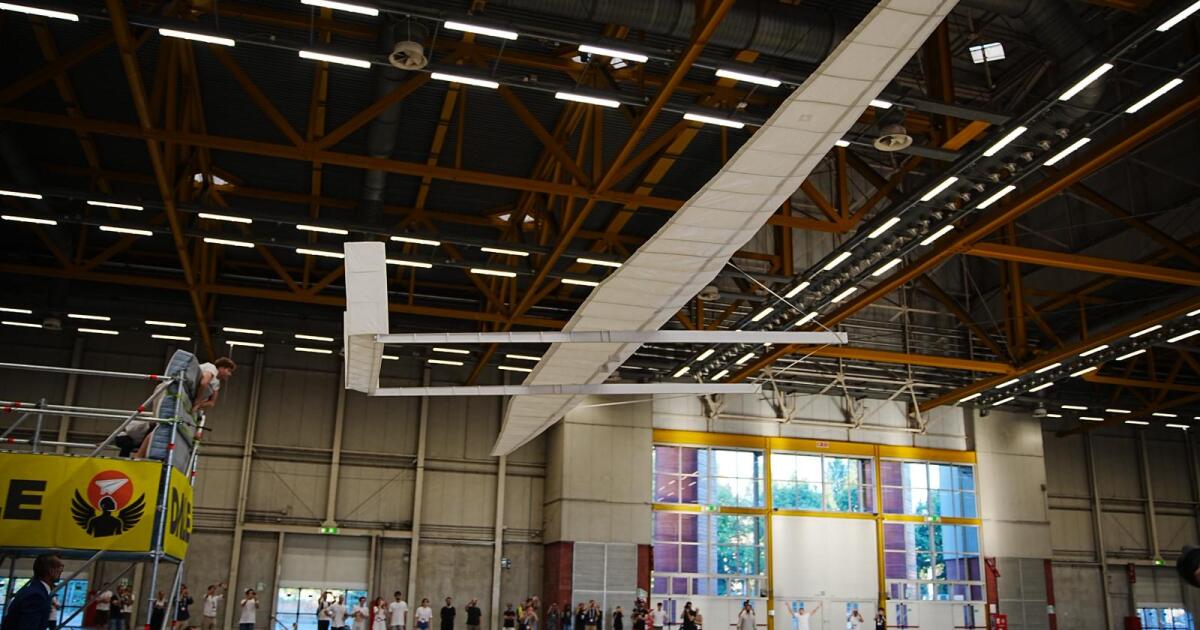
Building a paper airplane can be as demanding as building the airframe of a real aircraft. And once a group of students in Pisa set out to make the world’s largest one, the classroom craft turned into a very real engineering problem, tackling stability, weight, stiffness and aerodynamics with an almost surgical attention to every millimeter.
The team has now set the Guinness World Record with ICARUS. The paper plane is 7 m (23 ft) long with a wingspan of 20.04 m (65.8 f), weighs in at 28.49 kg (62.8 lb), and has flown 59 m (193.6 ft), beating a record previously held by the Braunschweig Institute of Technology since 2013.
The official certification came on June 25 during WMF – We Make Future at BolognaFiere in Italy. The project also had support from Jakidale (Jacopo D’Alesio), a science communicator and creator who helped produce the effort.
IL LANCIO DELL’AEREO DI CARTA PIÙ GRANDE DEL MONDO!
“When I met the guys from Pisa, I fell in love with a seemingly crazy idea: using paper and glue and the same logic used to design a passenger jet wing to build something that had never existed before,” says Jakidale.
What makes ICARUS interesting is not just its size but the way it was built. The students followed a construction logic closer to conventional aeronautical engineering, only with a different material. They used spars, ribs, a leading edge, a trailing edge, and a tail designed to keep it stable in flight.
They also used laminated paper sheets, repeated parts, and a geometry designed to hold together without increasing the weight. According to the project video, the team spent months studying, simulating, testing, and correcting the design before reaching the final version.
The students claim that a total of about 300 kg (661 lb) of paper and about 60 kg (132 lb) of Vinavil Pro glue, partly mixed with water, went into the project. The structure combined 120 g/m² paper for the stronger parts and 40 g/m² paper for the covering.
ABBIAMO COSTRUITO L’AEREO DI CARTA PIÙ GRANDE DEL MONDO
They glued the paper into a honeycomb structure to boost stiffness without adding much weight. The goal, they say, was not to pile on more paper but to arrange the material so it could carry more load with less bulk.
Building something huge wasn’t enough to qualify for the record. The airplane had to take off from a platform up to 3 m (9.8 ft) high, travel at least 15 m (49 ft), and be launched by a single person. That meant the design had to favor stability and efficiency, almost like a giant paper glider. The team states that wing shape, surface area, and speed were critical to generating enough lift, so they tested smaller prototypes before committing to the final aircraft.
“A 20-meter paper airplane may seem useless, and in a sense it is, but it is precisely by pushing things to the edge of engineering, for the sake of the challenge, that progress happens,” says Jakidale. “For months we battled humidity, structure, aerodynamics, millimeters, and gravity. Seeing it fly and then crash into the columns at the end of the hangar is proof that it is always worth trying to build the impossible.”
Sources: University of Pisa, We make Future

