


Soon after Earth formed, life happened. It all started with a soup of complex organic chemicals delivered express from space. Then stuff happened, and pow, there were itty-bitty cells.
Scientists are still figuring out exactly what that “stuff” was, and just how long the “pow” took, but researchers from the University of Minnesota have taken a monumental step toward understanding the process of abiogenesis by piecing together their own organic cell and watching it divide in two.
“This is likely the most exciting project I’ve ever worked on,” says synthetic biologist Kate Adamala, describing her team’s ongoing efforts to make a cell that can complete a life cycle.
“We’ve replicated in chemistry what only used to be possible in biology: the complete set of behaviors of a cell. It proves that the most fundamental functions of life, like growth and replication, do not need a mysterious magical spark.”
In 2010, the J. Craig Venter Institute took a Mycoplasma mycoides genome synthesized in a yeast cell and inserted it into a stripped-out bacterial cell, setting a benchmark in biology-by-design.
Synthetic biology has come along in leaps and bounds in recent years, with researchers now constructing microbes from the ground up, reducing genomes to their critical components before creatively weaving in novel blueprints.
It’s thought that a living cell could persist with a genetic instruction list just 113,000 base pairs in size. By comparison, the simplest free-living organism is a bacterium called Mycoplasma genitalium, which has around 580,000 base pairs.
With just 543,000 base pairs, a microbe built by Venter’s institute several years ago can even reproduce fairly reliably.
Yet there comes a point in minimalist models of life when they become mere shadows of biology. Sure, they can survive, but life is defined by more than just persisting in a metabolic state – it has a cycle that results in an imperfect form of reproduction that selection can act upon.
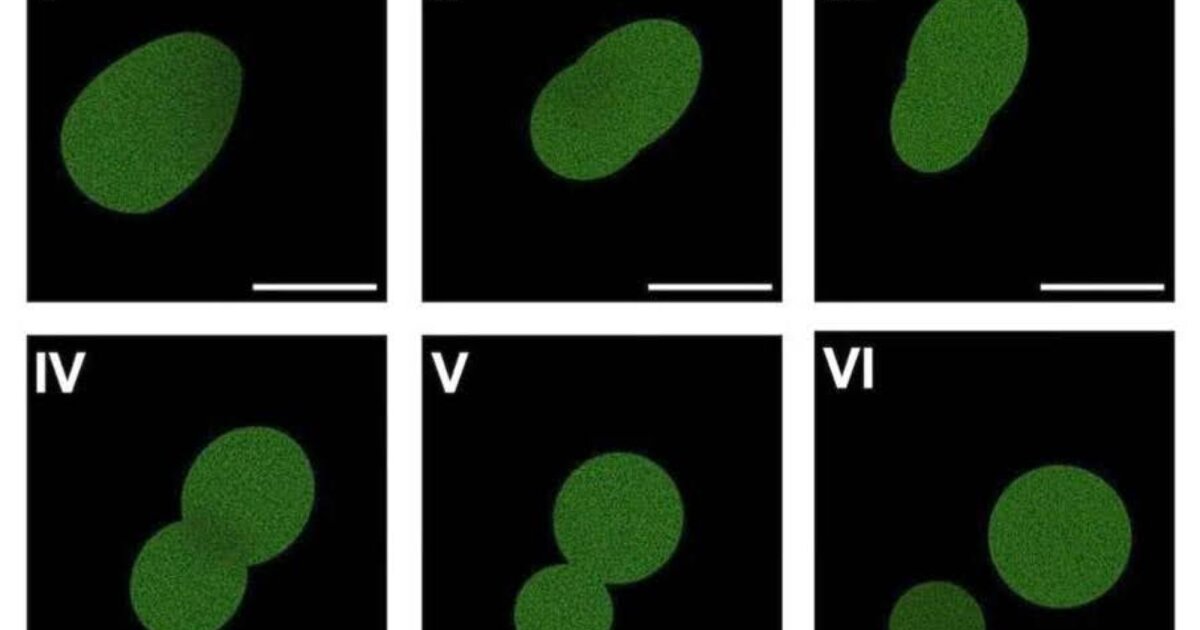
Adamala and her team succeeded in building a unique kind of cell-like system from scratch. Dubbed SpudCell, it uses a mere 90,000 base pairs of genetic code distributed across nine separate strips of DNA. Bundled in with them are 36 types of purified enzymes, all packed inside a lipid bubble.
The small blobs join with smaller bubbles to feed, slurping up building blocks and more enzymes as needed, all under the direction of its genetic coding.
Crucially, SpudCell can divide.
Natural cells undergo fission through a complex manipulation of their internal “skeleton”, which consists of a web of fibrous materials adjoining their membrane. Managing this in synthetic cells has proven a challenge, but SpudCell has its own trick, using accumulations of proteins in its membrane to split.
The researchers also mimicked an evolutionary leap. By artificially tweaking a gene that increased the production of proteins required to feed, they created a new line that could outgrow its peers.
“This work is just the beginning,” says Adamala. “We are showing it’s possible to engineer the basic functions of the cell.”
In time, the lessons learned from SpudCell could inform new ways to produce living pharmaceutical factories or revolutionize how we test innovative therapies in medicine. It may even provide a test-ground for evaluating theories on the emergence of life on ancient Earth.
SpudCell may not be life as we know it. But by coming close to it, it has become a significant breakthrough in our effort to learn the deepest secrets of biology.
This research hasn’t been peer-reviewed, but can be read at Biotic.
Source: The University of Minnesota
Fact-checked by Bronwyn Thompson

