


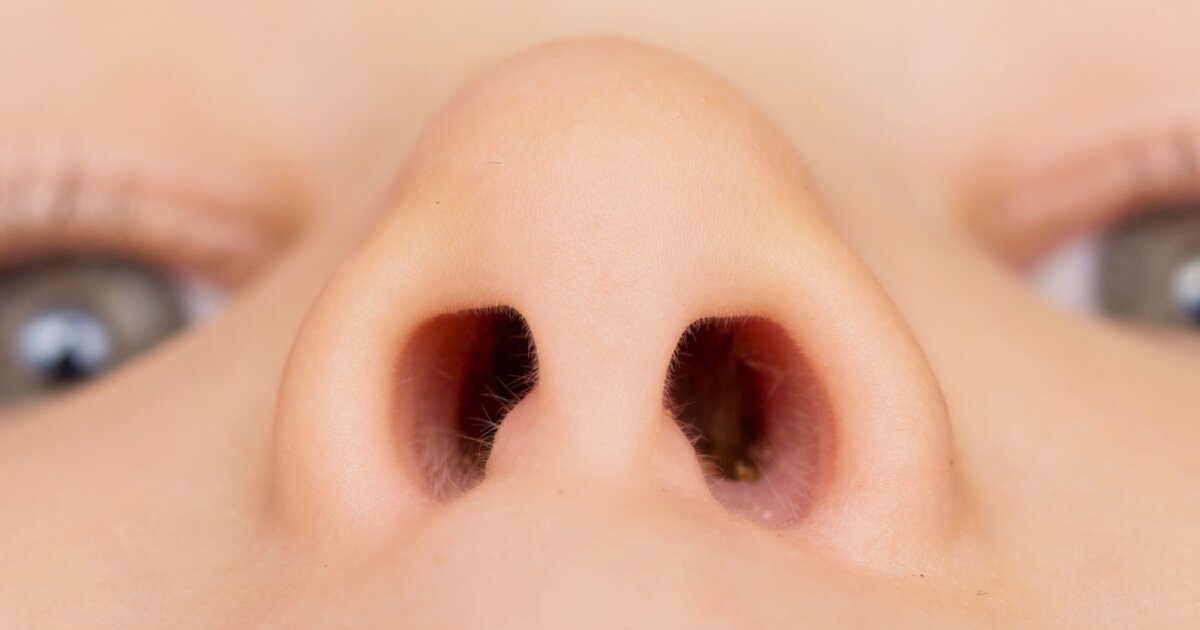
For centuries, scientists have marveled at the brain’s ability to organize sensory information into neat topographical maps. Vision, touch, and hearing rely on orderly patterns in which neighboring neurons respond to adjacent features.
But it has long seemed that the timeworn sense of smell violates this principle. Olfactory sensory neurons (OSNs) in the mouse nose were thought to randomly sample from a pool of around 1,100 potential olfactory receptors. The only indication of structure was the existence of ill-defined, overlapping “zones” in the nasal epithelium that modestly limit the expression of receptors.
Now, new research at Harvard Medical School has overturned this picture of chaos. Beneath the apparent randomness lies a hidden cartography: Each receptor is expressed at a unique average position along the dorsoventral axis of the nose.
In this sense, the map of olfactory epithelium is a highly tuned, systematic receptor grid, much like a city street grid.
The research team, as reported in the journal Cell, generated the first “smell” map of olfactory receptors in the nose and found that they cluster into closely defined horizontal bands by type. Neurons that express certain receptors form parallel stripes running from the top to the bottom of the nasal cavity.
This map is generated by a genetic program involving approximately 250 genes, including transcription factors, retinoic acid signaling, and guidance molecules.
Sandeep (Robert) Datta, from the Blavatnik Institute at Harvard Medical School, says, “Our results bring order to a system that was previously thought to lack order, which changes conceptually how we think this works.”
The OSNs are guided by a molecular compass, which is crucial for this organization. Each neuron receives a shared gene expression program that determines its dorsoventral identity. This program is controlled by a retinoic acid signaling gradient, which regulates the expression of transcription factors and axon guidance molecules.
Brann et al., Cell, 2026
Retinoic acid acts as a brush in the painter’s hand, brushing at various dorsal-ventral regions while conferring positional identity on individual neurons. The researchers showed that this molecule, which regulates gene activity, serves as a spatial cue in the olfactory map.
Its gradient across the nose tells each neuron which receptor to use based on location. When researchers experimentally varied retinoic acid levels, the receptor map shifted dorsoventrally, like sliding a ruler across a page.
“While the smell map is an exciting discovery in its own right,” Datta said, “it also provides foundational information that could help scientists develop therapies for loss of smell, which are currently lacking.”
“We cannot fix smell without understanding how it works on a basic level,” he said.
Imagine trying to dive in a city with random street names assigned: you will get lost. An olfactory map guarantees that the brain can translate the chemical chaos of the environment into meaningful sensations: perhaps sweetness from the mango, sharpness in smoke, muskiness gushing from rain-soaked earth.
The researchers used a combination of single-cell sequencing and spatial transcriptomics to create this map, analyzing data from nearly 5.5 million neurons across more than 300 individual mice. Single-cell sequencing identified the receptors expressed in individual neurons, and spatial transcriptomics determined their precise positions.
What is the meaning or purpose of the receptor map in the nose?
A receptor map organizes smell signals in the nose, but it is not as exact as maps in sight or touch. Strong odors activate dispersed receptors, while weaker odors typically trigger a less diffuse set of receptors. This clustering is based on duplicate receptor genes that respond to similar odors.
The spread of these genes, both in evolution and in their cross-positioning across receptor types in the nose, strengthens resilience; if one area is damaged, others can still detect common odors.
The authors state, “Our analyses do not rule out the possibility that chemical odor features not queried here, or other odor features related to meaning or valence, are spatially organized in the epithelium.”
Researchers think that when OSNs respond to odors, they send signals that encourage nearby stem cells to grow and make new neurons. These signals may spread directly or operate through supporting cells in the nose.
“Because single OSN precursors give rise to multiple OSN subtypes, authors continue, “a main prediction from our results is that the odor experience will recruit not only OSNs whose receptors respond to the experienced odors but also OSNs with similar DV scores.”
The team is now set to explore why these receptor stripes line up in this orientation. As such, the team is now extending its work to human tissue, examining whether a comparable olfactory map might exist across species.
This is now the most sequenced neural tissue ever studied, an ocean of genetic information. This scale was vital to cracking the code behind how the system organizes smells. That knowledge could eventually lead to therapies, from stem cell treatments to brain–computer interfaces that allow the restoration of a diminished sense of smell, something many now regard as a form of sensory loss, but other researchers point out is an entryway to depression itself.
This research was published in Cell.
Source: Harvard Medical School
Fact-checked by Mike McRae

