


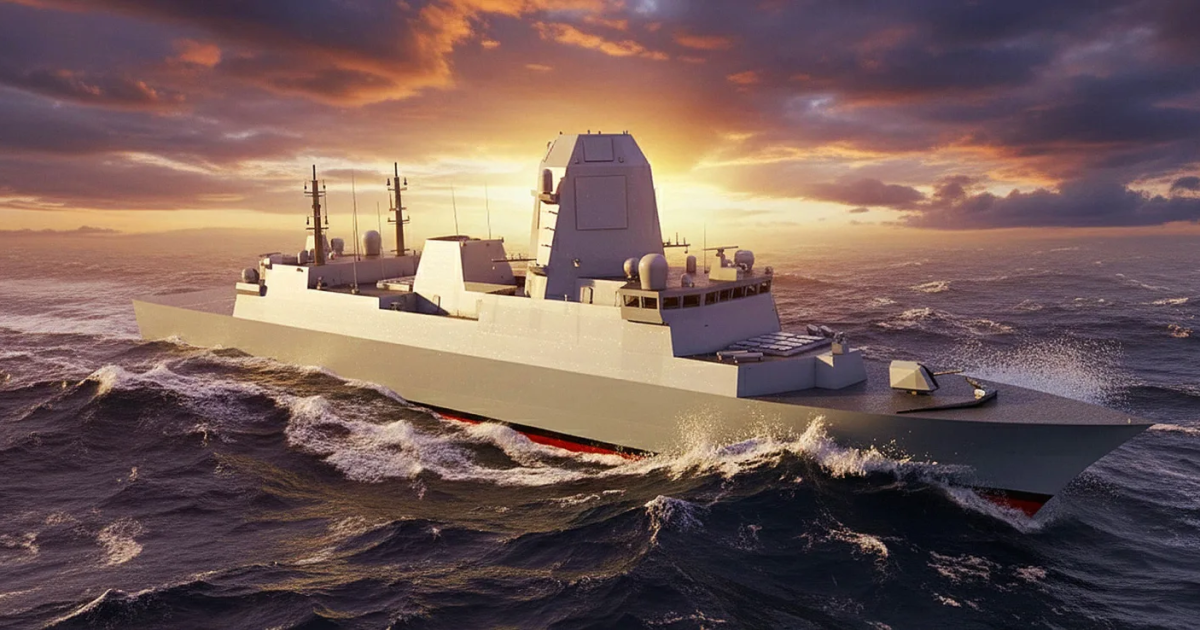
We got a glimpse of the Royal Navy of the future as the Ministry of Defence announced that it will not replace Britain’s aging destroyers, but succeed them with at least six Common Combat Vessels (CCV) that will act as drone command and control ships.
In service since 2009, Britain’s Daring-class Type 45 destroyers were the world’s most advanced guided-missile warships specialized for air defense and tasked with defending high-value targets—especially the Royal Navy’s Queen Elizabeth-class aircraft carriers. In 2012, a single Type 45 protected the skies over the whole of southern England during the London Olympics, showing the level of their sophistication.
However, technology progresses quickly and warships age even quicker under the rigors of training, patrols, and deployments. As a result, the British government planned to replace the Type 45 with a new destroyer called the Type 83 that would be part of a larger system-of-systems called the Future Air Dominance System (FADS) that would integrate the new destroyer with land, sea, air, and space platforms to deal with advanced threats, including hypersonic missiles.
The problem was that, like the Type 45, the Type 83 would be confined to a few state-of-the-art ships that have caused the Royal Navy to be described as a gold-plated Bonsai Navy too small and unfit for purpose. Added to this, Whitehall has historically faced criticism for treating the armed forces as a budget piggy bank to be raided whenever public funds run short.
As a result, the Type 83 never went any further than preliminary concepts, costing only about £1 million (US$1.3 million) on the destroyer’s design. What funds that were available went to higher priority items like the Dreadnought-class submarines, the SSN-AUKUS program, and the Global Combat Air Programme (GCAP).
This made the decision to go with the CCV a relatively easy one – even more so with the Russian invasion of Ukraine providing a stream of lessons as to the potential of drones and other robotic battlefield systems.
The new plan is for the CCVs to take on the role of the destroyers. Instead of a few capital ships filled with missiles and radar systems providing air defense, the CCVs would act as command and control ships that would provide maritime air defense by controlling a much larger number of uncrewed surface ships, robotic submarines, and airborne drones. These would include the Type 91 uncrewed missile platform, the Type 92 uncrewed underwater sensor platform, the Type 93 Extra-large Uncrewed Underwater Vehicle (XLUUV) and the Type 94 uncrewed sensor platform.
The idea is to create a layered defense divided into Atlantic Bastion, which deals with underwater threats and protecting underwater strategic assets like pipeline and cables; Atlantic Shield, which provides integrated air defenses for NATO based on the CCV; and Atlantic Strike, which focuses on amphibious operations, force projection, and special forces, which nobody likes to talk about because it involves things like the SBS (Special Boat Service), who tend to be a bit tight lipped.
Source: Ministry of Defence

