


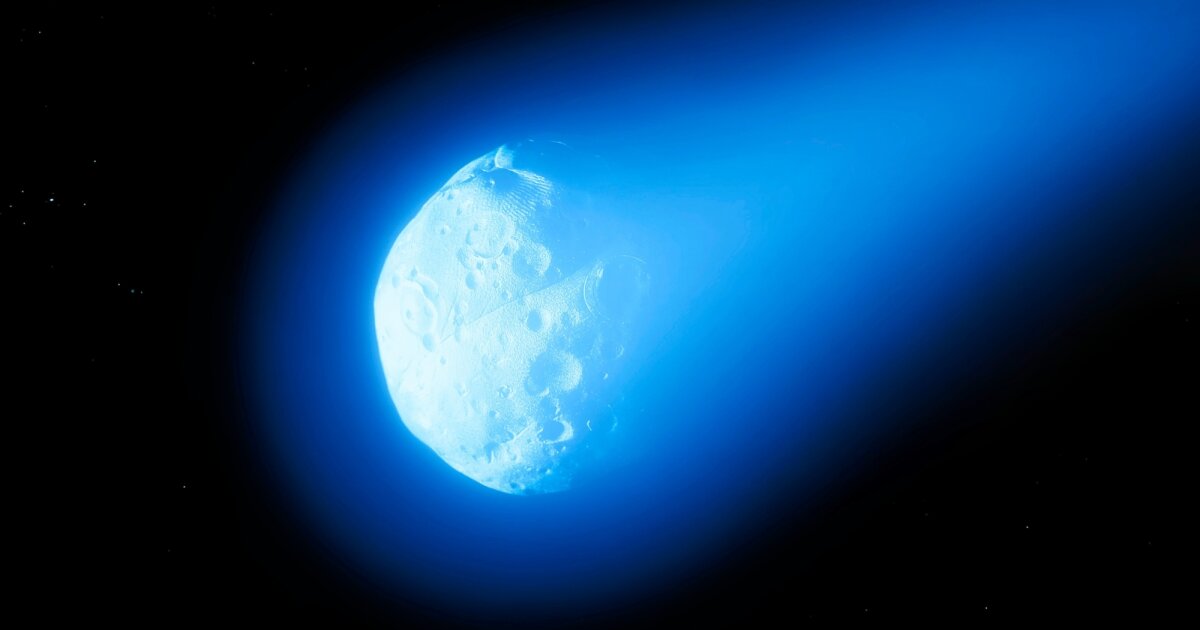
It’s not often that we get guests. So when the interstellar intruder 3I/ATLAS came zooming through our Solar System last year, it provided astronomers with a perfect opportunity to study a rock from another part of the galaxy.
An analysis by an international team of researchers using NASA’s James Webb Space Telescope (JWST) now reveals its chemistry is quite unlike anything under the Sun. Literally.
“This was a unique opportunity to study an ancient object from the distant galaxy, probably pre-dating our Sun and Solar System,” says lead author Martin Cordiner, an astrochemist with NASA’s Goddard Space Flight Center in Greenbelt.
“On the one hand, we get direct insight into that distant time and place, and on the other, we learn something about how unusual our own Solar System may be.”
In their recently published paper, Cordiner and his team of researchers present measurements of the comet-like object’s hydrogen and carbon isotopes that suggest a surprising origin in an astonishingly ancient part of the Milky Way, one that could be up to 12 billion years old.
Previous estimates based on the comet’s velocity already hinted at ancient origins for the comet, putting its age at anywhere from three billion to 11 billion years.
While it’s likely that material from other stars has entered our Solar System on countless occasions throughout its 4.5 billion-year history, astronomers have evidence of just three events – 1I/‘Oumuamua in 2017, 2I/Borisov in 2019, and 3I/ATLAS in 2025.
Of those, this latest example is the brightest, providing researchers with a prime opportunity to put some parameters on the kinds of alien rocks we might expect to shoot through.
The rock was both big and fast, with a diameter of up to 20 kilometers (12 miles) across and a record-breaking speed of 245,000 km per hour. Too fast for a permanent orbit around our star, giving researchers just one shot at studying its makeup.
NASA/JPL-Caltech
Thankfully, we had the perfect tool in place to capture its spectrum. Using data from the JWST Observatory, Cordiner and his team determined that the object’s deuterium was an order of magnitude greater than in any comet we’ve seen. Stranger still, the ratio of two carbon isotopes exceeded not only our Solar System’s values, but those of nearby interstellar clouds and infant planetary systems.
To bake a comet like this, the environment would need to be high in radiation and low in metals – just what you’d expect of a hot cosmic kitchen a billion years or so after the Big Bang.
Though it’s just a single sample, the findings demonstrate the significant benefits of analyzing material passing through our Solar System.
“Its distant origin in space and time makes 3I/ATLAS a uniquely valuable tool for galactic archaeology, highlighting the potential for interstellar object studies to help reveal the broader physical and chemical history of the Milky Way,” the team writes.
With the Vera C. Rubin Observatory in Chile set to map the sky in search of millions of asteroids, it’s more than likely we’ll stumble across more examples of ancient interlopers, building on our understanding of the Milky Way’s galactic traffic.
This research was published in Nature.
Source: NASA
Fact-checked by Bronwyn Thompson

