


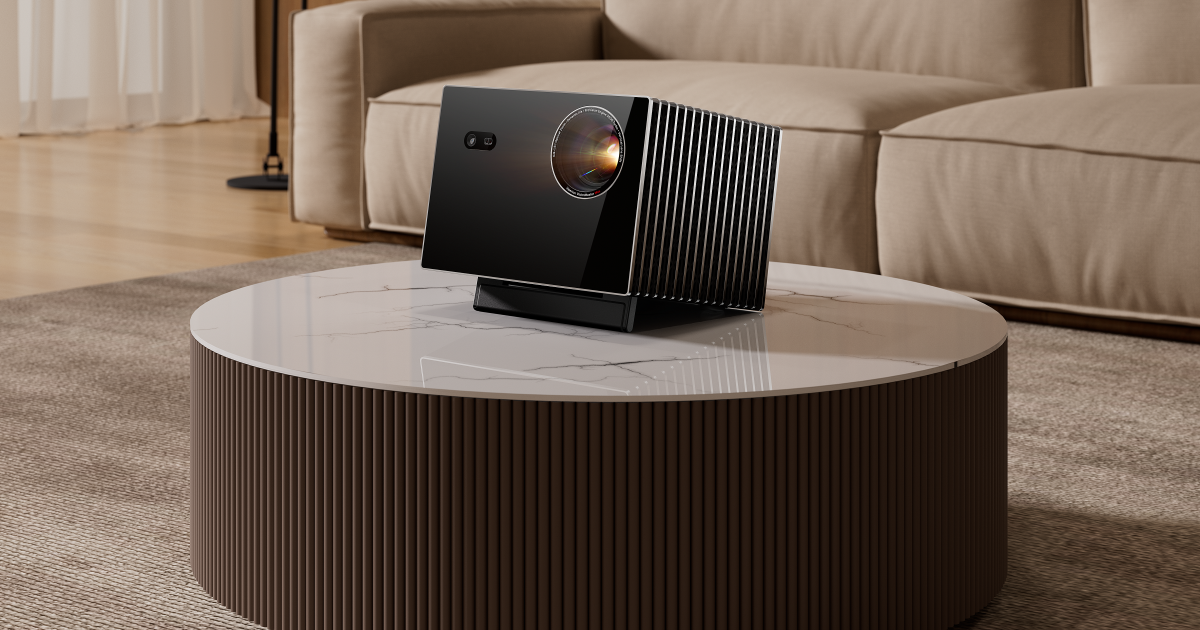
A beautiful box of smart-entertainment goodness turned up at my door last year from Valerion, following a successful Kickstarter and subsequent consumer launch. That was the VisionMaster Pro 2 4K triple-laser lifestyle projector, and now I’ve been sent the series flagship to play with.
But first, a brief catchup. Valerion is the sister brand to AWOL Vision – which manufactures ultra-short-throw smart projectors, such as the excellent Aetherion Max. The VisionMaster Max made its global debut at IFA 2024 in Berlin, Germany. The company then launched its VisionMaster series of feature-packed stylish short-to-medium-throw GTV projectors on Kickstarter a month later.
They were all similarly shaped and styled – with a shiny plastic front sporting the business end, a heatsink-like midriff and a featureless rear with a built-in trap door. Despite having a rather boxy appearance, each model had the confident look of luxury about it. Differences in performance and key specs, along with different-colored fronts, separated each member of the family.
That crowdfunding campaign netted the brand a cool US$10 million from eager backers. Valerion staggered the consumer launch of models in the series, and the Pro 2 I reviewed last year sits second to top in the series. The Max flavor on our review bench is the leader of the pack – and became available in the US toward the end of 2025.
Standing out from the crowd
Paul Ridden/New Atlas
Most of its specs are the same as the Pro 2, but with a few tasty performance upgrades and tech additions. Each model in the series has a 4K UHD DLP projection heart with 0.47-inch DMD chip. This is native 1080p and uses pixel-shifting to deliver maximum resolution.
The Max outshines the rest of the range with a triple-laser (RGB) light source putting out 3,500 ISO lumens, and it also leaves the rest in the shade when it comes to contrast – boasting a massive 5,000:1 native contrast ratio that can be boosted to 50,000:1 with some dynamic digital and mechanical help.
There are number of options in the menus to help here. Enhanced Black Level and Dark Detail help to improve the detail in the shadows. The former algorithm scans each frame to determine its dark and light levels, and then turns down laser intensity while adjusting color curves and contrast “so you see every glow, every glint, every shadow” in challenging scenes.
Dynamic Tone Mapping automatically deals with overexposed highlights and underexposed shadows in real time to enhance image quality when watching HDR content. And this is the only model in the range to offer six-step adjustment of the aperture for even more control over onscreen lights and darks. Not quite the dynamic capabilities that the name of the feature would suggest, but a powerful ally when paired with the right viewing surface.
For those who like to have options, settings also allow the user to select the color gamut in play, with five choices available – the native default, an auto setting, Rec.709, the wider DCI-P3 color space, and the selection is topped by 110% coverage of the BT.2020 space. Dolby Vision, IMAX Enhanced and HDR10+ content are all supported, plus there’s a Filmmaker mode that tweaks parameters to deliver cinema-like viewing, as well as options for running at 24 or 48 frames per second.

Valerion
The image projection size is reported to run from 40 diagonal inches right up to 300, but the maximum I could manage in my home was just short of 150 inches. I clearly need to invest in a bigger house, or muscle my way into a friendship with someone who lives in a mansion.
Interestingly, Valerion has cooked in some useful flexibility here. Out of the box, the ‘full-circle’ optics offer a native short-to-medium 0.9-1.5:1 optical throw ratio – which is the same as the Pro 2, but the lens is reported to be of a completely different design. This translates to a viewing rectangle stretching 100 inches diagonally from corner to corner if the unit’s darkened front is pulled back around 80 inches or so from the vertical surface.
The company has developed an optional lens attachment that can be externally mounted to alter the projector’s throw capabilities, offering a longer 1.5-2.0:1 ratio for more flexible installation opportunities. However, Valerion has confirmed that this module is not available at this time – the current focus is on “fixed-lens systems optimized for flexible placement and large-screen performance out of the box.”
Clearly the designers and engineers who put the Max together wanted users to have a great experience. The grainy visual noise that can sometimes spoil a tri-laser watch party has been put on notice, with cooked-in speckle reduction technology reckoned capable of taking out the effect by up to 99.99%.
Those troubled by the rainbow effect – which is caused by the red, green and blue lasers flashing rapidly to produce a single merged image, and can appear as color breakup during high-contrast or fast-moving scenes – are promised significant reduction thanks to technology that quickly blends color sequences so that the human eye doesn’t notice such fatiguing issues. This anti-RBE wizardry needs to be activated through the settings, but does result in a high-pitched whine as the tech kicks in.
And there’s more…
The Max is also the only member of team VisionMaster to feature vertical lens shift, which means the watcher can move the distortion-free visuals up or down without needing to touch the projector’s built-in (and rather stiff) kickstand. If you have some cash to splash, an attractive tripod is optionally available, as is a nifty desktop mount, or you could choose to hang the unit from the ceiling of your dedicated home theater via the standard tripod mount on the underside and a mount accessory. Optical zoom also means that the size of the thrown rectangle can be adjusted without moving the unit too.
Like its siblings, Google TV provides access to the audiovisual entertainment over Wi-Fi 6e or Gigabit Ethernet LAN, with direct access to Netflix, YouTube, Prime Video and Disney+ platforms via dedicated buttons on the IR/Bluetooth remote. The Android-based OS even offers up a media player and a web browser, and the GTV interface makes for relatively intuitive and fluid exploration of favorite apps, services and settings. If you simply must share the latest viral video from your phone with other Max viewers, you can do so wirelessly over Airplay 2, Chromecast or Miracast.

Valerion
The hinged plastic door to the rear hides cabled connections when not in use, which include two HDMI 2.1 ports for low-latency connection to external media players and consoles – with gamers able to get lag down to just 4 milliseconds at 1080p/240-Hz (rising to a still zippy 15 ms at 4K/60-Hz). ALLM (Auto Low Latency Mode) is baked in too, and details in after-dark action can be enhanced during gameplay at 21:9 or ultra-wide 32:9 aspects.
There’s a useful crosshair feature too for FPS battles, and a DLP turbo feature for improved performance during gaming, at the expense of certain settings like auto correction and 3D features being disabled. I’m not a player, so these aspects of the device went untested during my time with the Max.
The connections cubby is also home to one USB 3.0 port and one USB 2.0 – both Type-A – and a HDMI 2.0 port that caters for integration with home theater audio setups over eARC. There’s built-in sound too, in the shape of a pair of 12-watt DTS Virtual:X speakers with support for Dolby Audio immersion. A 3.5-mm audio jack is present should you wish to pop on a pair of wired headphones, and you’ll find S/PDIF digital for routing the signal through external audio gear. The Max can also integrate with Google Home or Apple HomeKit smart home setups, and works with Alexa and Control 4 too.
Is it better for movie nights than a big TV?
I get asked this quite frequently, and obviously my answer here is going to be subjective, but for me it would be a yes. Though a good-sized TV can be had for a few hundred bucks, I don’t like the idea of having a big black rectangle permanently mounted to a wall. Plus once it’s there, you don’t really have much choice about where you want to be in the house when the movie bug bites.
With lifestyle projectors like the VisionMaster Max, pointing the business end at pretty much any blank wall in the home can transform that space into a mini movie theater (of sorts). The minimum recommended throw rectangle size is a modest 40 inches, but you could go super large if your humble abode can accommodate it.
If you’ve got space to stow away a relatively inexpensive matte white projection screen between uses, all the better. And if your wallet is feeling particularly flush with cash, an ambient-light-rejecting (ALR)/Fresnel screen will bump up the quality of the cinema experience by several notches.

Paul Ridden/New Atlas
But installing such a screen could have you scratching your head a little as you weigh up the advantages and disadvantages of jumping into projector land. Many flavors are best mounted to a wall. So, you might say, that will give you the same room-domination feeling as a big-screen TV, and that’s true – plus these screens tend to be much larger than your budget-friendly gogglebox, so that could be even more jarring as you enter the room. And it would also limit viewing to the space it’s in, just like a TV.
You could get around all that by stumping up the cash for a motorized floor unit that hides the ALR/Fresnel screen away in a long rectangular coffin between uses. This solution could even be moved from space to space as needed, though that would involve more hefting than most of us would be happy undertaking more than a few times before calling it quits.
For what it’s worth, I’ve found the extra lumens pushed out by the Max, together with excellent contrast and color chops, make for pretty decent casual watching during daytime hours on a blank wall in partial shade – without so much as touching the picture settings. Direct sunlight streaming onto the viewing surface will bleach the imagery and spoil the party, but some common sense should see you right.
Daytime viewing on a matte projection screen in a similarly shaded position markedly improved the display quality, and tapped into a little cinema theater nostalgia too for good measure. No surprises for guessing the winner here though – by far the best results will be had on an ALR/Fresnel screen, particularly if you like to swim in inky blacks.
But in all cases, the less of a battle the Max has with ambient light, the better the picture quality – so I’d encourage embracing the dark side as much as possible.
Of course, if you want to catch the latest episodes of streamed show or watch the big game on a big canvas, rather than restrict your viewing to movies old or new, GTV provides the portal you need.
Watching with Max

Paul Ridden/New Atlas
Whether you’re a ‘take whatever you’re given out of the box’ kind of user, or someone who is only happy watching stuff after having spent an absolute age menu diving deep into the settings, the Max should prove satisfying either way. I found that just powering on and jumping straight in using the default settings resulted in a most engaging watch for things like YouTube videos and standard-definition streaming.
But I’m a tweaker, and there are a couple of ways to go. The first is via a quick menu bar activated by pushing a dedicated button on the partially illuminated remote. This brings up shortcut icons to frequently used settings and quick parameter changes – switching from a standard picture preset to a dynamic or theater one, for example, or scrolling through sound presets to better match the action.
This menu bar kind of hovers above the main image, and what shortcuts are available can be customized to a certain degree. Some options can be applied direct from the menu bar and the effects seen immediately, but others will bring up larger menus that partially hide a section of the main picture.
If you want to completely disappear down the settings rabbit hole, there’s a button on the remote that grants access to all sorts of goodies (or there’s a cog icon on the main menu GTV menu page).
These include a feature that can auto adjust the color parameters to compensate for using a non-white wall as the cinematic backdrop; another that can auto flip an image for ceiling-mount installations; picture clarity adjustments such as using AI to improve the show in real-time and reducing judder/blur capabilities; and the ability to set up custom gestures to control actions with the wave of a hand.
I reckon that there’s enough tweak potential here to satiate the nerdy appetites of even the most demanding user. And then some.

Valerion
After menu diving to taste, visiting friends who have a 65-inch TV mounted above the mantel in their home were quick to remark how impressively TV-like the image was – just bigger. Much bigger. Like the Pro 2, the Max benefits from autofocus and auto keystone correction for setup ease, resulting in a sharp, clear, engaging watch without too much hassle. Manual fine tuning of focus and keystone is available too, should you need it.
There’s another viewing option that’s good to have, even if – like me – you probably won’t use it much. The projector supports 3D content, and its 3D mode is activated automatically when such things load in and are detected by the system, though the user still needs to go into settings and choose the correct format. Apart from that minor inconvenience, the synchronization between the projector and the DLP-Link glasses that accompanied my review unit was top notch and the delivery quite astonishing.
Oh, one more thing. Genuinely eye-popping viewing potential is only half the picture when sitting back to indulge in a blockbuster movie or three. The soundtrack has to rock too. The Max features the same 24-watt DTS Virtual:X audio system as its siblings, for the promise of enough immersive output power to fill even larger spaces with aplomb. Despite the lack of a dedicated sub, I found the sonics to be well-rounded and punchy, and there’s a seven-band EQ on tap for a more tailored listen.
Directing audio to headphones is also possible for improved stereo separation and immersion – either via a cable or over Bluetooth. Useful.
The bottom line
Despite me featuring a bunch of information from the spec sheet, I’ve not included any luminance measurements, color validation results or what have you. This review is more about the home user experience than diving down into the murky depths of geekdom to verify manufacturer claims. Does it deliver the goods or will you feel like you’ve been short-changed?
The Pro 2 I reviewed a while back produced excellent imagery on wall, matte screen or light-rejecting screen. The similar-but-different series topper performs even better. Whether that’s because of the improved optics, more powerful laser output, the additional contrast technologies, the firmware tweaks and system enhancements and more I couldn’t say.
Pre-launch expectations were high, and Valerion has delivered. In spades. The Max deservedly sits at the top of an impressive series of stylish entertainment boxes, with many industry pundits ranking it very near the top (if not at the top) in the whole lifestyle projector space for this kind of thrower. Not bad for a relatively young player on the scene.

Valerion
I also happen to think that the Max is gorgeous. Of all the colors in the series, this one fits into my arsenal of speakers and amps and other equipment the best. That’s not to say you’ll need to have black or charcoal gear like I do, the dark front and back paired with the shiny metal slats on the top and sides should give it luxury arty appeal while likely serving as a conversation piece too. Highly recommended.
The important info for sizing up whether it is fill in your home are measurements of 10.23 x 7.3 x 9.2 in (259.8 x 185.4 x 233.6 mm), and my unit weighed in at a hefty 17.4 lb (7.9 kg).
The VisionMaster Max carries a recommended retail price of US$4,999, but there are regular offers and bundles for meaningful discounts. If you’re quick you could take advantage of just such a deal (32% off) as part of Prime Day on Amazon (June 23 – 26). The Pro 2 will also benefit from special savings (27%) while this brief window is open.
Product page: Valerion VisionMaster Max
Note: New Atlas may receive a commission from purchases made via links; this does not influence our review. Our reviews are impartial and our opinions are our own.

