


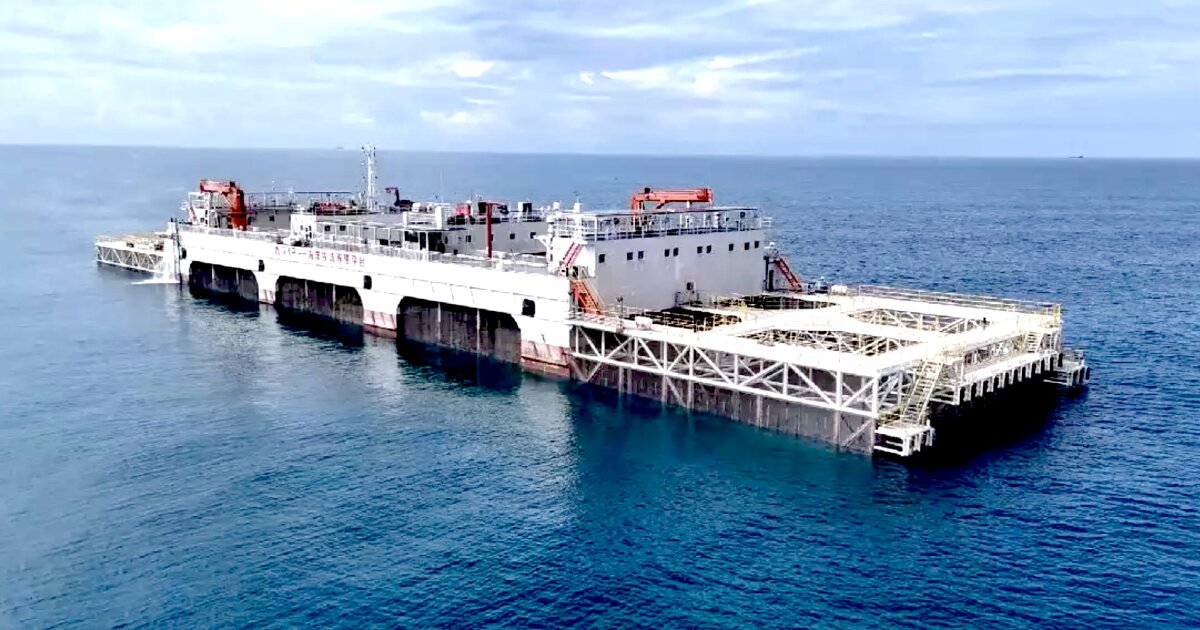
A semi-submersible aquaculture platform that holds more than 14 million gallons (64,000 cubic meters) of water – around 20 Olympic swimming pools’ worth – has begun operating in the waters off the Chinese city of Sanya, Hainan Province. It’s expected to produce more than 4,000 tonnes of ocean-farmed fish in the first year.
The aquaculture platform, known as Xinhuan No. 1 (鑫环1号), is the largest of its kind for the country. This month it will become home to around three million fry, largely made up of fourfinger threadfin and pearl grouper species. The platform is divided into areas and then compartmentalized further, making space for fish as they grow and allowing for rotational fish farming year-round.
“We raise two batches of fish each year, with 2,000 tons per batch, adding up to 4,000 tons annually,” said the farm’s general manager Li Xihuan, as reported by Chinese media outlet Bastille Post Global. “While we focus on raising quality fish, our second line of business is a service model that combines recreational fishing and sightseeing tours.”
The multipurpose farm will roll out a range of agriculture-tourism ventures, including spaces for recreational fishing and sightseeing.
As a semi-submersible structure, Xinhuan No. 1 uses a ballast system to adapt to varying marine conditions and has already shown it can withstand typhoons – part of its rigorous testing prior to starting up operations.
What’s more, it’s designed to mirror the conditions of the sea around it, as much as any large-scale aquaculture project can, and features a 24-hour large-volume seawater exchange.
While there aren’t a lot of details regarding the impact of this massive farm on surrounding marine habitats, it’s yet another example of China’s efforts to move industry offshore. Recently, we reported on the new underwater data center largely powered by wind turbines.
The floating fish farm is China’s largest but not the biggest in the world. That title goes to Havfarm 1 off the coast of Norway, which farms salmon. That said, the huge Havfarm 1 floating structure was built in China, before being relocated to Scandinavia.
However, a detailed report released earlier this year highlighted the growing environmental damage being caused by this intensive offshore salmon farming, with Norway’s booming aquaculture industry coming at a cost. And, as scientists noted, waste discharge is much harder to track out in the middle of the ocean, compared with terrestrial factories that have distinct runoff pathways. As such, the impact of this new kind of factory farming on marine ecosystems isn’t clear.
Source: CGTN, Bastille Post Global

