


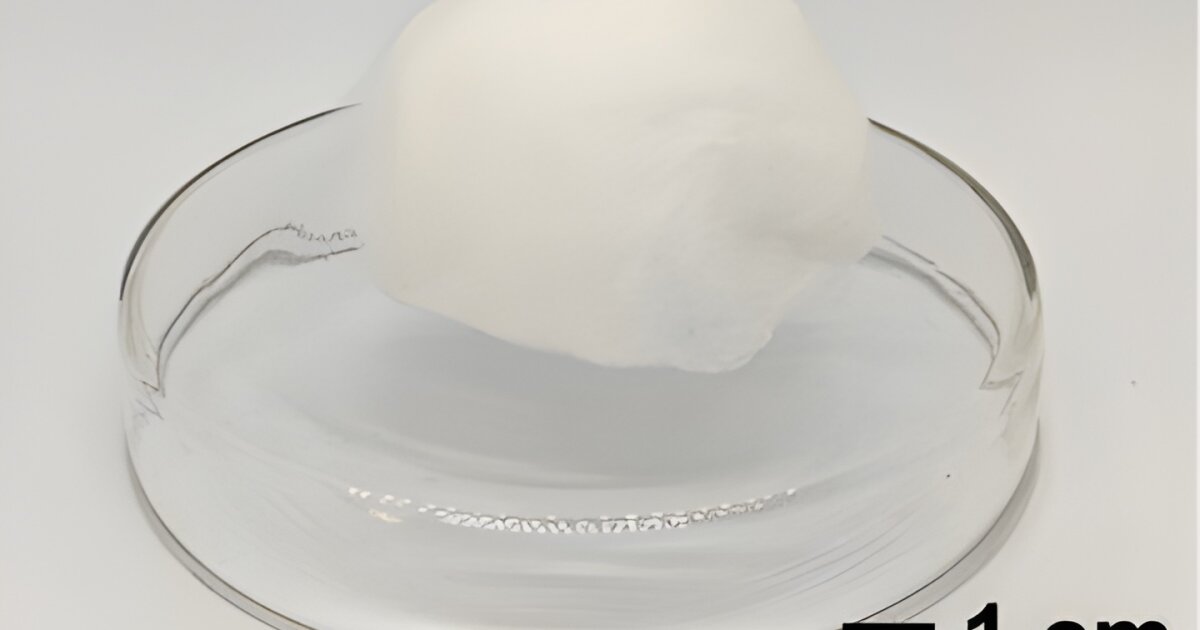
Cotton may be nice and soft and warm, but we’re told not to wear it for sporting activities because it traps moisture, becoming wet and ultimately drawing heat away from the body. Well, scientists have created a synthetic fabric that is claimed to repel moisture while still replicating the coziness of cotton.
Developed by Shihui Zhang, Zhihua Zhang, Quan Shi and colleagues at the Chinese Academy of Sciences, the lightweight flexible material is what’s known as a phase-change fiber aerogel (PCFA).
It consists of a network of hydrophobic (water-repelling) polymer fibers dotted with microscopic capsules of a phase-change hydrocarbon, formed into either cotton-like balls or flat fabric.
Adapted from ACS Energy Letters 2026, DOI: 10.1021/acsenergylett.6c00363
At relatively cool temperatures, the molecular structure of the hydrocarbon causes the fibers to bind together, storing heat. At a transitional temperature of 26.2 ºC (79.16 ºF), however, the structure of the hydrocarbon changes, allowing the fibers to open up and release the stored heat.
In lab tests, the scientists experimented on swatches of the material measuring about 6 by 20 inches (15 by 20 cm).
It was found that the samples didn’t absorb water vapor or droplets in humid environments, whereas cotton samples did so. The material also switched between storing and releasing heat based on air temperature – as it was supposed to – plus it kept a hand that was wrapped in the fabric significantly warmer than a hand that was wrapped in the same thickness of cotton, at an ambient temperature of -25 ºC (-13 ºF).
Additionally, after 20 wash cycles the material still wasn’t shedding any fibers, plus it retained its original fluffiness and 97% of its heat-trapping ability.

Adapted from ACS Energy Letters 2026, DOI: 10.1021/acsenergylett.6c00363
It is hoped that once developed further, the technology could find use in cold weather outdoor clothing.
A paper on the research was recently published in the journal ACS Energy Letters.
Source: American Chemical Society

