


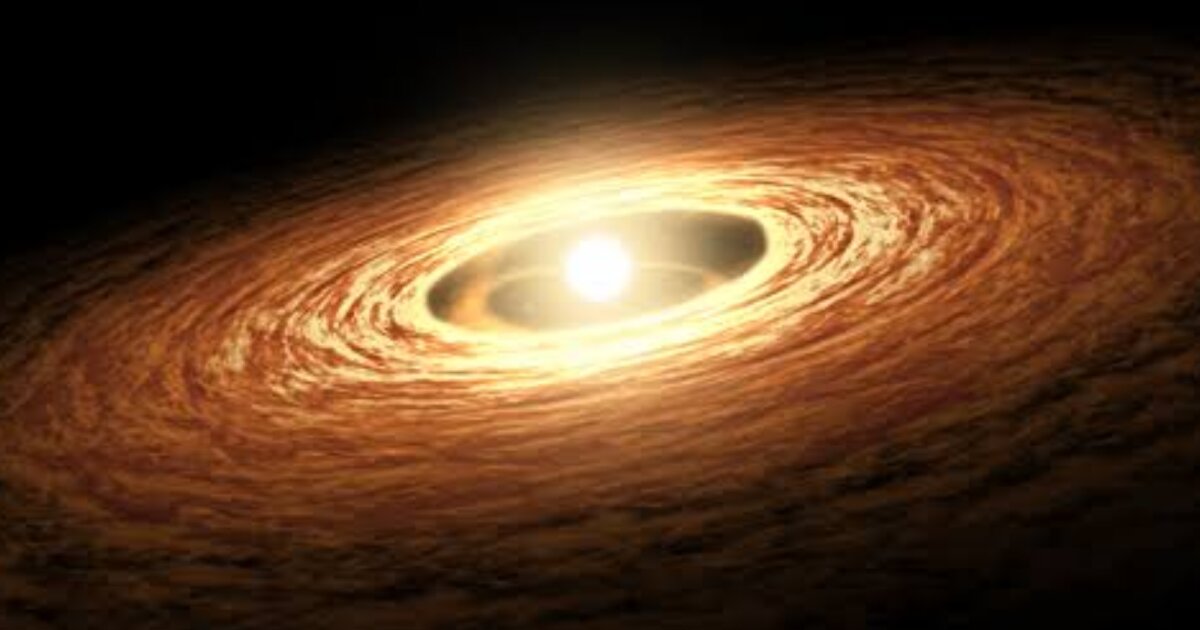
Researchers at the University of Warwick in the UK, the Massachusetts Institute of Technology (MIT), and McMaster University in Canada have shown that the structures of dust rings surrounding young stars can be used to estimate the masses of hidden planets.
Protoplanetary discs are cosmic clouds of dust and gas swirling around nascent stars. They have been a fascinating subject to astronomers since they were first imaged in the 1990s. But the images back then provided very little detail about them.
However, as telescopes improved over the following decades, clearer images revealed that these discs are not just quiet swirls of dust cushioning young stars. They are vast, structured bodies consisting of concentric rings separated by gaps.
The colliding gas and dust in protoplanetary discs provide the perfect conditions for planets to form. As they grow, gravity sweeps the surrounding material, organizing it into those distinct bands.
Most research done in this field has focused on the gaps, but this new work shifts attention to the rings themselves, exploring what they can reveal about the masses of the planets that formed them.
ALMA (ESO/NAOJ/NRAO), S. Andrews et al.; NRAO/AUI/NSF, S. Dagnello
“These bright rings are not just beautiful structures – they are essentially planetary fingerprints,” says lead author Amena Faruqi, a PhD student in the Astronomy and Astrophysics Group at the University of Warwick.
“By reading ‘between the rings,’ we have now found a way to reconstruct the masses of the planets that create the rings, even when those planets are too faint or too embedded to observe directly.”
Using 2D hydrodynamical simulations, they looked for features that varied with the mass of the planet that formed each ring, focusing on the width, the amount of dust, and the position of each ring’s brightest point. Of these three, the position of the ring’s brightest point proved the most reliable means of determining the planet’s mass.
As planet mass increases, this position shifts in a consistent, predictable way. Importantly, this pattern holds even when dust grain sizes vary. This is a major advantage over methods that estimate a planet’s mass based on dust grain size, which is often unknown.
The story is a bit more complex for the ring width and dust mass. At first, the rings become more distinct and trap more dust as the planets increase in mass, but this trend eventually plateaus. Once the planet reaches a certain mass threshold, called the pebble-isolation mass, the ring no longer changes, even as the planet continues to grow.
This is because above this threshold, the planet becomes an effective barrier, preventing the inward flow of materials from the outer disc. In effect, planets below the pebble-isolation mass tend to produce wider rings with lower masses, while those above it create narrower, more compact rings.
Faruqi and her colleagues applied their framework to PDS 70, one of the most well-studied planet-forming discs. They arrived at values that matched previous independent measurements, suggesting that the method is promising even in messy real-world systems.
“One of the strengths of this work is that it doesn’t stay in the realm of theory – we’ve been able to take these simulation results and apply them directly to real observed systems,” says MIT astrophysicist Jessica Speedie.
They also applied their approach to a broader sample of ALMA-observed discs, showing that the morphology of the rings, combined with gap measurements, can help determine both planet masses and properties of the disc itself.
There are, of course, some limitations to what their model can tell us. It assumes that planets do not migrate, that dust does not affect the gas, and that dust grains do not grow or fragment; all of which can happen in real-life settings.
Rings can also shift, blur, or split, and as the team notes, a single planet can sometimes produce multiple rings, particularly in low-viscosity discs, so not every ring maps neatly to a separate planet.
Still, as telescopes continue to evolve, astronomers are moving beyond detecting planets indirectly. The rings in protoplanetary discs may hold more detailed records of the planets shaping them than anyone realized.
This research was published in The Astrophysical Journal
Source: Eurekalert
Fact-checked by Mike McRae

