


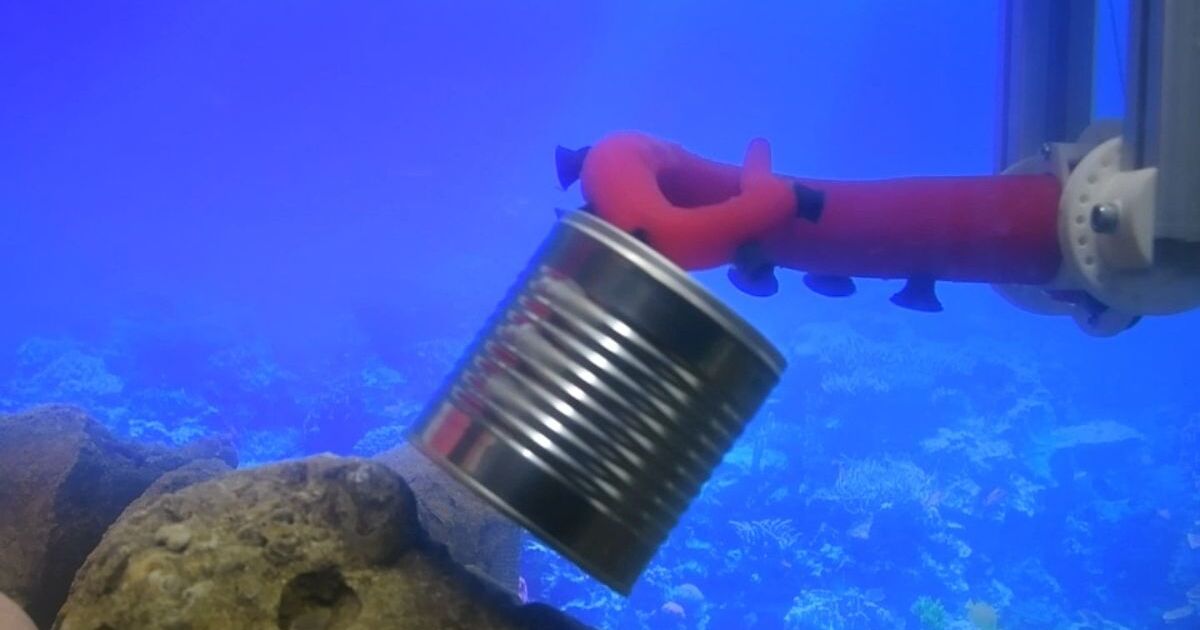
Robots exploring the ocean floor today use pre-programmed movements, centralized processors, and rigid structures to do their work. But the sea is unpredictable, and that architecture struggles wherever currents shift, visibility drops, or terrain changes without warning. Now, researchers at the Italian Institute of Technology (IIT) have taken a very different approach to sidestep all of that – one 500 million years in the making.
Their inspiration is the octopus.. The animal has a small central brain, but roughly 60% of its neurons are distributed across its eight tentacles. Each arm can process information locally and trigger reflexes – like grabbing prey – without waiting for instructions from the brain. It’s a decentralized nervous system that has worked flawlessly in unpredictable environments for millions of years. The IIT team has replicated that architecture but with silicone and electronics.
The result is a soft robotic arm 41 cm (16 in) long and 4 cm (1.6 in) in diameter at the base, fitted with 10 artificial suckers that narrow toward the tip, just like a real octopus tentacle. No cameras, external computers, or centralized control.
“We drew inspiration from the octopus to develop a robotic system in which perception and action are integrated and distributed throughout the body,” explains Barbara Mazzolai, director of IIT’s Bioinspired Soft Robotics lab and lead author of the study. “This approach allows the robot to interpret contact and adapt its grip autonomously, simply, and naturally.”
Inside each sucker, three pairs of LEDs and phototransistors – miniaturized optical components that measure reflected light – act as the tentacle’s nervous system. When an object touches a sucker, the silicone deforms and changes the light reflection pattern. The system translates that shift into three pieces of data: whether contact has been made, how hard, and from which angle.
The sensitivity reaches approximately 400 millivolts per Newton, with a force margin of error of just 0.1 N, roughly the weight of a few paper clips. Directional precision is equally sharp, with a maximum error below 18 degrees and a mean of around 8 degrees, similar to the gap between two consecutive numbers on a clock face.
Control operates in two layers. The first is purely local: each sucker has its own circuit that triggers suction the moment it detects contact, with no waiting for orders. The second layer receives data from all suckers, analyzes the object’s position over a window of roughly four seconds, and decides the global gripping strategy – whether to curl the tentacle up, down, or rotate it – overriding local decisions if needed.
“By integrating sensors and signal processing directly into the suction cups, the arm reacts to contact in real time and precisely, without relying on centralized control,” said Emanuela Del Dottore, a researcher at the Bioinspired Soft Robotics Laboratory from the IIT and first author of the study. “The result is a scalable and robust system designed to operate in complex environments, including underwater.”
IIT – Italian Institute of Technology
All experiments were conducted fully underwater. The arm successfully detected glass bottles and cups while already in motion, estimated the weight of a grasped object at 72.5 g (2.6 oz) against an actual weight of 85 g (3 oz), and manipulated objects placed at different angles, including an artificial starfish. Maximum payload reached around 500 g (1.1 lb), and the sensors maintained their accuracy after 300 repeated use cycles.
Because each sucker only sends contact direction to the main controller – rather than all raw data – the system requires far less bandwidth and can scale easily to more suckers or multiple tentacles without losing response speed.
The design is also modular. The number and layout of suckers can be reconfigured for different missions. Immediate applications include inspection of underwater infrastructure like pipelines, cables, and platforms, as well as biological sample recovery in environments where rigid robots can’t reach.
The IIT arm joins a field that has been reaching toward the octopus for inspiration for years. In 2017, German automation company Festo unveiled its OctopusGripper at Hannover Messe, a pneumatically controlled silicone tentacle with two rows of suction cups that wraps around objects when compressed air is applied – a clever design, but one that still depends on external pressure control and human operation.
More recently, researchers at the University of Bristol took a different angle altogether: rather than replicating the shape of an octopus tentacle, they studied its mucus. Their 2024 suction cup uses a multi-layer soft structure and an artificial fluid system that mimics the way octopus mucus seals gaps on rough, curved surfaces, allowing it to grip stones, wood, and irregular objects that defeat conventional suction cups.
More recently still, researchers from Peking University in Beijing, National University of Singapore, Zhejiang University, and the Beijing Institute of Technology designed a system to mimic the grasping strategy of cephalopods – the OUT-Robot’s gripper can quickly switch between pliable and rigid states to sort through and grasp objects of varying shapes, pliability and weight.
What sets the IIT design apart from both is autonomy. It doesn’t just grip, it decides how to grip. Despite this, the team acknowledges that current experiments used objects with relatively simple geometry. Next steps include testing with a wider variety of shapes and weights, and integrating neuromorphic computing to push the system even closer to the real neural circuitry of an octopus.
The research has been published in the journal Nature Machine Intelligence.
Source: IIT

