


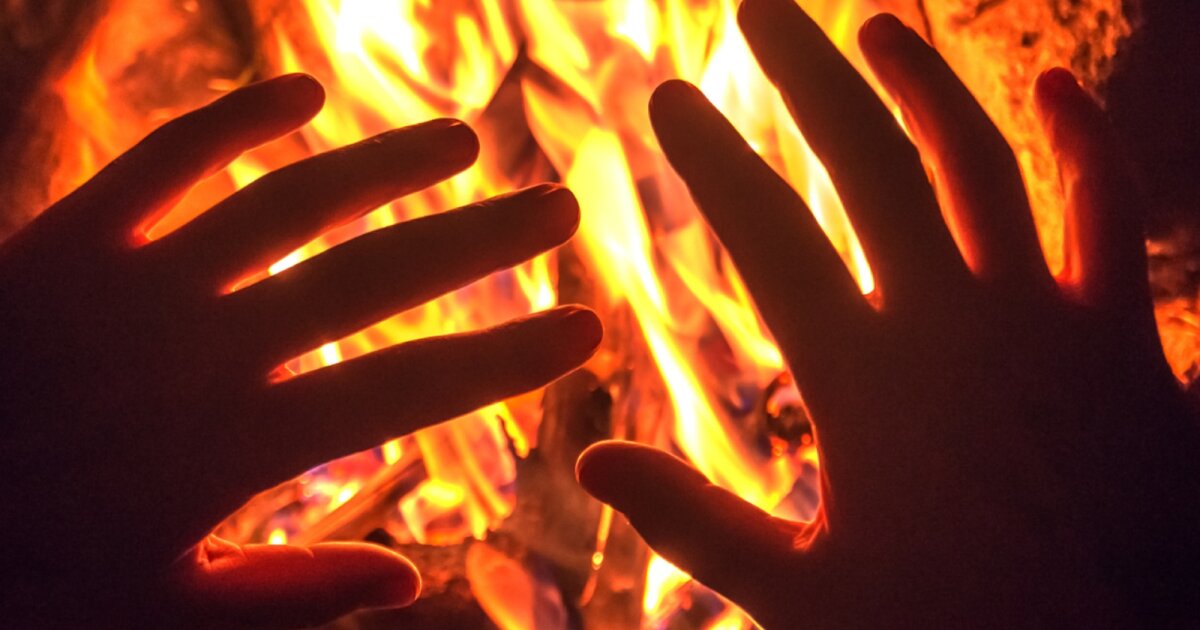
There’s no doubt about it – burning stuff is what makes us human. Aside from the fact that fire makes food safer, tastier, and more digestible, burning a few sticks pushes back the darkness, keeps predators at bay, and keeps us toasty warm.
That’s not even getting into its role in ecological management, or the technological benefits of using heat to harden materials and smelt ore.
Just when our ancestors fanned their first flames is an ongoing question, with current evidence suggesting it had to be at least a million years ago.
A discovery reported in the journal PLOS One pushes this timeline back even further, confirming hominins were probably playing with fire far earlier.
By testing the luminescence of tiny bones in ancient owl pellets, an international team of researchers led by Dores Marin-Monfort, a paleontologist from the National Museum of Natural Sciences in Spain, has provided strong evidence that residents of South Africa’s Wonderwerk Cave may have been warming their toes in front of a raging fire some time between 1.07 and 1.78 million years ago.
Wonderwerk Cave is already a renowned site among paleontologists, thanks to its extensive use by ancestral humans. For decades, researchers have sifted through almost 20 feet (about six meters) of material containing everything from pollen to stone artifacts to burned bones.
It’s those charred remains – along with residual ash and heat-altered stone – that have previously set records for the world’s oldest signs of a campfire halfway through the Pleistocene.
Of course, fire was a part of nature long before hominids thought it was cool. Evidence of burned material isn’t necessarily evidence that the burning is intentional. Just ask the guests of my last grill. Translocation of charred sediments can also mess up timelines, making it even more difficult to nail down when humans mastered the art of a good roast.
That makes the heat-affected remains of fire pits and cooked animals gold standards for confirming signs of a tamed flame.
When it comes to the oldest examples of fire use, however, hearths are extremely hard to find, implying that the first fires were opportunistic rather than deliberate constructions.
While it’s possible to use a bone’s color to tell if it has been cooked, metal contaminants in the soil can cause similar changes in hue. A suite of spectrographic tests is commonly used instead, including Fourier Transform Infrared Spectroscopy. Yet these also have their limitations in capturing the extent of a bone’s charring.
So Marin-Monfort and her team also applied a non-invasive method of measuring the luminescence of around 160 small mammalian bones found in owl pellets, which once littered the cave floor “like a carpet”.
Their findings confirm that small fires were located deep within Wonderwork Cave hundreds of thousands of years before previously established records, in line with other contested studies that also suggest earlier dates.
For cooking, warmth, or light, nobody can be sure. But the fires were unlikely to have been the result of a stray spark from a passing wildfire, the researchers write, leaving the strong possibility that these were deliberately placed by an ancestor such as Homo erectus.
It would take hundreds of thousands more years before fire would become a commonly used tool among our own species. But our fascination with fire, it seems, has been flickering away in our mind since the very beginning.
This research was published in PLOS One
Source: Science Meida Centre Spain via Phys.org
Fact-checked by Bronwyn Thompson

