


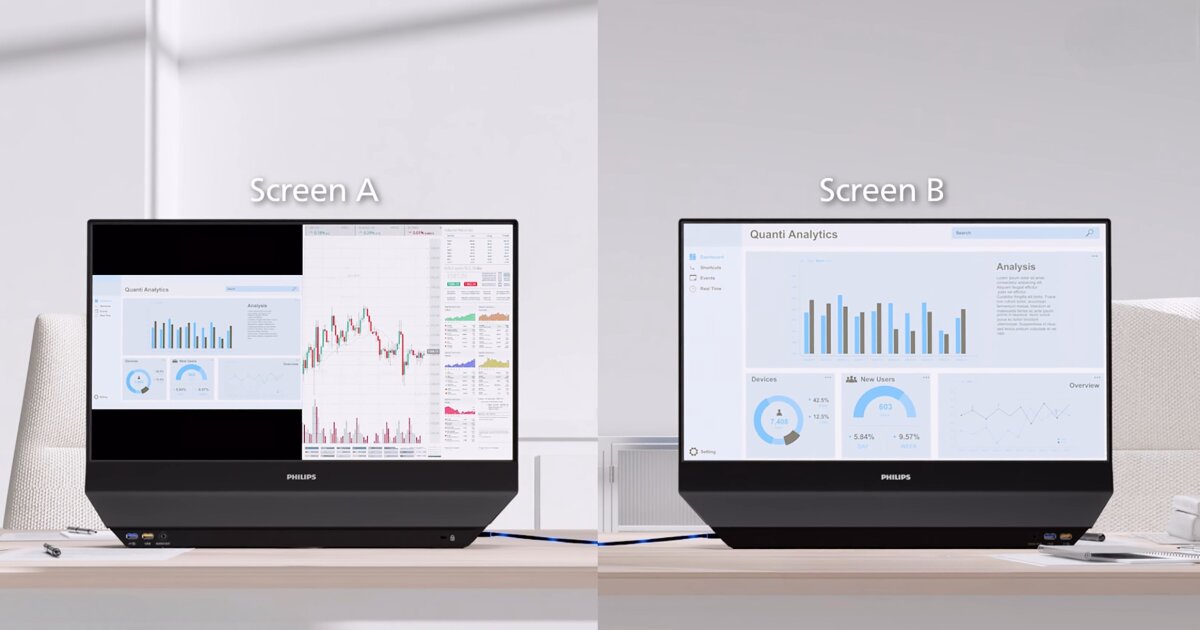
Rather than has folks on customer-facing or collaborative setups having to constantly swivel a monitor around for people on the other side of the desk, Philips has launched a dual-sided business monitor with a Full HD screen front and back.
Most monitors are built around a simple assumption: one screen, one direction, one user. Philips’ new business monitor challenges that by putting a display on both sides of the unit. It’s a standalone device with dual outward-facing IPS panels anchored to a 180-degree swivel base, allowing either screen to be easily turned toward the person who needs it.
Philips
Rather than focusing on resolution, size, or refresh rate as its main hook, Philips is rethinking the way a monitor sits between two people on opposite sides of a screen, particularly in environments where visibility, privacy, and collaboration all matter.
The 24B2D5300’s most obvious use case is customer-facing work. Philips’ DualView mode can either mirror or extend the main view to the rear screen, while SmartView splits content into virtual sections from a single source.
In practice, staff can keep administrative windows or sensitive data securely on their side while pushing relevant content – like check-in forms, digital signatures, or purchase breakdowns – directly to the client.
This layout makes the monitor a natural fit for high-traffic environments like banking counters, medical reception desks, and service queues where traditional screen-sharing is often clumsy or compromises privacy. The dual-sided design adds a layer of interactivity that conventional displays have never really had before.

Philips
The monitor also has a space-saving angle. Two people can use the opposite sides simultaneously, with each screen being able to connect to its own device via USB-C or HDMI. Each USB-C port supports up to 65-W power delivery, alongside hub and audio functionality. Of course, the 24B2D5300 isn’t going to replace a normal dual-monitor setup, but it does enable two-sided interaction in cases where separate screens would be a bit awkward.
The actual display specs are fairly standard. Each side uses a 23.8-inch IPS panel with Full HD resolution, 178-degree viewing angles, and a 120-Hz refresh rate. This should be more than sufficient for general business use, though the pixel density may feel a little underwhelming compared to high-resolution displays – one reviewer on Philips’ site noted that the text wasn’t nearly as crisp as on a MacBook.
Philips has also added a few comfort-focused features, including Flicker-Free technology, SoftBlue low-blue-light panels, Eyesafe Certified 2.0 protection, and built-in stereo speakers. There’s also a D-mode setting designed to improve grayscale perception – this comes in handy for detailed monochrome content like scans or technical illustrations.
The 24B2D5300 will be available from this month in select European countries, with a MSRP of £359.99 (roughly US$460). It’s not really about pushing panel performance forward; instead, Philips is addressing a specific layout niche. If businesses find the right scenario for it, this dual-sided monitor could make front-desk and shared-space interactions more seamless, private, and efficient.
Philips 24B2D5300 | Two screens, one smarter interaction
Product page: Philips 24B2D5300

