


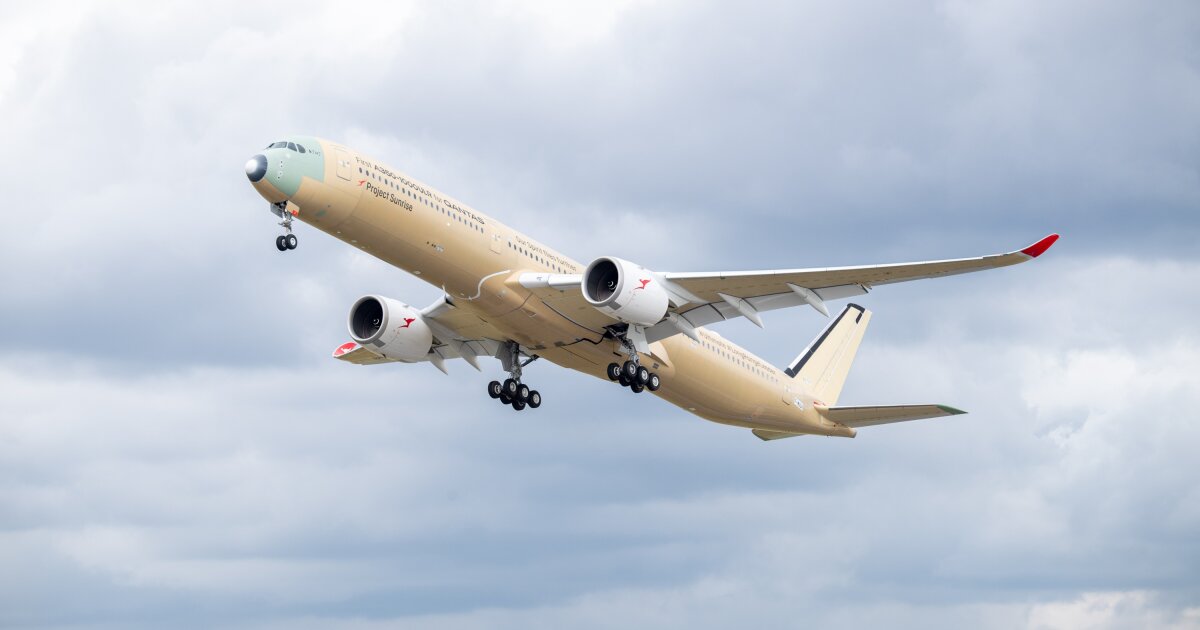
If it’s ever been your dream to spend 22 hours on a non-stop flight from Sydney to London, then good news: Airbus has announced the maiden flight of the world’s longest-range airliner, the Airbus A350-1000ULR, with a range of almost 10,000 nautical miles.
Getting from Australia’s major eastern cities of Sydney and Melbourne to New York or London has always been an adventure. After the Second World War, it could take up to four weeks by steamship. If you were in a hurry, seaplanes could make the journey in a mere 12 days, albeit with nine stops along the way. When jet airliner service arrived in 1959, the voyage was cut to 33 hours with only three refueling stops.
Today, even after seven decades of technological improvements, these antipodal routes still require at least one stopover in hubs such as Singapore, Dubai, Los Angeles, or Dallas. That can add up to four hours to the journey, along with the risks of missed connections, lost baggage, delays, and the general aggravation of customs procedures.
To address this, Qantas launched its Project Sunrise initiative, aimed at introducing nonstop flights to the other side of the world. The purpose extends beyond passenger convenience. The airline sees such routes as a way to capture more premium-fare traffic while insulating its flagship services from foreign regulatory changes, airport curfews, landing-slot constraints, and regional geopolitical instability. It also provides an opportunity to modernize the airline’s long-haul fleet.
Key to the project is the Airbus A350-1000ULR (Ultra Long Range), a specialized widebody twin-engine airliner derived from the baseline A350-1000. The prototype took to the air from Airbus’s facility in Toulouse, France, on June 2, 2026, for a test flight lasting three hours and 43 minutes and reaching an altitude of 41,000 ft (12,500 m).
The main difference between the A350-1000ULR and the standard version is a new 20,000-liter (5,283 US-gal) rear center fuel tank, increasing operational range by approximately 1,000 nautical miles (1,151 miles, 1,852 km) to a total of 9,700 nautical miles (11,163 miles, 17,964 km). The aircraft will typically carry 238 passengers in a four-class configuration. Added to this is a lighter galley cooling system featuring high-efficiency refrigeration units designed for ultra-long-haul operations, where minimizing both odors and power consumption is a priority.
According to Airbus, once flight testing is completed, the aircraft will be given its Qantas livery and then delivered to the airline, with a second aircraft scheduled for delivery in April 2027. The current plan is for a fleet of 12 of the ultra-long-range variant.
Unfortunately, it still means spending 22 hours in an airline seat next to someone with very strong views on air fryers.
Source: Airbus

