


Do you like driving? Maybe not stuck in an urban jam, dodging potholes or crawling amid draconian speed limits – but out there on the open road, taking sunny corners in a nice car? The roar of the engine as it changes gear, the pleasure of getting the line and the revs right through a corner? Surely even the most dour of modern motorists derive at least some joy from driving’s highlights.
But what exactly is that pleasure? And what is the trigger for it?
Oxford University scientists have begun a study of the thrill and pleasure of driving to answer those questions. The relevance: can the thrill of driving an old-school noisy polluting gas engine transfer to driving a silent and smooth electric car, especially one built for performance-oriented driving. That’s why the experiments are sponsored by Swedish electric performance car brand Polestar.
Polestar
The car company is working with the SDG Impact Lab at Oxford to explore if ‘driving thrill’ can be defined and measured through scientific research.
The study is all part of how the EV market is changing, from an early emphasis on ‘being good’ to a point where it can offer at least as much, if not more, driving excitement. Polestar is keen to position itself as a distinctive performance EV brand so one of the aims is to establish a measurable framework for driving thrill to inform its future car development.
The Oxford pilot study involves surprisingly complex psychological and physiological research questions. The team combines expertise from engineering science, philosophy and experimental psychology, supported by the University of Oxford senior academics combining academic rigor with Polestar’s automotive expertise.
“This project demonstrates how academic research can create real-world impact beyond the university,” says Prof Alexander Betts, Pro-Vice Chancellor and Co-Founder of the Oxford University SDG Impact Lab. “Working with Polestar allows us to translate scientific insight into knowledge that can help shape future innovation.”

Polestar
The study will record physiological, cognitive and behavioral responses of participants as they drive a high-performance Polestar. By analyzing brain activity alongside biometric and behavioral data (a combination including EEG, eye-tracking, heart rate, skin conductance, facial expression and emotive self-assessment), the researchers aim to determine whether the sensations associated with driving excitement can be observed, analyzed, quantified and compared.
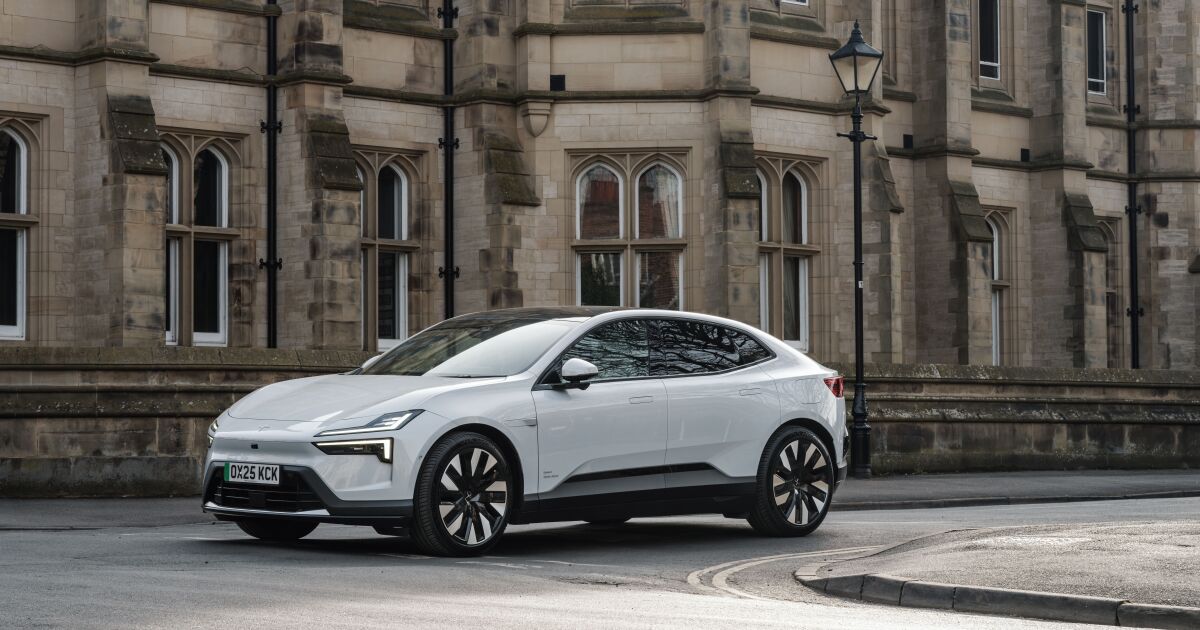
Each driver performs a series of pre-defined driving sessions, ranging from relaxed driving to dynamic and performance driving using a Polestar 4. Future plans are to apply the methodology on other Polestar models.
The researchers suspect traditional performance benchmarks are becoming less relevant in an increasingly electric world.
Some manufacturers are trying to mimic the ICE car experience, such as retro-fitting old school motoring noises and gear simulations to entertain understimulated EV drivers. Rather than simply playing a recording of old Ferrari engines every time you press the accelerator, Polestar and the SDG Impact Lab at the University of Oxford are taking a more long-term approach to how EV drivers might get their thrills. The researchers actually claim to be challenging the assumptions that driving excitement depends on engine sounds.

Polestar
Polestar began in 1996 as a Swedish racing team and became Volvo’s official performance partner, similar to Mercedes-AMG. By 2017, Polestar was spun off as a standalone electric vehicle manufacturer owned by Volvo and Geely. The Chinese multinational now manages Polestar, although it still shares engineering platforms and service centers with Volvo.
Christian Samson, Head of Product Attributes at Polestar, says the brand is committed to “challenging conventions around straight-line acceleration being the default measure of driving excitement. The scientific approach of this research promises real-world benefits for our customers, as the data can be used by our engineering team as an added layer for fine tuning our cars’ vehicle dynamics and performance attributes.”
Running until the end of July this year, the study will include vehicle testing at the Gotland Ring test track in Sweden. Results are planned to be presented later in the year at a dedicated event at Oxford University.
Polestar has recently launched its most performance-focused product yet – the Polestar 5. This four-door Grand Tourer uses bonded aluminum to reduce weight and provide precise responses. Sophisticated traction control, suspension systems, brake setups and bespoke tires support the performance feel. With a 0-60-mph time of around three seconds it’s offering exactly the sort of sensations the researchers are hoping to study.
Source: Polestar

