


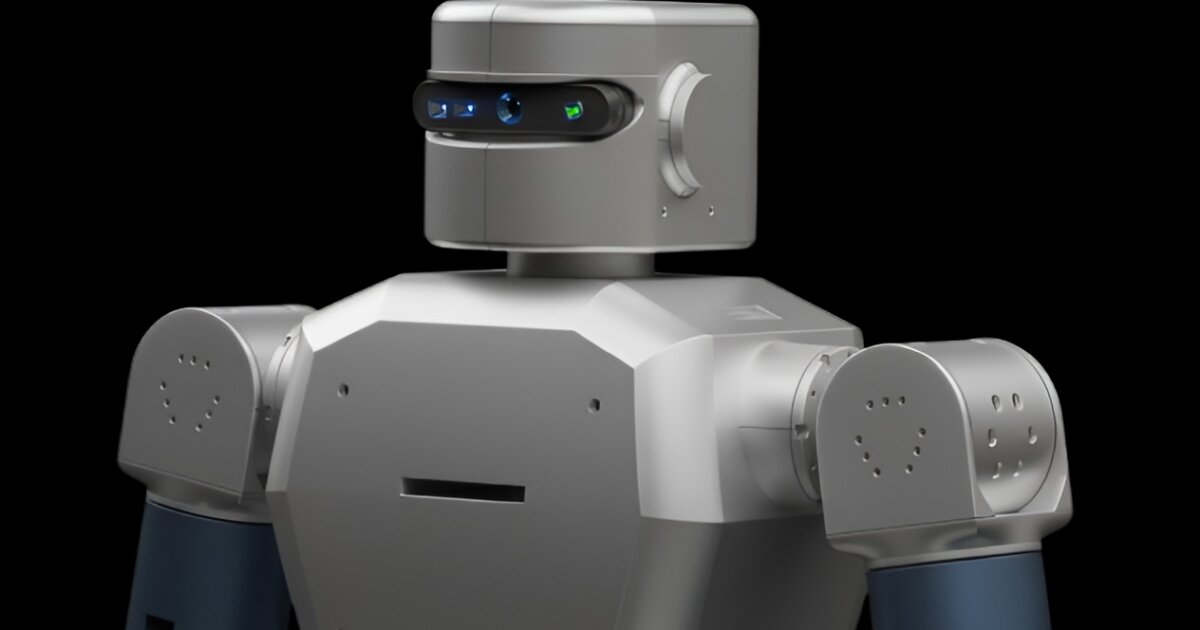
Until now, pretty much all humanoid robots have come with an eye-watering price tag. Rotaku, a startup from the San Francisco Bay Area, thinks that’s a solvable engineering problem and made its first move to change that.
The company just emerged from stealth with Domo, a humanoid robot starting at US$2,999. “Our goal is to make humanoid hardware more accessible to developers, educators, researchers, and smaller robotics teams,” founder Takuzen Lu (also known as Zhuoran Lu) told me via email.
Lu studied computer science at the University of Wisconsin–Madison and spent years living in Japan. This experience, he says, “shaped my interest in how technology can combine engineering, art, and everyday life.” His team spans mechanical and industrial design, electrical engineering, embedded systems, motion control, and AI algorithm development.
We are a humanoid robotics startup from the Valley.
For the past year, we’ve been quietly building humanoid robots.
Today, we want to share something special with the world:
Domo — a $2,999 humanoid robot built for developers, creators, researchers, and anyone ready to build… pic.twitter.com/rY1gqGes9j— Takuzen (@Takuzennn) May 11, 2026
Domo’s central idea is whole-body policy learning – an AI training technique that lets the robot learn complex tasks through demonstration or reinforcement, rather than being explicitly coded for each one. You don’t have to know programming; just show Domo how to pick up an object, navigate a room, or handle a tool, and it learns to repeat it.
The robot runs entirely cable-free, with all electronics, battery, sensors, and computing packed into an aluminum chassis. Developers connect via Wi-Fi, deploy AI models directly on the robot, and access the system through SSH (a standard protocol for secure remote control over a network). The battery lasts up to two hours of continuous use and recharges in 30 minutes, with hot-swappable packs so work doesn’t have to stop for long.
The platform also includes VR-based teleoperation for two-arm motion capture, data collection pipelines for training, gesture recognition for intuitive commands, and a voice assistant powered by a large language model for natural interaction. “Testing has been ongoing throughout Domo’s development, including internal engineering tests for motion control, hardware reliability, system integration, and user interaction,” Lu noted.
Rotaku
Domo ships in two versions. The entry-level Domo Developer, at $2,999, stands 90 cm (35 in) tall, weighs 20 kg (44 lb), offers 23 degrees of freedom, and delivers 70 Nm (51.6 lb.ft) of motor torque – built for rapid experimentation and custom behavior research. The Domo Plus Developer, at $9,899, steps up to 130 cm (51 in), 35 kg (77 lb), 25 degrees of freedom, and 110 Nm (81 lb.ft) of torque, aimed at labs and established research teams that need more power for dynamic movement.
For context, Unitree’s R1 robots run between $4,900 and $5,900 depending on version, and its G1 starts at $13,500. Cheaper platforms like Reachy Mini exist, but they’re desktop-scale devices – nowhere near Domo’s claimed full-body movement and AI training capabilities.

Rotaku
Domo is designed in California and manufactured through an international supply chain. “Key mechanical components, electronic parts, and assembly partners are selected based on cost, quality, and production capability,” Lu explained. Rotaku has secured early-stage backing and is preparing its next financing round, though it isn’t disclosing the fund name or seed amount at this time.
Reservations for the devbot are open now, with the first production batches already being prepared for early customers – though the company still has much to prove. Robotics startups have a well-documented habit of nailing the demo and stumbling at the factory door. “We are speaking with developers and partners to better understand their needs and prepare for the next stage of rollout,” Lu said.
Source: Rotaku

