


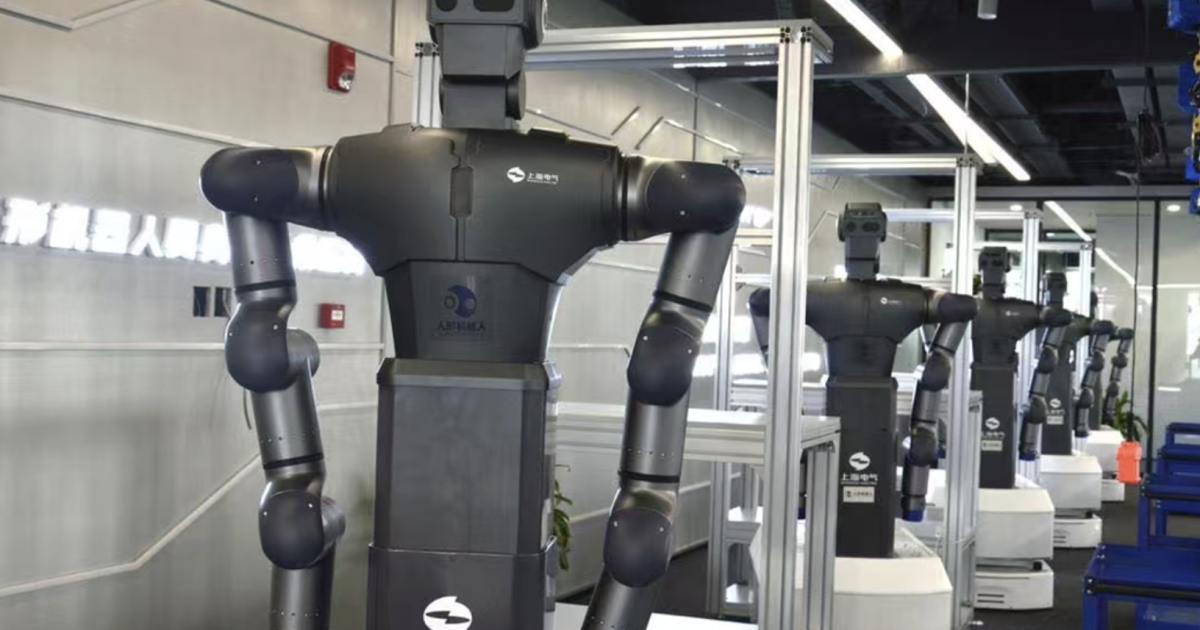
The first humanoid “training school” for robots of all shapes and sizes will open its doors in July, bringing together more than 100 different models made by a host of companies. As well as mastering real-world skills, the humanoids will provide unique data that’ll be used to advance the bots that follow in their footsteps.
For some, this sounds like a dystopian nightmare, but if you’ve been lucky enough to spend time witnessing the emergence of this technology first-hand in China, as I have, it’s hard not to be excited about the country’s first heterogeneous humanoid training center. Here, more than a dozen companies have enrolled 100-plus robots to take part in the pilot training program at the 5,000-square-meter (53,800-sq-ft) facility in Shanghai’s high-tech heart of Zhangjiang (张江).
Here, they will finetune their motor skills in order to ease into everyday life for people who can afford a domestic bot, as well as master tasks needed for specialized workplaces across the country. Then, millions of data points gathered from this inaugural Class of 2026 will be used to train larger and even more diverse robots at a faster rate. Depending on their capabilities, the humanoids are expected to be trained to work in a variety of fields including industrial, medical, service and agriculture.
It’s also worth noting here that this facility and the groundwork it’s laying are key aspects of China’s robotics industry. The sector operates more like a tech ecosystem – from startups to established companies – centered around crowded clusters of manufacturing and innovation hubs. With this comes the sharing of infrastructure, hardware suppliers and components between tech firms. Of course, there’s still plenty of competition, but there’s also collaboration. Which, generally speaking, results in faster, cheaper and more efficient advances. And this robot training school is a pretty good reflection of that.
Operated by the National and Local Co-built Humanoid Robotics Innovation Center, the new facility, which has been a few years in the making, will train a wide range of humanoids, with two goals. Firstly, to get these models ready for life in the real world – and also to build a massive database of learning intel to help future facility intakes of robots get up to speed quicker.
As the facility’s general manager Xu Bin told People’s Daily Online, the center is designed to advance the humanoid robot industry through shared technologies and fine-tuning the robots for real-world use.
“We established the center to enable large-scale data sharing and utilization, empowering the entire industry,” Xu said.
The diversity of the robots – which come in all shapes and sizes and have varying degrees of movement – will help researchers gather data on performance, strengths and ways to best work with specific humanoid designs in the future.
The “students” will have no time for R&R, with the robots expected to begin their learning by mastering 45 “atomic skills” including grasping, picking, placing and transporting items, crucial for the humanoids to function in industries like hospitality and in factories.
“The embodied robots being trained at the center are expected to accomplish more complex tasks requiring a sequence of actions based on their autonomous judgments formed through searching and matching the data collected through training,” Yang Zhengye, director of market systems at the center, told People’s Daily Online.
Much like my own experience in the science laboratories at university, the robots will need to understand directives from their human teachers, then follow through with the task on their own. They’ll also be put through more repetitive drills, like the surprisingly difficult art of grasping objects like humans can. This has been one area of movement that robots in the past have struggled with – yes, looking at you, Neo – but will be integral to their integration into fields that depend on precision and, well, knowing when to let go of a frying pan when it’s time to. (Though perhaps the joke is on that YouTuber who spent US$80,000 on his pan-flipping-and-tripping Unitree G1 late last year, which you can now buy for $13,500.)
The robot training center’s primary focus will be on gathering all the data possible, across a diverse collection of robots, in an effort to be able to fine-tune methods to teach new bots old tricks. According to the paper, a scientist may be tasked with watching and guiding a humanoid as it performs a single core movement or action up to 600 times a day, collecting important data along the way.
The 2026 class of assorted robots will primarily be trained to master 10 key tasks needed for work in the industries they’re most likely to be deployed to – domestic labor (of course), in industrial settings and in tourism. And while humanoids have come a very long way in a few short years, they still have some work to do when it comes to what we’d consider basic tasks: folding clothes, moving objects from one spot to another, tidying shelves and cleaning equipment. Incidentally, folding a T-shirt is one of the most challenging jobs for a robot as this article explains. (Just wait until someone introduces them to fitted sheets.)
Yang added that the training center, which is expected to be fully operational in July – and hopefully New Atlas will be able to check it out – will generate around 50,000 data points each day, amounting to an incredible 10 million pieces of intel a year. This critical foundational work will help China fast-track training and spot problems regardless of model.
True to China’s collaborative system, the center is also expected to create a data-exchange model for robotics firms to access and allow them to to focus on specific industries for their products, like healthcare, and to improve efficiency. Consider it home schooling, but with robust scientific data at the center of the curriculum.
And that’s not all. The mountain of data will be pooled, creating a general purpose robot (can we call it “Student Zero”?) – a model that will represent the wide range of humanoids being trained at the center. Yang told the news outlet that this “super brain” will allow robots of all shapes and sizes, developed by different manufacturers, to learn and advance together. And while this may sound like some sinister sci-fi movie arc, China’s focus is more about progress than power, supporting its community – be it human or machine.
Meanwhile, some robots skipped ahead to go straight into the workforce – where 3,000 machines work alongside humans in this Chongqing, China mega-factory.
Inside a factory run by 3,000 robots
Source: People’s Daily Online

