


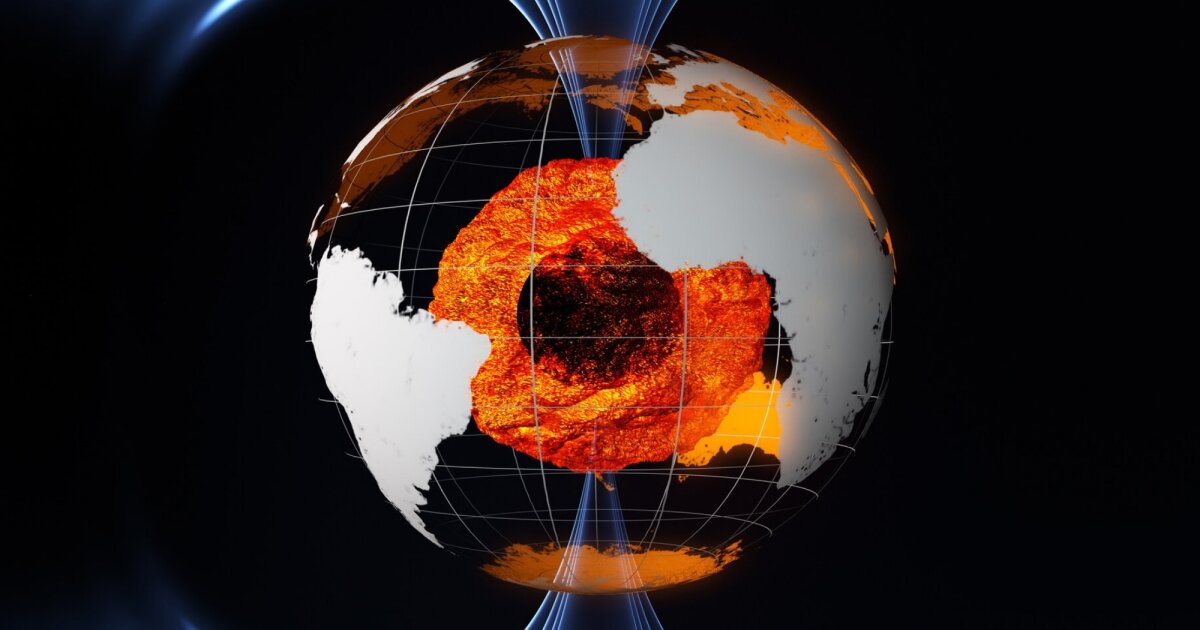
Deep beneath the Pacific near the equator, Earth’s outer core now flows east instead of west. Dynamics deeper within our planet’s core may help explain the change and what to expect in the near future.
A recent analysis in the Journal of Studies of Earth’s Deep Interior combines data from ground observations, the European Space Agency’s Swarm and Cryosat missions, the German Challenging Minisatellite Payload, and Denmark’s Ørsted Earth science satellite to reveal that the perplexing reversal more than 1,400 miles (2,200 km) beneath the surface began in 2010 and is now weakening once again.
The findings point to events afoot deep within the very heart of the planet, providing critical insights into the dynamics that churn away within.
Earth’s core is a hot, dense ball of iron and nickel spinning within a thick mineral soup. The movements of these materials are largely responsible for the generation of our planet’s protective field – a fluctuating shell of magnetism extending tens of thousands of miles into space.
Monitoring changes in this field using equipment on the ground and in orbit can reveal details on the inner core’s rotation and the outer core’s flow. Models based on such data indicate that the liquid outer core has weak, westward flow primarily caused by a large, off-center pattern of circulating material known as the eccentric planetary gyre.
An area near the equator, deep beneath the Pacific, is considered to be relatively unaffected by this gyre, though geologists have assumed the entire outer core has remained relatively stable in its overall motion. Several years ago, studies of core-surface waves suggested this region was no longer following the weak, westward trend and was instead flowing strongly in an easterly direction.
To gain a better understanding of this reversal, a team of researchers led by University of Edinburgh PhD candidate Frederik Dahl Madsen used variations in geomagnetic data collected between 1997 and 2025 and three different modeling techniques to construct a more detailed timeline of Earth’s core-surface flow.
By breaking down their description into its fundamental components, their new model predicted the imbalanced influences of the gyre and other deep planetary forces on waves moving along the core’s surface, determining that the flip took place around 2010 and has been slowly weakening again since 2020.
They also hypothesized that the reversal may be a consequence of events that took place deeper within the planet’s core that same year, pointing out seismic signatures that marked changes in periodic cycles and the appearance of magnetic waves along the core surface soon after.
While it seems as if the reversal may be short-lived, the swinging pendulum of turbulence and oscillating rotations suggests this might not be the last time we see such dramatic changes in our outer core’s flow, and it could help us predict the chaos of our planet’s protective magnetic shield.
“The large-scale flow reversal beneath the Pacific raises new questions about the behavior of Earth’s deep interior,” says Dahl Madsen.
“Scientists now want to understand whether the reversal represents a short-lived fluctuation, part of a repeating oscillation, or a new stable equilibrium for core circulation. Continued monitoring will be essential to determine how the flow evolves over the coming years.”
This research was published in the Journal of Studies of Earth’s Deep Interior.
Source: European Space Agency
Fact-checked by Bronwyn Thompson

