


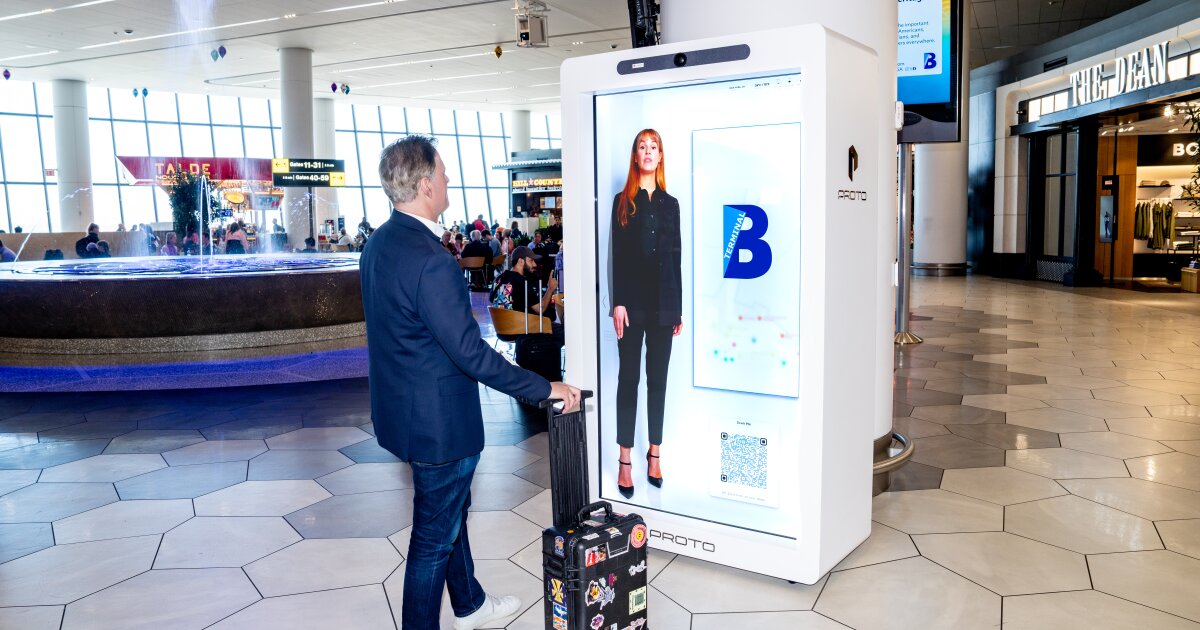
Terminal B at LaGuardia Airport in New York has unveiled Bridget, a life-sized, hyper-realistic AI hologram that can hold a real conversation – answering questions about gates, baggage claims, and VIP lounges. The technology is a signal that the way we navigate airports is changing from static signs and apps to conversational digital guides, and several major hubs are already competing to define it.
Bridget is a collaboration between Proto, the Los Angeles company that had already installed a non‑AI hologram inside JFK’s Terminal 4, and Holomedia’s AI Concierge Wayfinder platform. Together they pull real-time terminal maps to deliver step-by-step directions on demand. Bridget currently speaks English and Spanish – more languages are coming – and the kiosk is fully wheelchair-accessible, with on-screen subtitles for good measure. More units are planned across both concourses.
LaGuardia Gateway Partners
LaGuardia Gateway Partners (LGP), the private company managing Terminal B, frames Bridget not as a replacement for its human staff but as operational backup during peak demand – a digital extension of the guest experience team, with her own character and presence.
“At Terminal B, our North Star has always been to provide an exceptional guest experience through a unique blend of innovation and world-class hospitality,” says Suzette Noble, Chief Executive Officer of LGP. “The introduction of the interactive AI hologram aligns perfectly with this vision, allowing us to leverage next-generation technology to meet the evolving needs of our travelers. By providing an additional layer of intelligent, multilingual support, we are ensuring that every guest who passes through our terminal enjoys a seamless and stress-free journey.”
LGP has been billing the system as a world first, but that claim deserves a footnote. Miami International Airport had quietly rolled out four conversational AI holographic assistants of its own – developed by Hypervsn, Satisfi Labs, and Mappedin – three weeks earlier.
Miami’s system speaks 40 languages compared to Bridget’s current two, and it doesn’t live only in the building. The same conversational engine powers the airport’s website chatbot and WhatsApp assistant, meaning a passenger can start a query at home and pick it up in front of the hologram upon arrival.

LaGuardia Gateway Partners
What this cluster of deployments really brings to the surface is a deeper question about what we want airports to become, and two very different answers are emerging. One bets on the humanoid avatar, a memorable, personal point of contact. The other bets on ambient intelligence: invisible systems working in the background, from facial recognition boarding gates to multichannel chatbots. It’s frictionless by design, though biometric systems at airports have drawn scrutiny from privacy advocates concerned about data retention and consent.
Chinese airports have largely chosen the second path. They’ve been experimenting with holograms since at least 2017, when Guangzhou Baiyun installed holographic safety guidance displays with bilingual explanations of prohibited items. Since then, China’s major hubs have pivoted toward large-scale biometric automation and immersive visual environments. Guangzhou’s Terminal 2 features one of the world’s largest 3D screens, measuring 33 x 25 m (108 x 82 ft), used for glasses-free 3D visuals. It’s airport design as a spectacle – passengers have an experience, but not a conversation.
“As passenger expectations evolve, airports are increasingly seeking technologies that not only improve operational efficiency but also create memorable, frictionless, and personalized journeys,” says Glenn E. Smith, Spatial Computing XP Architect at Holomedia. Whether either approach will meaningfully reduce the stress of flying remains to be seen. Would you rather interact with human staff, life-size holograms or smart systems when navigating terminals? Let us know in the comments.

