


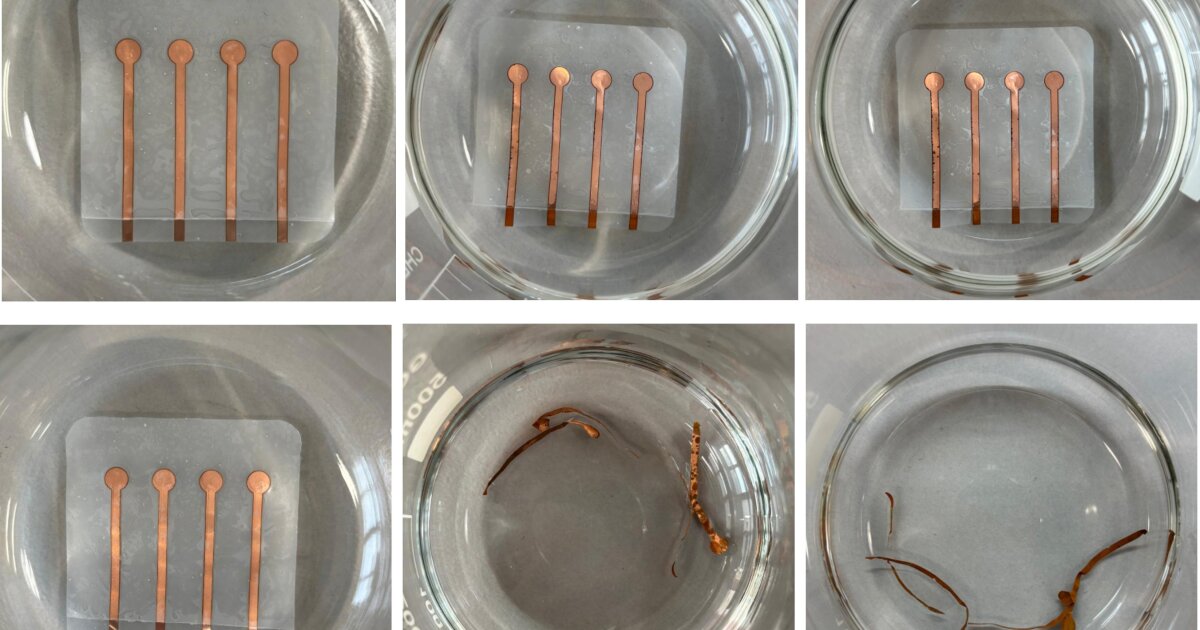
Living things degrade, die, and decompose. Even when we turn plant and animal material into furniture or clothes, the process is inevitable. On the other hand, left alone, plastics are practically indestructible. Scientists are rethinking this characteristic with a simple but consequential question: What if plastics were alive?
A team of scientists from the Chinese University of Hong Kong has created a living plastic that can “self-destruct” on command. They achieved this by embedding plastic-eating microbes directly into the plastic material. The microbes remain dormant until they are activated by a hot “nutrient broth,” after which they proceed to fully consume the plastic within days, leaving no microplastics behind.
Plastics can take up to 1,000 years to decompose. That’s an awfully long time for something we often use only once. Even then, they leave behind toxic microplastics. Factor in the fact that humans live for an average of 73.8 years, and you realize that we are creating problems that could last generations. The key characteristic of materials that decompose is that they are composed of living cells. This characteristic formed the entire basis of the research study.
“The realization that traditional plastics persist for centuries, while many applications, like packaging, are short-lived, led us to ask: Could we build degradation directly into the material’s life cycle?” said Zhuojun Dai, a corresponding author on the paper.
Certain microbes are capable of breaking down long polymer chains using enzymes they produce. Guess what is made of long polymer chains? Plastics. The scientists took advantage of this ability by engineering Bacillus subtilis spores to produce plastic-degrading enzymes, before embedding the dormant microbes directly into a plastic matrix. When activated by heat, the spores awaken and begin secreting enzymes that chemically break down the material from within.
Adapted from ACS Applied Polymer Materials 2026, DOI: 10.1021/acsapm.5c04611
This is not the first time scientists have used microbes to break down plastic. In fact, the material the research team used, polycaprolactone (PCL), is itself a biodegradable plastic that has previously been degraded using microbe-produced enzymes. However, the team’s innovation is two-fold. First, most previous attempts to degrade PCL relied on a single enzyme system. In contrast, the researchers engineered separate strains of Bacillus subtilis to produce two cooperative polymer-degrading enzymes that work in tandem.
One of the enzymes cuts the long polymer chains at multiple points, rapidly weakening the plastic structure. The second enzyme progressively breaks the fragmented chains down into much smaller molecules for further microbial processing. Together, the two-enzyme system proved significantly more effective than single-enzyme approaches, enabling near-complete degradation of the PCL matrix within six days.
The second innovation lies in embedding the engineered microbial spores directly into the plastic matrix itself. Doing this makes the plastic “alive” and endows it with a self-destructive characteristic, as the microbes and plastic are now a single material. The resulting material has mechanical properties similar to those of plain PCL films.
Now, the material doesn’t just spontaneously self-destruct. The catalyst is a nutrient broth at 122 °F (50 °C). Once the broth comes into contact with the material, it activates the spores, initiating degradation. To test their technology, the researchers created a wearable electrode from the material and added the catalyst. The material completely broke down in two weeks, leaving no microplastics behind.
Now for the caveat. First, the technology currently works with PCL, an already biodegradable plastic. Also, there have been other studies on “living” plastic in which microbes were embedded in the material. The researchers’ double enzyme method is the innovation that makes the process faster and more efficient.
Secondly, as with most “biodegradable” plastics, degradation still depends heavily on environmental conditions. Embedding engineered microbes directly into the material is a clever solution. However, unless you have the secret formula for brewing the researchers’ nutrient broth, you are left with what seems like good ol’ plastic. Well, not exactly. PCL is known to biodegrade in soil and compost environments containing naturally occurring plastic-degrading microbes.
Despite these reality checks, the potential of the research is significant. The scientists aim to develop a water-based trigger, as most plastic pollution ends up in water bodies. They are also looking to apply the work beyond PCL to other plastic types, especially those commonly used in single-use plastics.
The study was published in the Applied Polymer Materials Journal.
Source: American Chemical Society

