


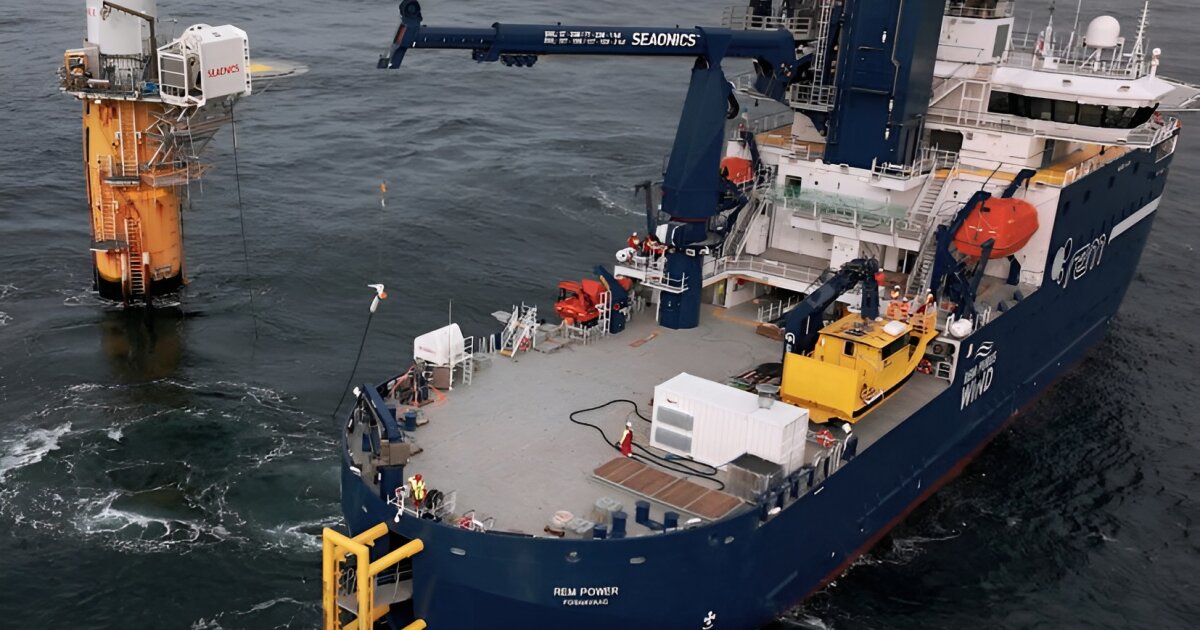
Poseidon is probably still getting used to our growth from wooden boats to enormous cruise ships. Imagine his shock when he sees electric boats casually pulling up to recharge right in the middle of his abode, thanks to a new offshore charging system.
Engineers at the Norwegian research organization, The Foundation for Industrial and Technical Research (Stiftelsen for industriell og teknisk forskning; SINTEF) have created a “plug and play” charging system that allows electric vessels to charge at sea via a magnetic field. This inductive technology replaces traditional physical plugs that are highly susceptible to corrosion and wear from saltwater and algae.
The charging system is the latest breakthrough in the Ocean Charger project, a collaborative initiative led by shipbuilding company VARD and a consortium of green-energy maritime partners. Launched in 2023, the project set out to develop, simulate, and test a full-scale charging solution that enables ships to charge directly at offshore wind farms. The goal was to ensure the continued availability of emission-free vessel operations without ships needing to return to shore for power.
It took thousands of years for humanity to go from sails and human-powered ships to steam engines, roughly a century for steam propulsion to give way to diesel-powered vessels, and now – after another century of diesel dominance – the maritime industry is progressively adopting electric and hybrid-electric vessels.
Various challenges have hindered this adoption, one of the biggest being how to recharge onboard batteries. Charging infrastructure is typically located onshore, limiting how far electric vessels can travel before needing to return to port for recharging. Engineers proposed what seemed like a simple but ingenious solution: build charging stations out at sea where vessels could recharge without making long return journeys to shore, with turbines powering the charging stations for truly autonomous power.
However, offshore charging also introduced a new set of problems. You see, conventional charging plugs and electrical connectors are designed for relatively stable, dry environments. These charging systems rely on rigid physical connectors that must maintain direct metal-to-metal contact for electricity to flow efficiently. On land, this is relatively straightforward. A car remains stationary while a plug locks firmly into place. At sea, however, the environment becomes dramatically more hostile for this kind of connection.
Waves, currents, and wind constantly shift both the vessel and the charging platform. The resulting misalignments, even small ones, can place enormous mechanical stress on charging connectors, potentially damaging pins, loosening contacts, or interrupting power transfer altogether. There is also the issue of electrical arcing that can occur if contacts momentarily separate while current is flowing.
The seawater adds another layer of issues. Salt water is highly conductive and extremely corrosive to exposed metals. Over time, salt deposits and oxidation will almost inevitably degrade charging contacts, increasing electrical resistance, reducing charging efficiency, and raising the risk of overheating or electrical failure.
In addition to these factors, there’s also water intrusion to contend with. Conventional plugs are not designed to tolerate repeated exposure to water. Moisture entering the connector can trigger short circuits and cause insulation breakdown.
To overcome these problems, the researchers developed contactless marine charging systems based on inductive power transfer. Instead of relying on exposed metal connectors, these systems transfer electricity wirelessly through magnetic fields. Think wireless phone charging, but on a far larger scale.
SINTEF Energy
A transmitting coil inside the charging platform generates a rapidly oscillating magnetic field using alternating current. When a receiving coil on board the vessel is positioned within this field, the changing magnetic flux induces an electric current in the receiving coil through electromagnetic induction, without contact. Both coils are safely encapsulated in a waterproof material that is also salt- and algae-resistant.
“We’ve tested a possible solution that works almost like a regular electrical contact. But we can avoid all the problems because we transfer the power inductively by encapsulating the plug itself in materials that can withstand just about anything,” says Giuseppe Guidi, a senior research scientist at SINTEF.
This approach seems to address most of the problems associated with charging at sea. First, it eliminates exposed electrical contacts entirely. Because no direct metal-to-metal connection is required, corrosion becomes far less problematic. Small movements between the vessel and the charging platform are also more tolerable, since power can still transfer even if the alignment is not perfectly rigid.
Furthermore, with no exposed live contacts, the risk of electrical arcing is dramatically reduced. Lastly, the system’s sealed nature helps protect critical components from seawater intrusion and moisture damage.

Hege Tunstad
On paper, the technology is deceptively simple. However, the process involves advanced engineering precision. According to the researchers, achieving the induction-based charging required far more than simply scaling up wireless phone charging technology. The system also depends on specially engineered cables, intelligent control software that minimizes energy loss, and electromagnetic components capable of handling extremely high power levels in rough offshore environments.
Another amazing aspect of the broader charging-at-sea project is the local production of energy using wind turbines. When winds are low, continuous charging is ensured through intermediate storage solutions, creating a fully functional “Offshore Substation (OSS),” according to the researchers.
“The OSS hub functions as an electrical hub out at sea, collecting electricity from the wind turbines and making it possible to charge vessels directly, without traveling to shore,” says Vards Håvard Vollset Lien, head of the Ocean Charger project.
The long-term ambition of the project is to populate coastlines, starting with the Norwegian coastline, with networks of these substations, where compatible vessels can stop and charge.
“Perhaps one day it will become a common sight for electric service vessels and coastal vessels to charge their batteries at sea and out in the shipping lane,” Vollset Lien says.
The project is truly significant for the maritime industry, especially for service vessels used in oil and gas, offshore electrical infrastructure, and marine law enforcement.
Source: Norwegian SciTech News

