


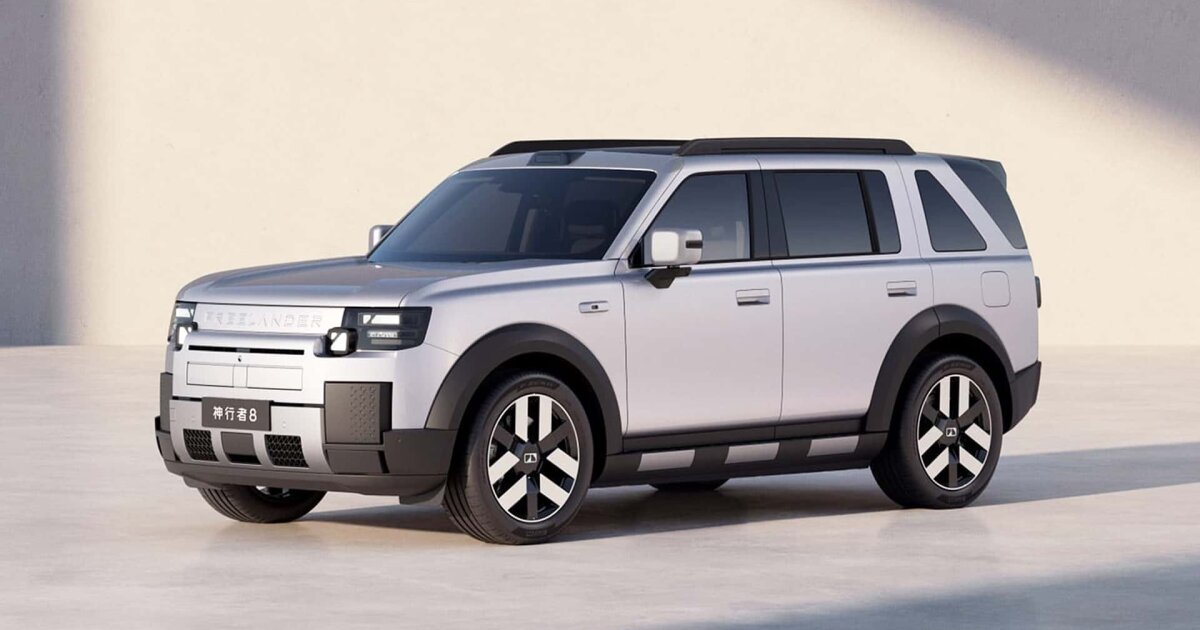
The original Land Rover Freelander may have died after just two generations in 2015, but that hasn’t stopped Jaguar Land Rover from reviving the nameplate now in 2026. Except it’s no longer a standalone SUV, with Chery-JLR launching Freelander as a full-fledged brand.
Called the 8, the very first model from the newfound brand pretty much continues the design direction of the Concept 97, which was revealed last month. It was revealed at the Chery International Business Summit in Wuhu.
Its design will drive a lot of opinions, both ways, as can already be seen. On one hand, it has the same “castle body,” the signature triangle window, interlocking headlights, floating taillights, and the dual-peak hood as the original Land Rover Freelander in 1997.
Freelander / Cherr-JLR
On the other hand, the new Freelander 8 is a 200.7-inch (5.1-meter) long, three-row SUV — much closer to a Defender 130 in footprint than the original Freelander. That effectively takes it from an urban 4×4 to a full-blown family SUV with proper road presence.
But the good thing is that design hub director Phil Simmons – the one who was behind the original Freelander and the L322 Range Rover – is behind the new three-row EV. Inside, though, things are quite changed.
It sports a widescreen display that extends all the way, similar to the Panoramic Vision display seen in the new BMW iX3 and i3. Beneath this display are two rotary knobs, a row of physical (thank god!) air conditioning controls, and a sizable infotainment touchscreen.
In the second row, you can opt for twin captain’s chairs with built-in ottomans, heated, ventilated, and massage features, as well as a one-touch “zero gravity” recline option. In contrast, the third row sports traditional twin seats, which should be more than comfortable for kids at the very least. Of course, the Freelander badging is slapped across as much as possible – because, why not?

Freelander / Cherr-JLR
On the tech side of things, the vehicle comes with a roof-mounted 896-line LiDAR system and Huawei ADS 5 intelligent driving assistance. It will also come linked to an intelligent all-terrain system called i-ATS, which combines data from binocular cameras and LiDAR to recognize the terrain and tailor the driving experience.
As for the motor, it’s based on a new dedicated platform, which supports BEV, PHEV, and extended-range versions. All we know for now is that the battery system, which was developed in collaboration with CATL, has a peak charging capacity of 350 kW and a charging performance of up to 6C.
Although Freelander has been established as a new energy vehicle (NEV) brand, it is anticipated that it will be available in electric and plug-in hybrid versions (the prototype you see here has dual ports for gasoline and charging). However, no technical specifics have been disclosed yet.
Keep in mind that this is not a series-production model, but rather a production-intent prototype. The Freelander 8 is set to debut in China in the second half of 2026, followed by a global rollout thereafter.

Freelander / Cherr-JLR
What the Freelander 8 really proves is how far the idea of a “Freelander” has drifted from where it started. The original was honest to a fault. It was compact, a bit awkward, and refreshingly unpretentious in the way it went about its business.
This new SUV seems like it’s been briefed for an entirely different audience. It’s bigger, sharper, loaded with tech, and far more deliberate about the image it wants to project. You can still spot the nods to the past if you look closely, but they feel more like design Easter eggs than the foundation of the car’s identity.
And maybe that’s the point. The Freelander badge here isn’t about continuity; it’s about familiarity. In a market flooded with anonymous, tech-heavy SUVs, a known name gives this Chery–JLR creation a head start. But peel that layer away, and what you’re left with is a very modern, very global product that’s less concerned with off-road heritage and more focused on screens, software, and scale.

Freelander / Cherr-JLR
Don’t forget that Western markets already boast a ton of big SUVs with electric drivetrains. Sure, the apparent range-extender may temporarily set it apart, but big-name manufacturers are already making investments in REEVs. Does that mean the Freelander 8 might be a few years too late? What’s your take?
Via: Car News China

