


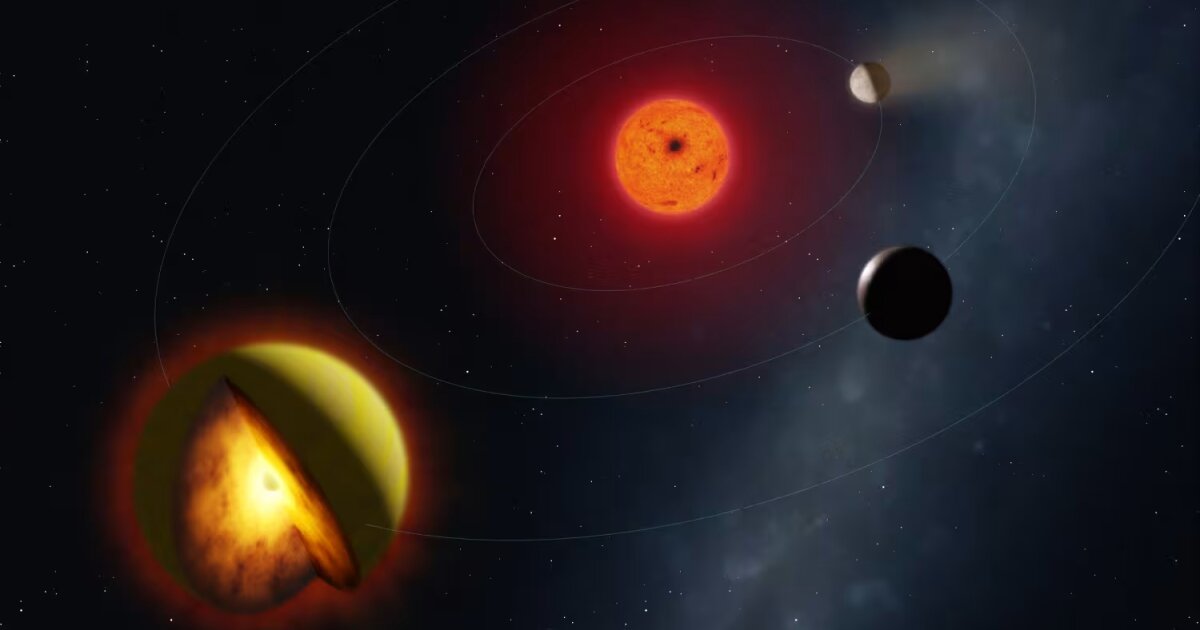
The floor is literally lava on a nearby exoplanet, new telescope observations show. Given its small size and strange history, one team of scientists suggests planet L 98-59 d’s molten ocean and odd atmosphere might represent an entirely new category of extraterrestrial world.
In space terms, the planet is relatively close to us — about 35 light-years away — and similar to Earth’s size, measuring about 1.6 times our planet’s diameter. But L 98-59 d has a puzzling composition, compared with our planet’s size and history: it essentially has a mantle composed of molten silicate, which is similar to lava on Earth. This molten reservoir allows the planet to store enormous amounts of sulphur deep in its interior, and makes it unlike other rocky planets seen before. L 98-59 d may therefore be part of a new class of sulfur-rich, magma ocean worlds, never before witnessed.
Peer-reviewed results, based in part on observations from the James Webb Space Telescope (JWST) and ground observatories, were published March 16 in the journal, Nature Astronomy. The discovery shows that “we still have so much to learn about how planets form and evolve,” study lead author Harrison Nicholls, who performed the research as a Ph.D. student at the University of Oxford, told Refractor.
“This result emphasises the diversity of planetary environments that exists in the galaxy, which we must keep in mind when interpreting observations of ‘habitable zone’ planets,” added Nicholls, who is now a postdoctoral research associate at the University of Cambridge. “Understanding the deep interiors and evolutionary history of all planets is necessary for knowing — with any level of certainty — whether they are habitable or not.”
A primordial ocean persists
The major parts of Earth’s atmosphere are nitrogen, oxygen and argon. Most rocky planets, like ours, lose the majority of their atmospheric hydrogen and sulfur over time because a nearby star (like the sun) gradually blows those elements into space via its solar wind.
Against all odds, however, L 98-59 d held onto its hydrogen-rich atmosphere for billions of years. The key is its molten ocean. How that ocean persisted is a tricky story to unravel because JWST only observed a moment in the planet’s nearly five-billion-year-old history. So to do so, scientists turned to advanced computer modeling.
Early in the planet’s formation, their work suggests, L 98-59 d was much hotter and “more inflated,” Nicholls said — more gaseous and closer in style to a sub-Neptune planet. Although L 98-59 d cooled down and shrunk a little over the eons, the planet still has a low density. That in turn suggests a massive, high-pressure atmosphere.
A high-pressure atmosphere rich in hydrogen would be opaque and Venus-like, creating a greenhouse effect on the planet’s surface, Nicholls’ team stated. That atmosphere, the researchers believe, is the biggest factor keeping the “primordial magma ocean” liquid, but other things help: the planet’s parent star sends out a modest amount of radiation, and nearby planets are heating up L 98-59 d’s interior — producing tides.
We have seen magma oceans before on other planets, like 55 Cancri e, but these worlds tend to be near stars sending out a considerable amount of radiation. Things are different on L 98-59 d: the thick atmosphere, the radiation, and the tides all appear to be working together to keep the magma ocean liquid. That scenario is not accounted for in our existing planetary classifications, Nicholls said.
The story of sulfur
Studying this planet could tell us a little more about our neighborhood’s history of sulfur, which is an element that can be key to life under the right circumstances. While the molten L 98-59 d is not friendly to life as we know it, a glance at the planet’s early history with modeling suggests it must have formed in an environment filled with more sulfur than our own solar system. That has bigger implications for searching out other rocky worlds.
“Other more Earth-sized planets could also form with substantially different element inventories to the Earth, so we could begin to speculate about smaller sulfur-worlds,” Nicholls said.
To get more data, the team wants to find more worlds like L 98-59 d, which may come soon from JWST, as well as from larger-scale examinations of planets like the planned Atmospheric Remote-sensing Infrared Exoplanet Large-survey (ARIEL).
Assuming more planets like L 98-59 d are found, the ideal would be to better map out what a “super-Earth” actually means. Right now, Nicholls pointed out, the classification is purely based on size. While L 98-59 d technically qualifies as a super-Earth — a rocky planet larger than Earth but smaller than Neptune — it shows different super-Earths may have vastly different compositions within that collection.
“By modelling the whole super-Earth population and comparing with trends in the exoplanet census, we will be able to pick out different subgroups according to their composition and structure, and connect these with the planet formation/evolution processes,” Nicholls said.
The team is preparing now to run more simulations of planetary evolution using machine learning, as they gather more data from space missions studying exoplanets.

