


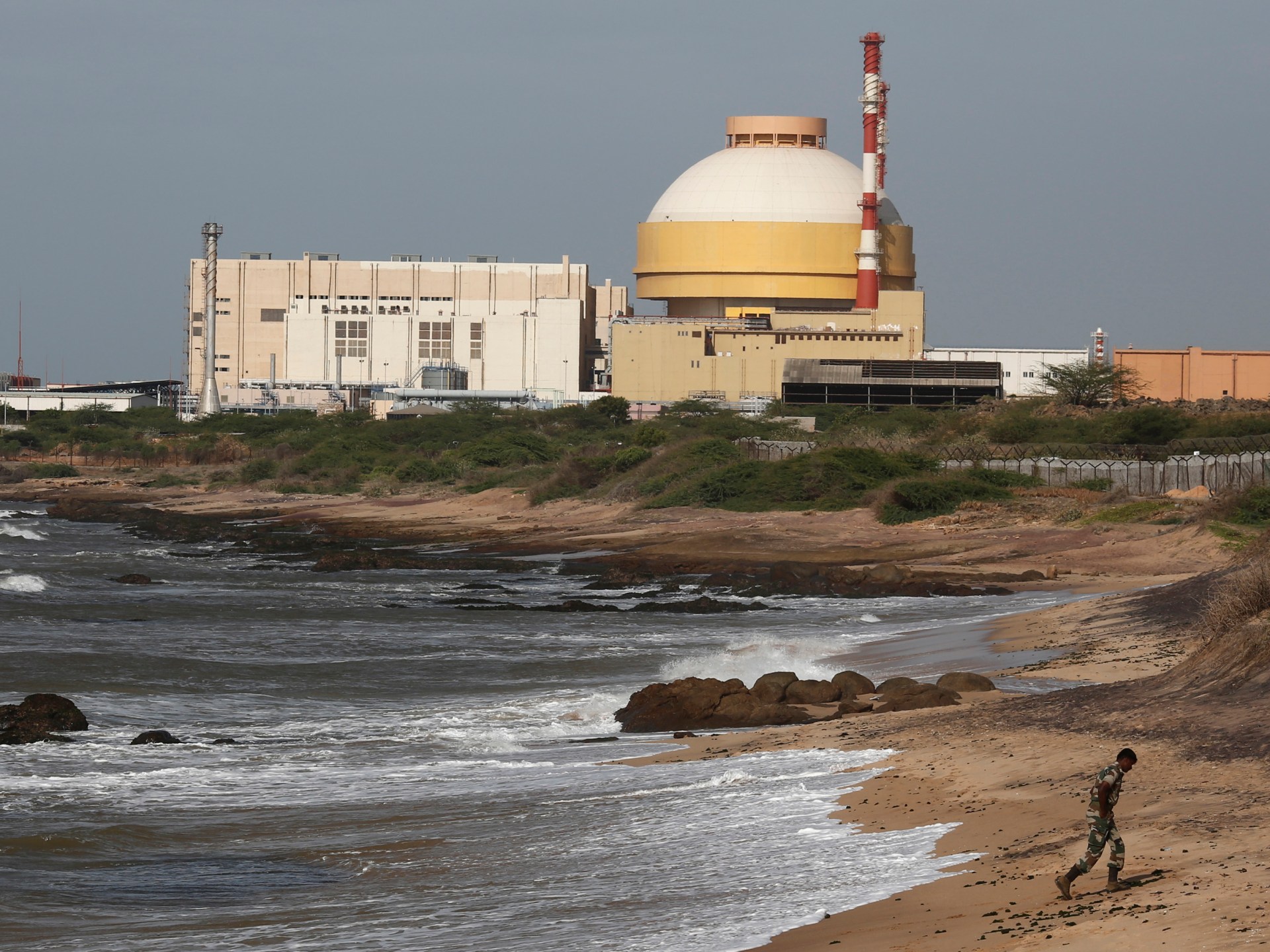
India’s most advanced nuclear reactor has reached a self-sustaining stage that marks a major leap for the country’s atomic energy programme, and takes it a step closer to cutting dependance on uranium.
The prototype fast breeder reactor (PBFR) at Kalpakkam in the southern Indian state of Tamil Nadu reached criticality – the stage at which a nuclear chain reaction can continue on its own – on Monday. Once the reactor becomes fully operational, India will become only the second country after Russia to have a commercial fast breeder reactor.
Recommended Stories
list of 3 itemsend of list
Indian Prime Minister Narendra Modi called it “a proud moment for India” and “a defining step” in advancing the country’s nuclear programme.
“This advanced reactor, capable of producing more fuel than it consumes, reflects the depth of our scientific capability and the strength of our engineering enterprise. It is a decisive step towards harnessing our vast thorium reserves in the third stage of the programme,” he said in a post on X on Monday.
So what is a fast breeder reactor, and why does this latest advance matter – for India and the world?
Here’s what we know:
What is India’s fast breeder reactor all about?
A fast breeder reactor is an advanced nuclear reactor that produces more fissile material – fuel that can be used for fission nuclear reactions – than it consumes.
India’s fast breeder reactor has been designed and developed by the Indira Gandhi Centre for Atomic Research (IGCAR), a key research and development institution under the country’s Department of Atomic Energy. It has a 500 megawatt electrical (MWe) capacity.
The nuclear reactors that India and most other countries otherwise use are what are known as pressurised heavy water reactors. They use uranium as their fuel, and churn out plutonium as waste.
But a fast breeder reactor can then use that ejected plutonium as fuel to set in motion a self-sustaining nuclear reaction. Fast breeder reactors also use uranium as fuel, but need less since they can also consume plutonium. So in effect, the Kalpakkam reactor will need less uranium to generate electricity than heavy water reactors would.
That’s why it’s called the second stage of India’s nuclear programme.
On Monday, the Indian government said that the reactor is designed to enable “India to extract greater energy from its limited uranium reserves, while paving the way for large-scale deployment of thorium-based reactors.”
A March 2024 report by Modi’s office said India’s PFBR “will initially use the Uranium-Plutonium Mixed Oxide (MOX) fuel. The Uranium-238 ‘blanket’ surrounding the fuel core will undergo nuclear transmutation to produce more fuel, thus earning the name ‘Breeder’.”
Uranium-238 refers to the most abundant, naturally occurring form of uranium that is only weakly radioactive by itself, but that can capture neutrons to turn into plutonium.
“Since it uses the spent fuel from the first stage, [the] FBR [fast breeder reactor] also offers great advantage in terms of significant reduction in nuclear waste generated, thereby avoiding the need for large geological disposal facilities,” the report added.
How does a fast breeder reactor work?
Paul Norman, a professor of nuclear physics and nuclear energy at the University of Birmingham, told Al Jazeera that – as the Indian prime minister’s office said in its report – fast breeder reactors use both plutonium and uranium. The uranium is converted further into plutonium, too.
“One bonus of this type of system is that it can increase nuclear fuel reserves enormously, by in theory making use of ‘all of the uranium’ [via plutonium conversion] rather than just a small part of it,” he said.
“The technology can also be tweaked towards thorium systems, and there is meant to be more thorium out there in the earth than uranium, providing a further huge boost in the amount of nuclear fuel,” he explained.
Globally, thorium reserves are four-times larger than uranium reserves.
And in India, this equation is even more loaded: The country is home to about 1-2 percent of the world’s uranium, but has more than 25 percent of the world’s thorium.
How do the vast thorium reserves help India?
The construction of the PFBR officially began in 2004 after multiple delays. But its importance was highlighted by the country’s scientists much earlier.
An October 1996 report written by Indian scientists Shivram Baburao Bhoje and Perumal Chellapandi for the International Atomic Energy Agency said that the fast reactor programme was important in India because of the country’s growing and continuous demand for electricity.
India is the world’s third-largest energy guzzler, after China and the United States. With the world’s largest population and a fast-growing economy, India’s energy consumption is only expected to grow further.
As the war on Iran, and its impact on global energy prices has demonstrated, a continuing overwhelming dependence on fossil fuels poses a risk to economies like India’s.
At the moment, nuclear energy represents only 3 percent of the country’s energy mix, but India wants to raise that dramatically, from 8,180MW in 2024 to 100GW by 2047.
That’s where the three-stage nuclear programme and thorium fit in.
In the second stage, the fast breeder reactors use uranium and the plutonium waste from heavy water reactors to generate electricity. They also produce more plutonium and a lighter isotope of uranium called uranium-233, which is ready, fissile material that can be used as fuel in third-stage reactors.
Those third-stage reactors, once designed, would be thorium-based. They would be fed with thorium – which India has in abundance – and uranium-233. The waste those reactors would produce: also uranium-233, which can be fed back as fuel for the reactors.
Once India accomplishes its three-stage process, it would in effect be able to reduce its need for naturally found uranium significantly, and instead use thorium for much of its nuclear energy needs.
Why does this matter to the rest of the world?
Other countries – including the US, France, UK, Japan and Russia – have worked on fast breeder reactor technology.
But until now, only Russia has a commercial fast breeder reactor.
Norman said that challenges with reactor materials, reprocessing, and the economics of the entire process have often also stopped the large-scale deployment of such systems.
If India is able to turn the success of its prototype reactor into a commercial nuclear-energy-generating model, it could inspire other countries to follow suit.

