


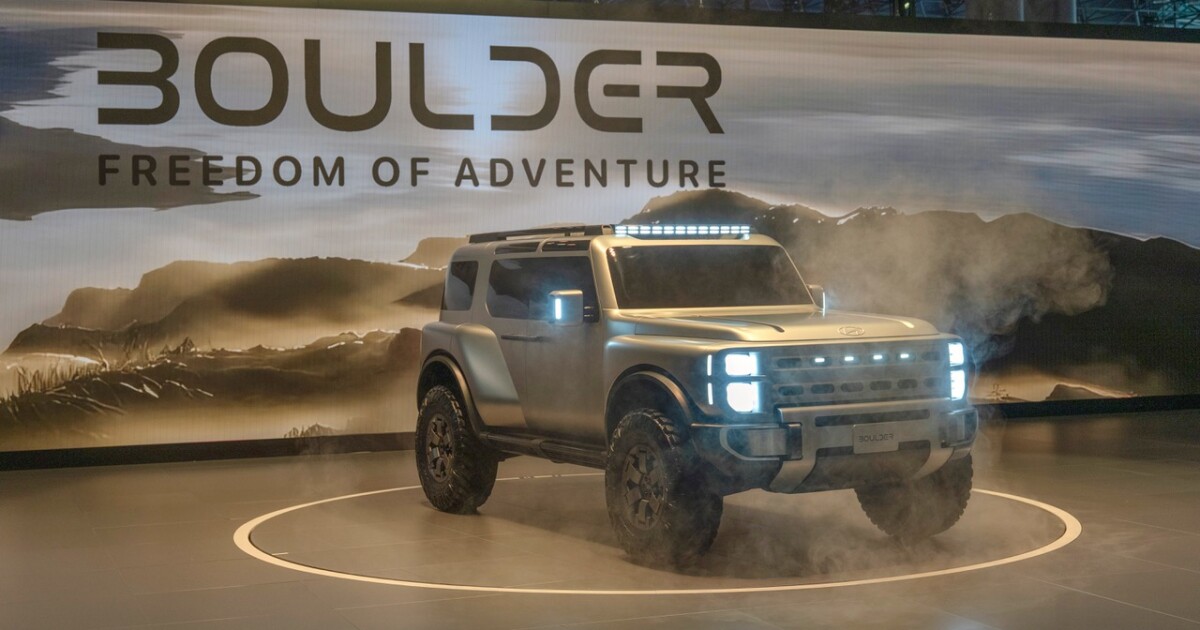
With its cowboy-chunky jawline and boxy, muscular body, it looks big, modern, tough, and desirable. And Detroit is suddenly worried.
Hyundai has just surprised the motor world by unveiling a bold concept at the 2026 New York International Auto Show. From the 37-inch off-road rubber to wheel arches that look like they could serve as railroad bridges, the Boulder Concept seems to have everything from the Ford Bronco to the Land Rover Defender in its sights.
Little wonder, then, that it made headlines in the Detroit News last week. “Off-road parks are going to get crowded,” it said, sounding a little worried at the prospect.
Hyundai
Check out the roof-mounted light bar, safari-style fixed upper windows, coach-style doors, low-profile roof rack for packing camping gear, and the full-size spare wheel on the tailgate. You can be sure that Detroit marketing executives are doing the same.
Some of the American reaction suggested that this cheeky intruder from Asia was targeting the big players of the US truck world. That America-centric view ignores the fact that Hyundai is now the world’s third-largest automaker, well ahead of GM, Stellantis, and Ford. Even in the US, the Korean group is building more than one in 10 vehicles sold. Hyundai sales are booming in all directions, and that’s not something Detroit has been familiar with for quite a while.
The Hyundai Group has long been characterized as producing mainstream, safe, unchallenging vehicles, perhaps unfairly. But recently, the gloves have come off, and we’ve been spotting rather exciting niche concepts appearing across the auto space. From Dakar-destined dune busters to all-electric camper vans, the Hyundai team is clearly looking to start gobbling up those niche markets.
So for Detroit’s automakers to be surprised by Hyundai’s bold and brawny Boulder Concept shows they haven’t been paying attention. Yes, it’s Hyundai’s first body-on-frame, truck-based SUV, but Motor City icons like the Jeep Wrangler and Ford Bronco should certainly be getting worried.

Hyundai
Hyundai isn’t testing the water here. The Boulder looks suitably unstoppable, and the brand is also promising a US-made pickup on the same platform by 2030. And it’s not the only Asian automaker aiming for the heart of America’s profit-rich truck segment.
In this conservative sector, US brands still dominate. Toyota is trying hard but remains a distant fifth behind the ever-present Ford F-Series, Chevy/GMC trucks, and Ram pickups. Toyota’s Texas-built Tundra posted just 147,610 sales in 2025 because it lacks heavy-duty versions. The ladder-frame Tacoma pickup and 4Runner and Land Cruiser SUVs are doing a little better. At the moment, Hyundai barely registers.
Hyundai’s unibody-based Santa Cruz pickup seems flimsy compared to the ladder-frame, stump-pullers from Detroit and will be discontinued after this model year. Hyundai’s Alabama and Georgia factories will have the capacity to build an all-new ladder-frame platform. The Boulder Concept (itself based on the Crater Concept seen in Los Angeles last year) will be followed by a pickup concept soon. Expect Boulder production for the 2028 model year.
“The Boulder Concept’s stout, ladder-frame-style construction has long been favored by US consumers seeking trucks and SUVs for serious off-roading, towing, and hauling,” Hyundai admitted in a press release. The Boulder and its pickup sibling will also be designed in the United States, with steel coming from a new Hyundai Steel plant in Louisiana.

Hyundai
The Boulder Concept was created by the Southern California-based team at Hyundai Design North America. This design study was developed with a specific focus: catering to the desires of US off-road enthusiasts and attracting new buyers to the Hyundai brand.
“The Boulder Concept SUV’s construction and appearance is more than a clear indication of Hyundai’s future design direction; it’s a signal of the unlimited potential for rugged off-road capability and do-it-all utility that will be hallmarks of the company’s future body-on-frame production vehicles,” reads the press statement.
Source: Hyundai

