


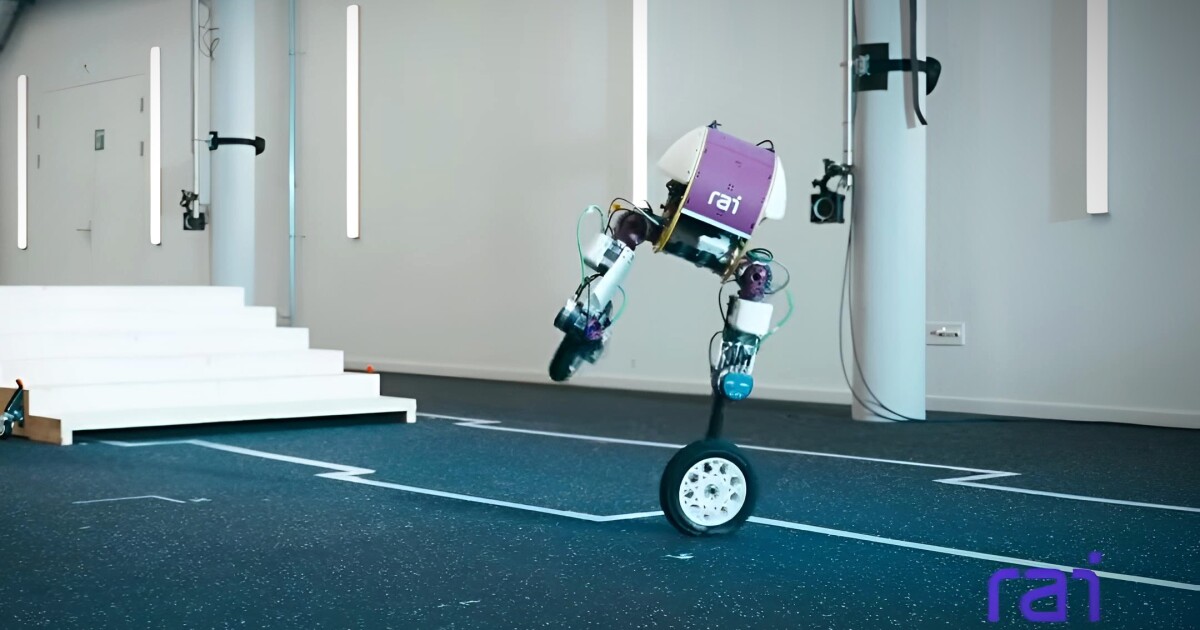
The Robotics and AI Institute (RAI) has just released a video of its Roadrunner robot. Although it lacks a torso, the bipedal bot more than makes up for it by rolling, stomping, stair-climbing, and even showing off while using only one of its legs.
Launched in 2022 with a US$400-million investment from Hyundai Motor Group, the RAI is piloted by Marc Raibert, the founder and current Chairman of Boston Dynamics. In case you’re not up on your robo-culture, Boston Dynamics (BD) is the company that’s given us such impressive robots as the gymnastic Atlas, and the dog-like Spot, which made a big splash in the entertainment world last year when a squad of them performed on TV show, America’s Got Talent.
Taking Raibert’s pedigree into account, and considering the agility exhibited by BD’s bots, it’s no surprise that RAI has just released this video of Roadrunner.
Meet “Roadrunner”: a bipedal, wheeled robot for multi-modal locomotion
As you can see, the 15-kg (33-lb) Roadrunner is little more than a pair of robotic legs atop two wheels. But they really are some legs! Not only can they roll along in a side-by-side configuration, but they’re also able to do just fine in an inline mode, where one wheel rolls behind the other. They’re even able to roll up and down stairs, that is when they’re not locked and stomping up and down them with about as much finesse as your drunk upstairs neighbor at two in the morning. But we digress.
In addition to also being able to balance on one wheel, Roadrunner shows the ability to switch directions simply by bending its “knees” the opposite way. “The robot’s legs are entirely symmetric, allowing it to point its knees forward or backward, which can be used to avoid obstacles or manage specific movements,” says RAI.
Of course, at this point, Roadrunner is more of a proof of concept rather than any kind of useful bot. But just imagine how impressive it will be once the company gives it a torso and some AI decision-making skills.
You can see more of RAI’s robotic shenanigans on its YouTube page.
Source: RAI

