


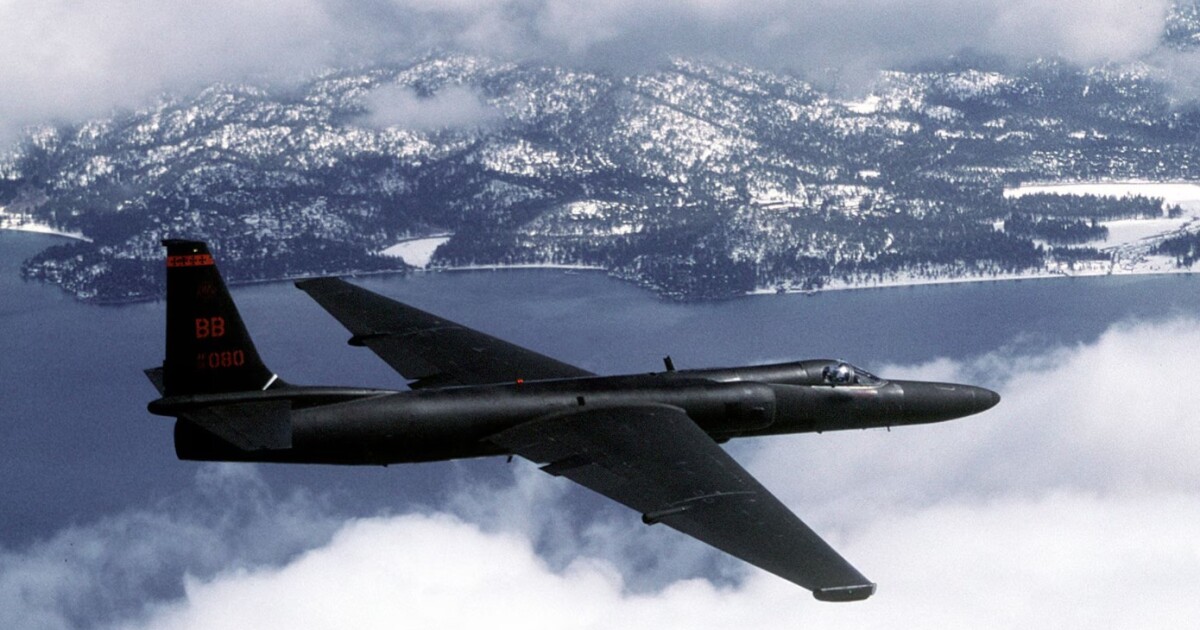
The legendary Cold War-era Lockheed U-2 Dragon Lady spyplane is getting a new lease on life as BAE Systems gives it an upgraded version of the AN/ALQ-221 Advanced Defensive System (ADS) to protect the aircraft against modern radar and electronic warfare threats.
Some military aircraft come and go so fast that they seem to vanish from service before the cement on the Airfix model has a chance to dry. Some like the Lockheed F-104 Starfighter variants flash by as technology changes. Meanwhile, there are others that remain in service for decade after decade until the grandchildren of the original pilots are flying them.
Sometimes this longevity is hard to believe, with some aircraft battling against cancellation before they even leave the ground only to last so long that they’ve outlived even their supposed replacements.
Perhaps the most improbable of these is the Lockheed U-2 Dragon Lady. When it was first proposed in 1954, it was flatly rejected by General Curtis LeMay of the US Strategic Air Command (SAC) because it was about as far from standard combat aircraft specs as it was possible to get. It only had one engine, no guns, no armor, no landing gear, and was remarkably fragile because much of the support had been removed from the structure.
U-2
And yet, the U-2 went on to enter service in 1956 and is still flying today.
The reason the U-2 was conceived in the first place was because in the 1950s the Cold War was in the deep freeze. NATO had no real idea of what was going on behind the Iron Curtain and had little in the way of solid evidence as to Soviet military capabilities.
What they did know was that the converted bombers like the English Electric Canberra, which could reach 48,000 feet (14,600 m), that the West relied upon for photoreconnaissance simply weren’t up to the job. The aircraft flew too low and Soviet radar demonstrated that they could detect and track any plane that came near their territory. Worse, they were vulnerable to the new types of anti-aircraft missiles and artillery.
US government
What the Americans wanted was a spyplane that could fly above 70,000 ft (21,000 m) where, it was then believed, it would be invisible to Soviet radar and anti-aircraft systems. That way, the US could penetrate deep into Soviet airspace and capture updated images of military installations that the West had previously only seen in photographs taken by the Germans during the Second World War.
Added to this, in the 1950s, President Eisenhower was very keen on promoting an internationalist foreign policy, combined with a desire to split the Gordian Knot of the threat posed by all-out nuclear war. What this entailed was gaining as much reliable information about the Soviet military as possible while stumping for an open skies policy that would allow overflights by both sides of the other’s territory to prevent accidental war.
As part of this, the civilian scientific community, through the Land Panel and the Killian Committee, convinced Eisenhower that the U-2 could be used for scientific work like meteorology and astronomy, and if the plane was controlled by a civilian agency rather than the military, the administration would be able to deny any military role if one was shot down.

US government
Thanks to its modular and distinctly unmilitary design, the U-2 fit the bill and sidestepped the Air Force’s objections when the command of the operation went to the CIA. Since the U-2 was only supposed to fly for two years, it seemed doable. Officially, the plane was civilian doing innocuous civilian things. Even the pilots were “civilian,” though they, for some reason, tended to be suddenly “retired” US Air Force pilots and many were foreign nationals.
What set the U-2 apart was that it was essentially a jet-powered glider. With a length of 63 ft (19 m), the current version has a wingspan of 103 ft (21 m), yet has an empty weight of only 16,000 lb (7.2 tonnes). It’s powered by a single General Electric F118-GE-101 jet engine generating 17,000 lb of thrust, giving it a cruising speed of 356 knots (410 mph, 659 km/h) and it has a range of over 6,000 nautical miles (7,000 miles, 11,200 km) or over 12 hours of endurance. Because it has to fly at such high altitudes, a new jet fuel that wouldn’t evaporate during the missions had to be developed.
Instead of being made of riveted sheet metal and I-beams, the U-2’s High Aspect Ratio Wings are made from large, single billets of aluminum that have been milled into shape for greater lightness and strength. The wings themselves have a glide ratio of 23:1, which allows the aircraft to glide thousands of miles if necessary – and has on at least one occasion when the engine failed.
US government
For this reason, the commanders of any emergency field where the U-2 was likely to land in the early days had top secret instructions of what to do if the fantastic plane and its space-suited pilot suddenly touched down.
These wings may be great for keeping the U-2 at high altitude, but they make take off and landing a bit dicey. At 70,000 ft the air density is a bit on the sparse side, resulting in a very narrow flight envelope for a jet-powered glider. That means the U-2 always has to fly very close to its stall speed, while the speed of the air flowing over the wings is close to supersonic. The safety margin is so small that the pilot has to keep the speed just right to prevent either losing control or causing structural damage.
That’s already a drawback and it’s made worse because to save weight there aren’t any power-assisted control systems, so the pilot has to use brute strength on the joystick and pedals when at low altitude and use the lightest touch at cruise altitude. Not easy when you’re wearing what is essentially a space suit to protect against cabin depressurization.
Taking off and landing is also problematic.

US government
The U-2 has only a minimal bicycle-style undercarriage and a pair of “pogos.” which act like training wheels. They sit on the ends of the wings to keep the plane from tipping over and then fall off when the aircraft leaves the ground. If that sounds tricky, landing is even worse. Those huge wings generate an air cushion effect that keeps the U-2 from actually landing. To keep from smashing it every time it sets down, the pilot has to keep the plane at no more than 2 ft (60 cm) off the ground and then deliberately stall it so it drops, with the rear wheel touching the ground first.
The public had little awareness of the U-2 until the infamous Gary Powers incident in 1960 when a U-2 was shot down by the Soviets inside their territory, which was a bit of a shock in more ways than one. The main reason the U-2 was green lit was because it was thought to fly so high and had such a small a radar signature that Warsaw Pact radar and anti-aircraft systems wouldn’t detect it, much less shoot it down. Unfortunately, that assessment turned out to be wrong because those systems were much more sophisticated than first thought.
The other shock was that the pilot Powers survived the attack and was put on a very public trial in Russia on an espionage charge while the debris from his aircraft was put on display in Moscow. Powers was sentenced to prison but ended up being exchanged for a KGB agent being held by the Americans. However, the CIA suddenly had its super-secret plane plashed on the world’s front pages.
It didn’t help in 1962 when a U-2 was shot down during the Cuban Missile Crisis, killing the pilot.

US government
Despite these very public setbacks, the U-2 became a hidden success story and a major player during the Cold War. By penetrating Soviet airspace, the spyplane was able to provide the West with accurate information about the true number of Soviet bombers and ICBMs, which were a tiny fraction of what Moscow claimed. It also monitored the Bay of Pigs invasion, made many flights over Asia, and to this day is a vital intelligence asset. In fact, it was so successful that, for a time, U-2s were loaned to Britain and Taiwan to make flights that the US government couldn’t officially sanction.
A major factor in the success and longevity of the U-2 is its modular design, which makes upgrading it relatively easy. Using standard attachments and a payload system that allowed for quick swap-outs, it’s been possible to make surprisingly large changes to the spyplane, including adding an extra seat for trainers or missions that require a specialist operator.
Over the past 70 years, the U-2 has received a whole new engine, a completely redesigned cockpit (twice!) that now includes a new mission computer and a digital cockpit with multifunction displays that replaces most of the analogue controls, and some changes so great that the U-2 often looks like a completely different plane than that of the 1950s.
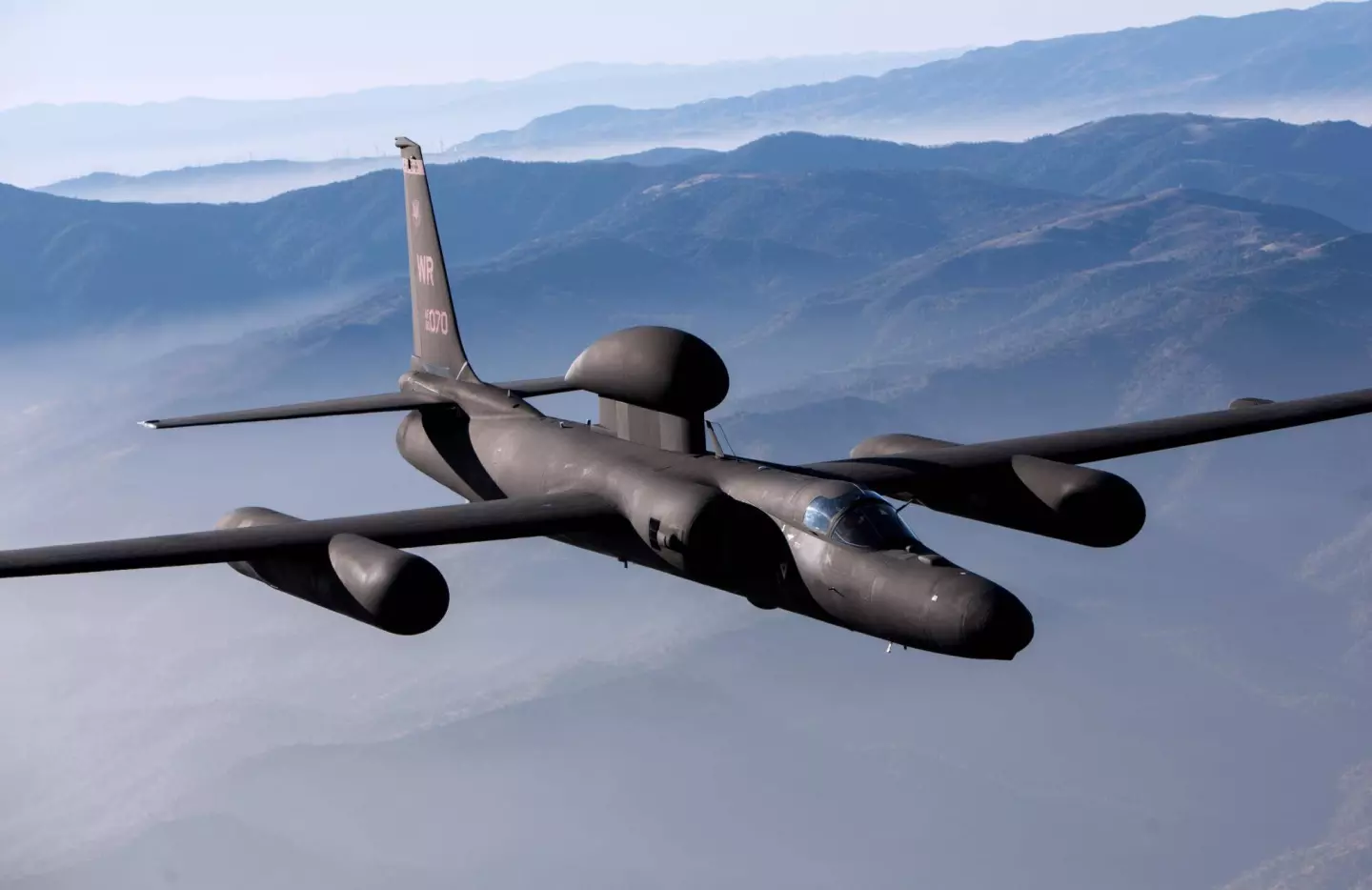
Now under command of the Air Force, the modern U-2 has a greater wingspan and can take off with over double the weight of the original. It’s also noticeably faster and has about three times the range. It doesn’t even look like its first variants. The modern U-2 has a long, bulbous nose containing the side-looking radar antenna and a pair of what look like huge tanks under the wings. For years I thought these were fuel tanks, but they are, in fact, superpods for carrying 650 lb (295 kg) of interchangeable instruments, including specially made cameras, for different missions. In addition, there’s a spine pod that contains a satellite link that allows the aircraft to upload and download reams of data.
It’s to this that the AN/ALQ-221 ADS helps with extending the U-2’s life into its eighth decade by improving the spyplane’s ability to counter emerging radars and electronic warfare systems as well as letting it act as a testbed for 6th-Gen fighter plane technologies.
What’s ironic is that this ability to adapt and upgrade made the U-2 outlive even its own successor.
By 1966, the original two-year lifespan had long been exceeded, prompting the launch of the Lockheed SR-71 Blackbird as a direct technological replacement for the Dragon Lady. After the Gary Power incident, the US government decided that the only way to overcome the Soviet aircraft systems was to build an aircraft that could fly so high and so fast that it would either be out of range or could outrun any missile fired at it.
With a ceiling of 85,000 ft (26,000 m) and a top speed of Mach 3.3, the Blackbird was certainly up to the job, but there were some problems. One was the fact the Blackbird was a sprinter, while the U-2 could loiter in an area for up to 12 hours to monitor signals or movements, so it was still better at some missions than the Blackbird. Another problem was that the Blackbird had extreme maintenance requirements and exorbitant operating costs, and was extremely difficult to upgrade.
The upshot is that the U-2 is still kicking along while its successor has been sitting in museums for three decades.
At the moment, not for the first time, the US Air Force is pushing to retire the U-2 fleet. Congress has set firm limits to this, including allowing the retirement of no more than eight aircraft a year because of fears of a capability gap, with the fleet consisting of 26 aircraft at last count.
There isn’t any successor to the U-2 available and other platforms like drones and satellites aren’t up to the task. The Dragon Lady can be sent aloft and short notice loaded with cameras and instruments suited for the mission and a pilot who can make decisions on the spot. That’s pretty hard to replace.
Beyond that, the U-2s are still valuable as flying laboratories for both science experiments and for testing new technologies in communications, AI software, and other gear for the next generation of fighters and the Advanced Battle Management System (ABMS).
So it looks as though the Dragon Lady is going to be flying at the edge of space for quite a time to come.
Not bad for a plane that was only expected to fly for two years back in the 1950s.
Source: BAE Systems

