


Safety on a motorcycle is a double-edged sword. On one hand, safety is paramount when you’re riding on two wheels. But on the other hand, how far are you willing to go to safeguard yourself without interfering with the riding experience?
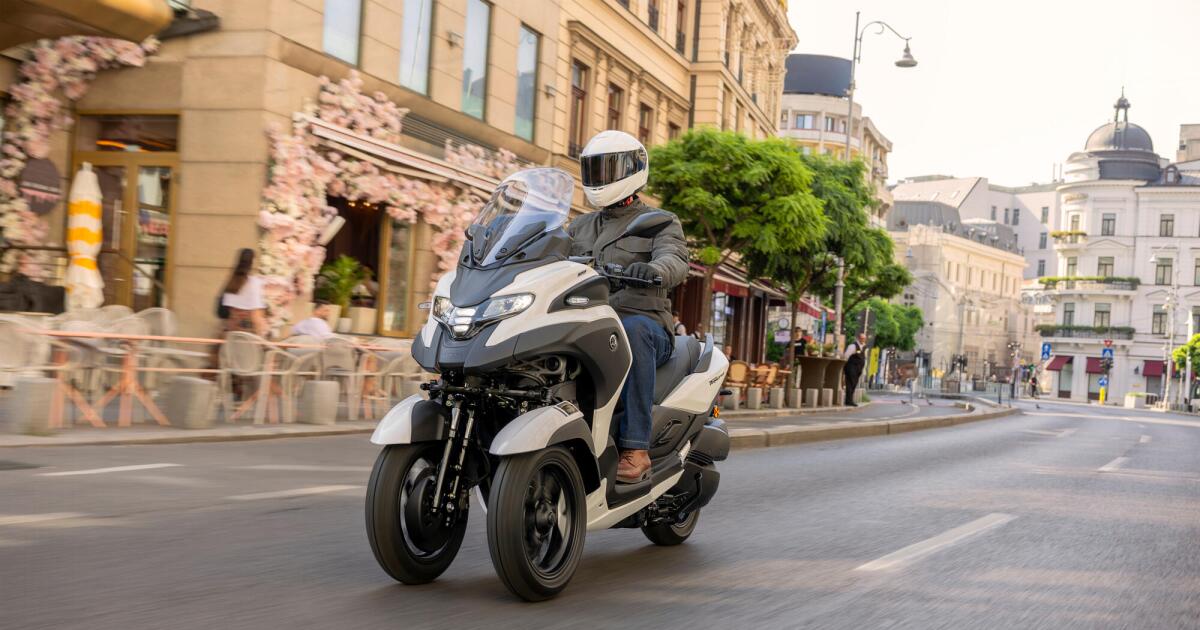
Yamaha is trying to answer exactly that question with its latest scooter: the 2026 Tricity 300. Granted, it’s a reverse trike , but it’s still a scooter nevertheless.
And here’s why it’s a big deal: scooters have historically lagged behind even motorcycles in safety tech. Airbags have existed on motorcycles for nearly two decades now (a $30,000 Honda Goldwing that tips the scales at over 800 pounds), but scooters? Well, you’re now technically looking at the world’s first scooter with an airbag.
Yamaha
To achieve this feat, Yamaha has joined forces with Swedish automotive safety specialist Autoliv. The airbags are attached to the scooter’s front panel, and linked to two G-sensors that are positioned at the center of the scooter.
The way it works is that these G-sensors identify any abrupt deceleration that could be a sign of a frontal collision, compare it to a predetermined value, and transmit the information to an electronic control unit or ECU, which then instructs the airbag to deploy. In order to minimize rider impact with the handlebars or other hard surfaces, the airbag inflates upward during a forward crash.
The principle is simple: absorb the rider’s kinetic energy and stop them from going over the bars. When deployed, the Autoliv airbag is much more compact than the one Honda uses on the Goldwing, because it takes the shape of a spherical pillow rather than a segmented clamshell.
Do note, though, that the airbag will activate only in frontal accidents and under certain deceleration conditions. Yamaha clearly states that there may be situations in which the airbag will not deploy, such as when the collision angle is off. It also won’t activate if the scooter is hit from the side or back, topples over, or is pinned beneath another vehicle.

Yamaha
Autoliv revealed that the airbag has been tested for “validation consistent with applicable development standards, including advanced simulations and full-scale crash testing.” Daisuke Asano, Yamaha Tricity 300 project leader, added that “the Tricity 300 is used by riders of many ages, including business people. For them as well as for their families, an easy-to-understand safety feature like an airbag will give them peace of mind as well.”
Airbag aside, the upgraded scoot also gets upgraded styling, most evident at the front end. It’s sharper than before, which gives the Tricity 300 a slimmer stance. The lights are also redesigned – vertically stacked triple LEDs at the front and a newly styled rear LED gives it a sporty look.
It continues to be powered by the same 292cc Blue Core single-cylinder engine, which is paired to a CVT transmission. The only major change there is the new muffler with an updated catalyzer to meet emissions regulations.

Yamaha
Being a reverse trike, it gets Leaning Multi-Wheel tech for the two front wheels. There’s also what Yamaha calls the Standing Assist system that helps keep the three-wheeled scooter upright when you come to a halt.
A new dual-display dash combines a 2.8-inch LCD panel and a 4.2-inch color TFT. Good thing for Garmin users – you now get Garmin StreetCross navigation right on the dash via a connected phone. Smartphone connectivity, meanwhile, comes as standard that lets you access calls, texts, and ride data via Yamaha’s MyRide app.
There are plenty of functional features here too. A parking brake, smart key, a USB-C port, and 1.5 cubic-feet (45 liters) of underseat storage (sufficient to store two full-face helmets) are all standard.

Yamaha
On the tech side, it’s loaded with traction control and lean-sensitive ABS, which is thanks to the addition of an inertial measurement unit. It also gets Yamaha’s Unified Braking System, that you’d typically find on Yamaha supersport bikes, which automatically balances stopping forces between the three discs when the front, rear, or both brakes are applied.
Safety clearly is a priority on this scooter. And why not, when you consider most scooter riders lack experience. Sure, you can wear airbag vests from companies like Alpinestars and Dainese, but it’s highly unlikely that you’d wear them on a scooter.
So, to have tech like this integrated onto the motorcycle itself is perhaps the best it can get for rider safety. Plus there’s the fact that trike scoots are already far safer than standard scooters. As long as tech like this encourages more people to get on two wheels, or three in this case, I’m all for it.

Yamaha
The 2026 Tricity 300 airbag model is priced at £8,780 (which converts to around US$ 11,770) in the UK. Unfortunately for those of you who ride scooters in the United States, you can’t get this Stateside since Yamaha doesn’t sell the scoot here.
Source: Yamaha

