


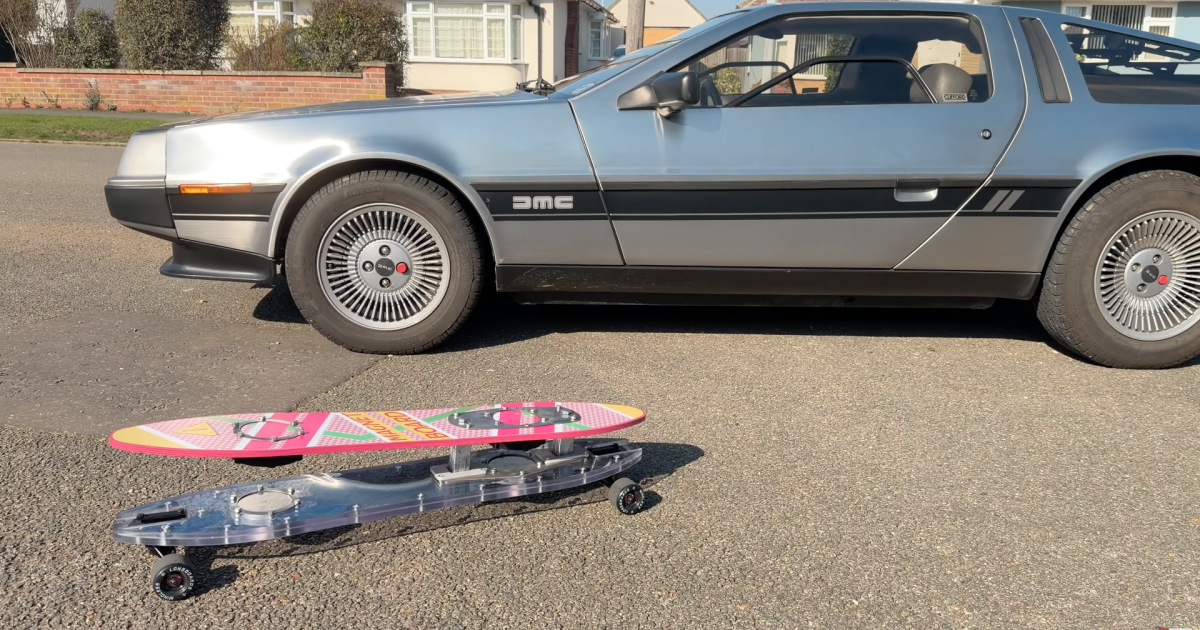
Mad-as-a-hatter British inventor Colin Furze recently set out to create a real-life version of the hoverboard from Back to the Future II. Technically, he failed. But what he built along the way has its own considerable merit: a double-deck skateboard where the top platform floats above the lower one through the repulsive force of neodymium magnets.
Furze has built a career out of turning insane premises into functioning machines like retractable Wolverine claws, a jet-powered bicycle, and a hoverbike made from paramotor engines. His latest project, the Magboard, builds directly on an earlier experiment – the Magnet Bike, a fat-tire mountain bike that used two pairs of magnets with more than 500 kg (1,102 lb) of pull force each to replace coil/spring suspension, already proving the concept could survive real-world wheels and road vibration.
The idea for the Magboard came from a YouTube comment. A user named Don Brown – who turns out to be one of the founders behind the Etnies shoe brand – asked: “Can you do this with skateboard trucks?” Furze loved the idea, got to work, and, after at least seven or eight prototypes, landed on a board that not only levitates but steers and rides just like a conventional longboard.
The MAGNET Suspension SKATEBOARD
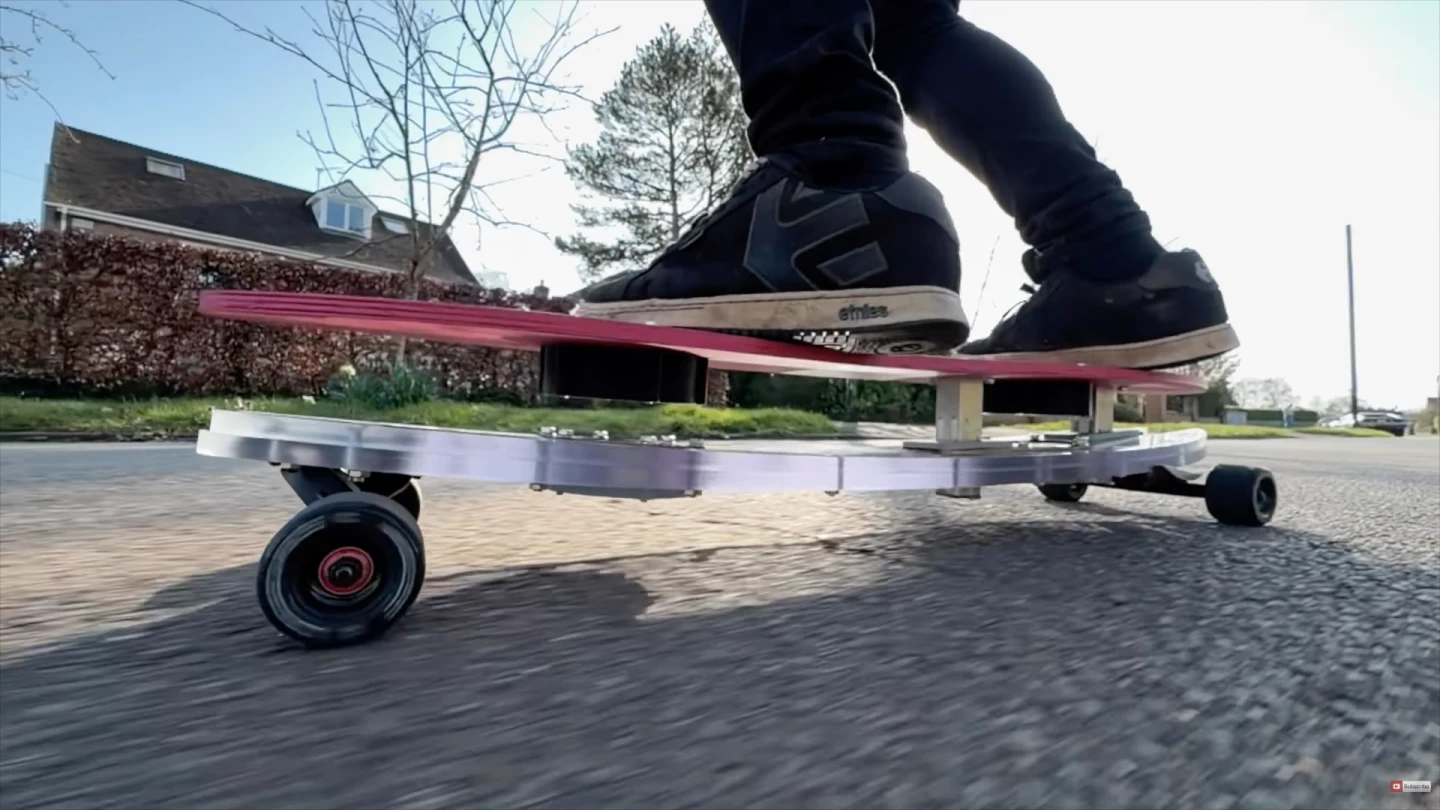
Furze built two decks, put magnets between them so that repelling force created an air gap. The lower deck carries the trucks (the metal axle assemblies that hold the wheels) and the upper deck is where the rider stands.
The real challenge wasn’t making it float, that worked within three minutes of the first prototype, but making the assembly steerable and stable without the top deck wobbling like a broken shopping cart. Furze tried linear pins, bearings, hinges, cross-brake cables, and combinations of all of the above. The final version uses square tubes with bearings integrated into 3D-printed sleeves, which allow vertical movement with minimal friction while still transmitting the rider’s foot rotation to the trucks.
Colin Furze/YouTube
The longboard-sized base deck uses two layers of 12-mm (0.47 in) polycarbonate because one layer alone was too flexible. The magnets are the same 100 x 30-mm (3.9 x 1.2-in) discs used in the bicycle project.
“Bouncing on magnetism is completely different,” Furze noted in the video. “It’s like frictionless. It genuinely feels like an air cushion.” To prove the point, he strapped a glass of water to a conventional longboard and compared it to the Magboard on grooved concrete. The water barely rippled in the magnetic version, while it visibly sloshed in the standard one.
As often happens with Furze’s inventions, one wonders whether this goes beyond a mad backyard YouTube experiment. For now, limitations are real: it performs best on smooth surfaces, weighs considerably more than a standard skateboard, rules out ollies (the foundational jump-and-flip trick in skateboarding) and any airborne maneuver, and the added height raises the center of gravity.
Colin Furze/YouTube
That said, the design solves a problem no previous hoverboard attempt had cracked: freedom of movement. Designs that levitate objects over copper plates or superconducting rails work, but they tether you to the size of the platform or the length of the rail. Furze’s Magboard goes wherever you go. “Unlike a hoverboard, which has no connection to anything, this works, and you can steer it,” the inventor said.
Furze acknowledges that he hasn’t solved every problem yet, and has asked his community for ideas to eliminate the last visible mechanical elements. But the concept might have real implications for personal transportation.
A suspension system with no directly contacting mechanical parts means, in theory, zero friction wear on the damping mechanism, offering a potentially significant advantage for urban electric scooters navigating cobblestones and cracked asphalt. Sometimes the most interesting engineering advances start from an idea everyone else scrolled past.
Source: Colin Furze

