


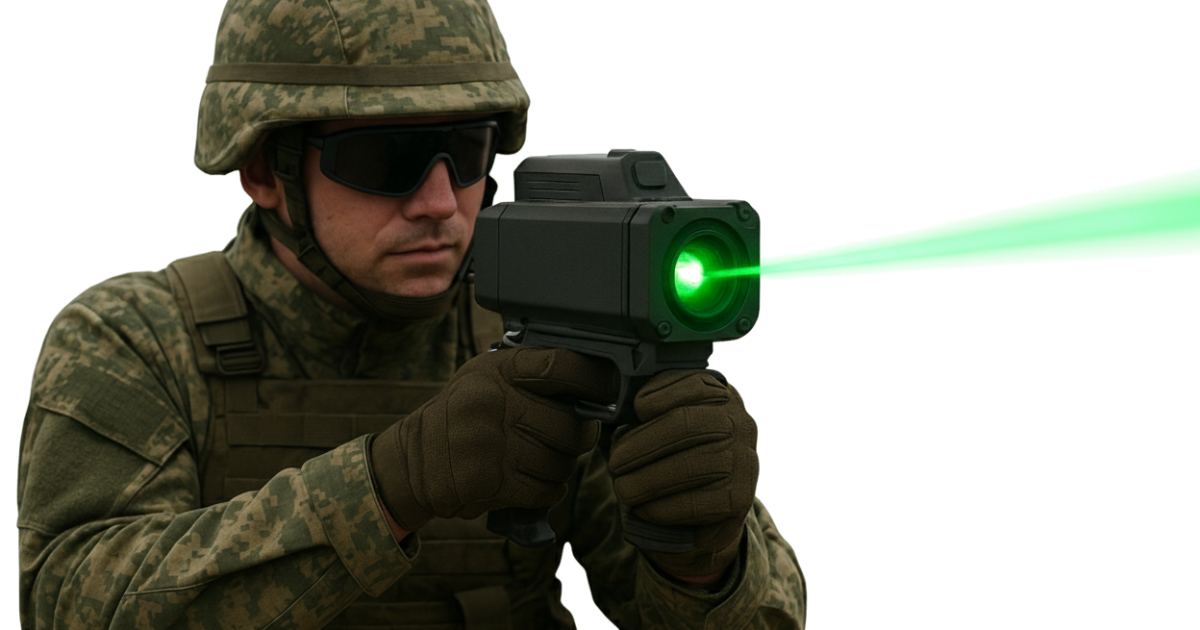
Laser weapons have become super portable. Defense and security company NUBURU’s Lyocon subsidiary has adapted industrial laser technology to create an anti-drone laser weapon small and light enough to fit on an infantry rifle.
If you’ve been following the news, you’ll probably have noticed that over the past few years drones have become a major player on almost all levels of warfare. Their potential has still to be fully realized but – as always happens with military tech – the eternal arms race between offence and defense is on for young and old.
For every new drone capability that’s created, countermeasures quickly follow. In fact, the counter-drone industry is now worth billions of dollars a year and shows no sign of slowing down. These countermeasures cover a wide variety of technologies, with lasers playing a central role.
The utility of lasers as a way of destroying or neutralizing drones is obvious. Laser beams travel at the speed of light, they can engage multiple targets near-simultaneously, require no physical ammunition other than a power source, and are remarkably cheap to operate.
While the high-energy lasers capable of destroying missiles, mortars, and large aircraft get most of the limelight (now there’s a phrase that dates me to sometime in the Victorian Era), smaller lasers are also coming online that can turn the individual soldier into an anti-drone fighter.
One of these is the new proof-of-concept laser system being developed by Lyocon. Based on commercial laser technology, this solid-state weapon, which includes the laser emitter and optics, is designed to be mounted on a standard MIL-STD-1913 “Picatinny rail” infantry rifle mount.
With the aid of Heckler & Koch, the system is built to be ergonomic, compatible with military systems, and ruggedized to handle combat situations that tend to be a tad harsh on gear. Meanwhile, Maddox Defense is working on rapidly scaling the technology and distributing it through the US Department of Defense supply chain and Tekne S.p.a. is helping ensure that the laser doesn’t interfere with friendly communications or navigation systems.
Powered by high-density lithium-ion batteries kept in a modular vest (or integrated into the rifle stock), the laser’s key advantage is that it operates in a multi-wavelength spectrum, incorporating green, blue, and infrared (IR) bands at a power range between one and 10 Watts.
The blue is particularly important because lasers in that part of the spectrum are absorbed easier by many materials, including metals and plastics, compared to infrared lasers, making them more effective even at low power levels.
The upshot is that the Lyocon laser can dazzle or destroy the sensors on a hostile drone at a range of up to 500 m (1,640 ft), blinding the attacker or even crashing it. According to the maker, it can be particularly effective because it can integrate with man-portable radar or radio frequency detectors to detect and lock onto targets.
The main purpose of the Lyocon laser is to deal with the “tactical bubble.” That is, to fulfill the need to frontline units and logistics convoys from low-cost, commercially available drones weighing up to 25 kg (55 lb).
“The successful completion of the POC confirms the robustness of the architecture we have engineered and the scalability of Lyocon’s directed-energy platform,” said Paola Zanzola, Executive Director of Lyocon. “Our objective has been to design a compact, modular system capable of delivering effective optical countermeasures against drone threats while maintaining portability and operational flexibility.”
We’re yet to see a photo of the system in question, and assume it’ll be vastly different to the cheaply rendered hero image above provided by Lyocon.
Source: NUBURU via Businesswire

