


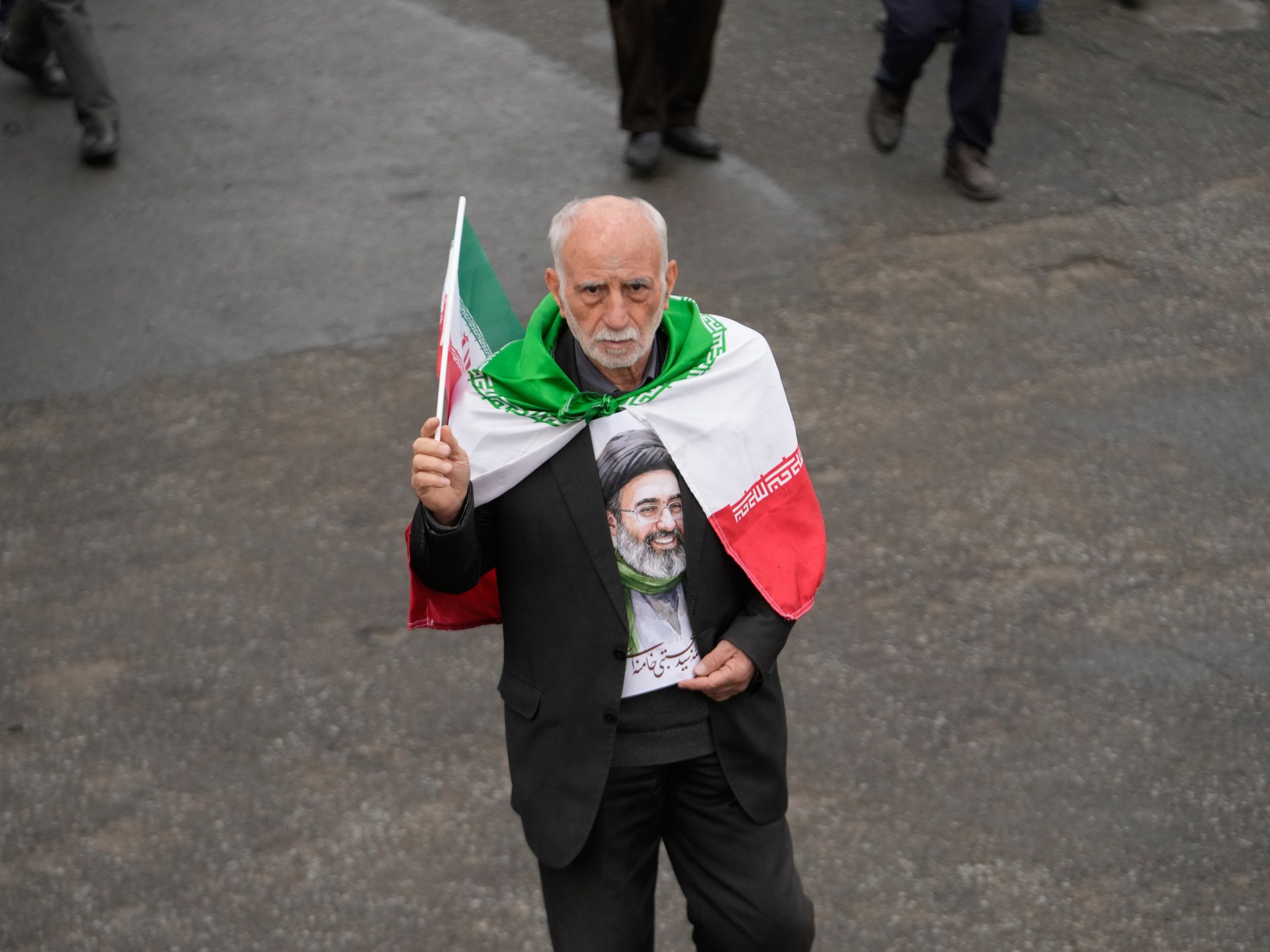
Tehran, Iran – Iran is celebrating Nowruz, the Persian New Year, during wartime for the first time since the 1980s, when neighbouring Iraq launched a full-scale invasion, leading to eight years of war.
In the lead-up to the festivities on Friday and the coming days, people queued up at local markets and shops in Tehran and across the country to buy flowers and exchange greetings despite heavy bombardment from United States and Israeli warplanes overnight, and periodically throughout the day.
Recommended Stories
list of 3 itemsend of list
Many people were with loved ones at home for the moment of the spring equinox, which marks the start of the new year and symbolises new beginnings for Iranians. It occurred this year on Friday at 18:15:59pm local time (14:45:59 GMT).
Some air defence batteries in Tehran fired intermittently for several minutes after the moment of the new year in an apparent celebratory move. Some people cheered from their windows and rooftops while others chanted “Death to the dictator”.
“We’ve been mostly hunkered down at home, but regardless of the bombs and missiles, Nowruz is always a blessed time, and we will give it value as people have been for millennia,” said Ghazal, who lives in Tehran with her husband and two young children.
“There is still a lot to hope for this year, even though the war also makes you concerned about the future of your children and country,” she told Al Jazeera, requesting that her identity remain anonymous.
Several other residents of Tehran who spoke with Al Jazeera said they felt that the city of more than 10 million was more crowded this week compared with the early days of the war nearly three weeks ago, as some people have come back to their homes after temporarily moving away to seek safety.
There was some traffic on the streets on Friday as spring rain fell in the afternoon, but the city was still far from its usual state of commotion as fighter jets and drones pierced the skies and completed bombing runs from time to time.
Some petrol stations in the sprawling capital still often see vehicles queue up, but the government says there is no shortage of fuel despite the bombing of oil depots earlier this month, and that citizens can use their personal fuel cards to get 30 litres (eight gallons) per day.
Authorities also said there were no shortages of blood at healthcare facilities, as people have been donating regularly since the start of the war on February 28.
The state continues to impose a near-total internet shutdown on more than 92 million Iranians for the 21st day, creating a black market for global connectivity and limiting the majority of people to an intranet designed to offer some basic services and connect to local news outlets.
“Iran is entering Nowruz, the Persian New Year, in digital darkness,” said internet observatory NetBlocks, adding that connectivity is at less than 1 percent of previous levels – which were already heavily constrained.
Families visit graves of fallen protesters
Keeping in line with longstanding traditions, many families across the 31 provinces of Iran visited the graves of their loved ones yesterday, on the last Thursday of the year.
Some set up small Haft Sin tables, cleaned tombstones and left colourful flowers to honour and carry the memory of their departed through to the next year.
But for many thousands of families, the visits reopened wounds that are still fresh from the unprecedented killings during Iran’s nationwide protests in January.
Footage circulating online showed the mother of Sepehr Shokri, a 19-year-old who was gunned down while peacefully protesting in Tehran, screaming and crying at the grave of his son at Behesht-e Zahra, the grand cemetery of the capital.
“You have guns, and my son stood up to you with his chest,” she said, telling crowds gathered in support that members of the family have been threatened with arrest and violence by state authorities.
The family captured hearts after the father of the young man released a haunting 12-minute video from the Kahrizak medical examiner’s office on the outskirts of Tehran in January, showing how he searched among numerous bodies of killed protesters laid out in the open.
Iran’s government claims that 3,117 people were killed during the protests, all by “terrorists” and “rioters” armed and funded by the US and Israel. The United Nations and international human rights organisations accuse heavily armed state security forces of a lethal crackdown against peaceful protesters.
The US-based Human Rights Activists News Agency (HRANA) says it has documented just more than 7,000 deaths and is investigating close to 12,000 others. UN special rapporteur on Iran, Mai Sato, said more than 20,000 civilians may have been killed, but information remained limited due to a lack of access granted to international observers by the state. US President Donald Trump said 32,000 were killed.
Lingering focus on streets
As the US and Israel say they want to see the Islamic Republic overthrown after 47 years via a popular uprising assisted by air strikes, Iranian authorities continue to urge their supporters to remain on the streets as much as possible, especially when daylight wanes.
The authorities organised more events across the country on Friday, including some to mark the Muslim festival Eid al-Fitr, encouraging supporters to gather at mosques and a large number of main city squares and streets.
State forces continue to send pick-up trucks with huge speakers mounted on the back to roam neighbourhoods in Tehran and broadcast pro-state religious chants.
The paramilitary Basij force of the Islamic Revolutionary Guard Corps (IRGC) props up armed checkpoints and roadblocks, many of which have been bombed by Israeli drones over the past week. In one of the latest incidents, the IRGC force in the northwestern province of East Azerbaijan said on Friday that 13 Basijis were killed and 18 wounded in a checkpoint attack in Tabriz the previous night.
Multiple top state officials have also been killed over recent days, including security chief Ali Larijani, Basij head Gholamreza Soleimani, IRGC spokesperson Ali Mohammad Naini, and Intelligence Minister Esmail Khatib.
People are urged to refrain from sharing footage of impact sites or checkpoints, or face arrest and legal prosecution, which could entail confiscation of assets or execution.
Three young men, including a 19-year-old wrestling champion and member of Iran’s national wrestling team, were executed one day before the Persian New Year in relation to the nationwide protests in January.
They were accused of killing police officers, but rights groups said they were executed without a fair trial and had given confessions under torture, charges Iranian authorities reject.
A day earlier, the Iranian judiciary had announced the execution of another man, who held dual Swedish citizenship, for spying for Israel.

