


Some people collect cars, some collect art, jewelry, ceramics, first edition books, entertainment memorabilia, movie posters and guitars while others collect baseball cards, comic books, video games and vintage technology. Items that were once throwaways are now sometimes worth a million bucks… quite literally.
Jim Irsay had enough disposable income to collect whatever he wanted and his inspired personal collection of cultural icons is now “up for grabs” due to his untimely demise last year.
In essence, that means the world’s foremost post-WW2 cultural museum is being dispersed.
Jim Irsay was once offered US$1.15 billion dollars for his private collection of cultural memorabilia.
If he’d accepted it would have been the most valuable collection ever sold – currently that mantle is held by Sotheby’s two-part Macklowe Collection auction held in 2021/22. The Macklowe divorce became one of the most public and acrimonious divorces for many a year, resulting in the court ordering the sale because the couple could not agree on a valuation. The Macklowe collection of modern and contemporary art grossed $922.2 million in New York.
The Billion Dollar Art Collection was famously on display in the foyer of the former couples’ Fifth Avenue apartment in the Plaza Hotel making it one of those places where the Macklowes were capable of making a deeply lasting first impression at their famously lavish cocktail parties. From Town and Country Magazine, “It was a setting that once inspired a major museum benefactor to turn to her billionaire husband and exclaim, ‘And I thought we were rich!'”
The whole salacious story can be found here (at the bottom), but the inclusion of Alberto Giacometti’s Le Nez ($78.4 million), Mark Rothko’s No. 7 ($82.5 million), Jackson Pollock’s Number 17, 1951 ($61.2 M), Cy Twombly’s Untitled ($58.9 M), Andy Warhol’s Nine Marilyns ($47.4 M) and Sixteen Jackies ($33.9 M), Gerhard Richter’s Abstraktes Bild ($33.0 M) and Pablo Picasso’s Figure ($26.3 M) helped form a solid base for that astronomical figure.
Just 65 artworks accounted for the $922 million spent on the Macklowe Collection, which easily surpassed the previous collection record held by the 2018 sale of Peggy and David Rockefeller’s Estate ($646 M) which had in turn surpassed the third most valuable collection in history ($433 M) of Yves Saint-Laurent in 2009.
Hence despite not containing any item likely to step into the $10+ million bracket, the Irsay Collection has been valued at more than the Macklowe Collection.
The Irsay Collection comprises over 400 lots, it is quite different to any previous construct known as a collection.
Jim Irsay (1959 – 2025) danced to a different drum his whole life and while best known as the ultra-successful businessman and owner of the Indianapolis Colts NFL football team, Irsay was far more nuanced and multi-layered than a focused successful entrepreneur has any right to be, and one of his many diverse (and extremely well-funded) passions was collecting landmarks in cultural history.
Though he spent just two-thirds of a century on the planet, becoming a captain of industry and fulfilling every little boy’s dream of owning the NFL football club he had worshipped all his life, it might well be his self-curated personal museum of cultural cenotaphs for which he is ultimately remembered.
The Jim Irsay Collection is currently on display at Christie’s New York offices, and in the next five days it will be sold and dispersed forever, so if the evolution of modern culture is of interest to you, the clock is now ticking on the last chance to see it all in one place.
The auctioning of the items contained in Irsay’s personal museum will also present as a cavalcade of recent world cultural turning points when the auctions are streamed live – a free event available everywhere and it’s not often you get to see a recalibration of society’s self worth. Be in no doubt, that’s what will happen and it’s likely to be well worth witnessing. Here are the dates and times worth putting in your calendar.
The Jim Irsay Collection: Hall of Fame, New York, 12 March 2026
The Jim Irsay Collection: Icons of Pop Culture, New York, 13 March 2026
The Jim Irsay Collection: Icons of Music, New York, 14 March 2026
The Jim Irsay Collection: Online, New York, 3-17 March 2026
Thanks to Irsay’s essentially limitless resources for anything he was passionate about, the collection is massive in size. The catchphrase “Go big, or go home” might well have been coined just for Jim Irsay, who had a red hot go at everything he did, and the focus he lavished on his collection remains congruent to the very last lot – it’s the detail of the collection rather than the star lots which fully capture the essence of important events in modern popular culture like no other construct.
Christie’s describes the collection as “a constellation of cultural touchstones – part rock-and-roll chronicle, part national archive, part folk-hero legend.”
Kerouac’s original ‘On the Road’ scroll to be auctioned in New York
Irsay’s ability to scour auctions over the last few decades for iconic items that somehow distilled an era and captured it in an object is now clearly available for all to see. I’d written about many of these objects over the past 25 years when they previously came to auction, and until Jim died, I hadn’t realized how many Irsay had accumulated, because it was his personal museum and only parts of it were occasionally visible to the public.
In that regard, it is quite sad that the collection will be dispersed as when you put a number of these items together, they do more to define our civilization than they do individually. It truly is a synergistic collection. We really should find a way to keep it all in one museum, the collection as a whole is one of the modern wonders of the world.

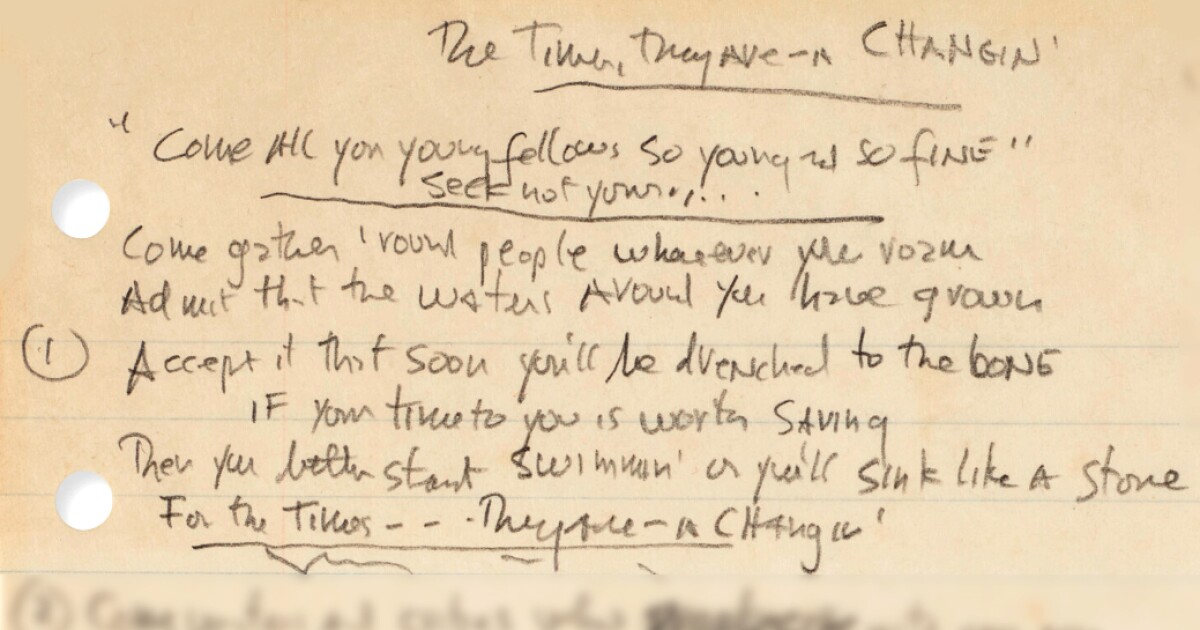
Irsay’s choices for his personal museum of inspiration display some remarkable insights into catalytic periods in world history: Kerouac’s stream-of consciousness “On the Road” novel, Steve Jobs’ inspirational note to a young Apple customer to “go change the world”, a Buddy Holly concert poster dated 3 Feb1959 (“the day the music died”) and a particularly relevant reminder of the lessons of world history in this technologically and socially cataclysmic year-to-be of 2026: Bob Dylan’s handwritten lyrics for “The Times they are a’changin.”

The Dylan and Buddy Holly items are two of dozens of musical acknowledgements to those who gave us the soundtrack to our lives, a unique phase in modern history where moments/eras in our lives became indelibly imprinted with an audio layer containing a song or band.

In this area, Irsay acknowledged all those who made a difference, across all genres of popular music (from John Coltrane and Miles Davis through Janis Joplin, Elvis, Elton John, Johnny Cash to Jim Morrison) and viewed from a slightly different angle, his collection of musical memorabilia contains the finest collection of important guitars ever offered at auction – nothing else comes remotely close.

The guitar collection is led by several of the world’s most expensive guitars, headed by Kurt Cobain’s MTV Unplugged 1959 Martin D-18E and Dave Gilmour’s “Black Strat.”
The Martin D-18E is an expensive and rare instrument in its own right, but its central role in one of the all time great MTV Unplugged performances, and its status as the last guitar Cobain played before his death, make it the current heavyweight guitar champion.

Christie’s
The Black Strat can be heard on everything created by psychedelic rock band Pink Floyd from 1970 to 1983, including all The Dark Side of the Moon (1973), Wish You Were Here (1975), Animals (1977), and The Wall (1979). A half dozen of the world’s most admired guitar solos emanated from Gilmour’s Black Strat, including “Shine On You Crazy Diamond,” which Gilmour insists “came out” of this guitar of its own accord. Other prominent appearances of THE Black Fender Stratocaster include the guitar solos in “Comfortably Numb,” “Money,” “Another Brick in the Wall, Part 2,” “High Hopes” and “Sorrow.”

But wait … there’s more … so much more that you’ll have trouble comprehending the depth. Irsay clearly spent a lot of time, or worked with some finely tuned cultural historians and curators in assembling this collection and while it contains dozens of iconic instruments such as Eric Clapton’s “The Fool” SG, Jerry Garcia’s “Tiger,” Kurt Cobain’s “Smells Like Teen Spirit” Fender Mustang, John Lennon’s 1963 Gretsch, and Bob Dylan’s Newport Folk Festival Stratocaster. It’s in the margins where I think iconic objects which will increase in value over time can be procured quite reasonably at this auction. Every single lot has a detailed and compelling story behind it that contributes to the whole.

The above image contains less than half the instruments in the Irsay Collection and the remainder are nearly all guitars too, each one chosen for the collection because it has a remarkable and relevant back story, and it’s only when you see them all together that you comprehend the magnitude of Irsay’s “personal project.”
The guitar collection boasts iconic axes from ALL of the masters – the Jimi Hendrix guitar has a wonderful provenance in that Hendrix presented it to his mentor, and once more the depth of Irsay’s knowledge in finding each one of these cultural tributes is evident. The collection is so big that it has been broken into multiple auctions, but start searching through the clutter and you’ll find countless fascinations.

Anyway, the whole theme of this article is that significant investment opportunities occur in the margins of significant auctions. This is a significant auction despite the collection being a work in progress of something quite special. Irsay’s end goal is unclear, but if you spend an hour or two looking over the lots on offer, you’ll agree with me that this collection is one of the grandest in collecting history. It’s also clear that the collection was a work in progress not aimed at investing potential but at documenting the significant points of modern culture.
His untimely demise brought the initiative to a close, but one wonders how broad and deep the entire exercise might have become had he lived another decade. The collection will strike a chord with everyone because it is inclusive of so many cultural sub-sets.

Just as there were key memorabilia from super athletes sprinkled across Irsay’s collection, (a Babe Ruth & Lou Gehrig signed baseball, Mohammed Ali’s World Championship belt from the “Rumble in the Jungle” and Wayne Gretzky’s ice hockey jersey), all who inspired Jim to be his best, his inclusion of Secretariat’s saddle in his private museum adds a new dimension – an appreciation of athletic perfection.

Secretariat (30 March 1970 – 4 October 1989) is one of the few racehorses in history to have transcended into public consciousness. Standing 16.6 hands tall (66 inches, 168 cm), he was lauded as a near-perfect racehorse bio-dynamically, even before he won the big three races in America in a single year – the “Triple Crown.” Secretariat won 16 times from 21 starts, and had God-like bloodlines, but it was the visible edge in acceleration and sustained speed shown in his second year of racing that rewrote the record books and captured hearts. When he made his move, he was clearly physically superior, even from a distance.
Secretariat began by winning the first of the big three, the1973 Kentucky Derby in a record smashing time that has not been bettered since, repeating all of those feats when he won the Preakness Stakes, often called ‘the Middle Jewel’ in the Triple Crown.
The final jewel was the Belmont Stakes, where Secretariat became a folk hero in his own right. Indeed, the times Secretariat ran in 1973 in all three of the Triple Crown’s constituent mega-races are still the fastest times ever recorded in those races.
The same increases in knowledge, science and understanding that have enabled athletes to continually improve the world’s best human performances by any measure of athleticism for half a century, have been available to horse trainers and breeders for just as long, but Secretariat set records 50 years ago that still stand today. In the third leg of the “Triple Crown,” Big Red broke the world record time for the one and a half mile distance of the Belmont Stakes, which he won by 31 lengths. Blood-Horse magazine’s List of the Top 100 U.S. Racehorses of the 20th Century ranked Secretariat second only to Man o’ War.

Another landmark inclusion in Irsay’s private museum was a bat used by Jackie Robinson (1919 –1972), the first African American to break the “color barrier” and play Major League Baseball in 1947. It was the end of racial segregation in sport and a step forward for society in so many ways. It might look like a fairy story now, but the truth was much uglier, and the hatred and bigotry that Robinson faced was sustained and an indictment on the state of “civilization” not long ago.
One of Robinson’s baseball caps sold for $590,000 a few years back because of his enormous historical significance as a statesman and athlete, but it was, on closer inspection, the forerunner to the batting helmet which was still many years away. The cap was essentially the first baseball cap that offered more than protection from the sun. Lightweight hard plastic shells had been inserted in specially sewn pockets in the cap.
Like Jim Irsay, Jackie Robinson strongly believed that sailors don’t complain about the sea, and he endured regular death threats against himself and his family with enormous grace. Beanballs were common accompaniments to the racial slurs of opposition players and being on first base, he was often deliberately spiked. On the road, in some states he was sometimes not allowed to stay with the team and had to stay in segregated hotels. As a soldier during WW2, he was once court-martialed for refusing to move to the back of a bus, based on the color of his skin. The baseball cap was simply an attempt to mitigate the damage from the countless beanballs aimed at his head.
Look deep into the Jim Irsay Collection and you might find a heartfelt keepsake at a bargain price. What often happens when a collection as big as this is dispersed, is that the lesser lots go cheaper than they should.
Simply being part of this collection will validate its importance in future times, and just as many of the high value items will likely set new records, the collection has had so much research put into it, that there are blue chip investments that rated on a global scale that will sell for less than $10,000.
The whole story is told in our 2021-2022 auction year overview and is far more salacious than a dime novel.
Jim Irsay once confirmed he had declined an offer of $1.15 billion for the collection so it will be interesting to see if the real world bidding on a lot by lot basis reaches $1.15 billion.
It won’t, which means many items will sell for less than they are worth now.
It’s the lots that will sustain their value on the stage of history that are those with genuine investment potential.
All you have to do is decide which lots they are.

