


There was a time when the name Xiaomi was synonymous with home appliances. That has changed of late, with the Chinese company venturing into the automotive segment with the 217-mph 4-door SU7 – a car that outsold the Tesla Model 3 in China and the YU7 SUV that followed it.
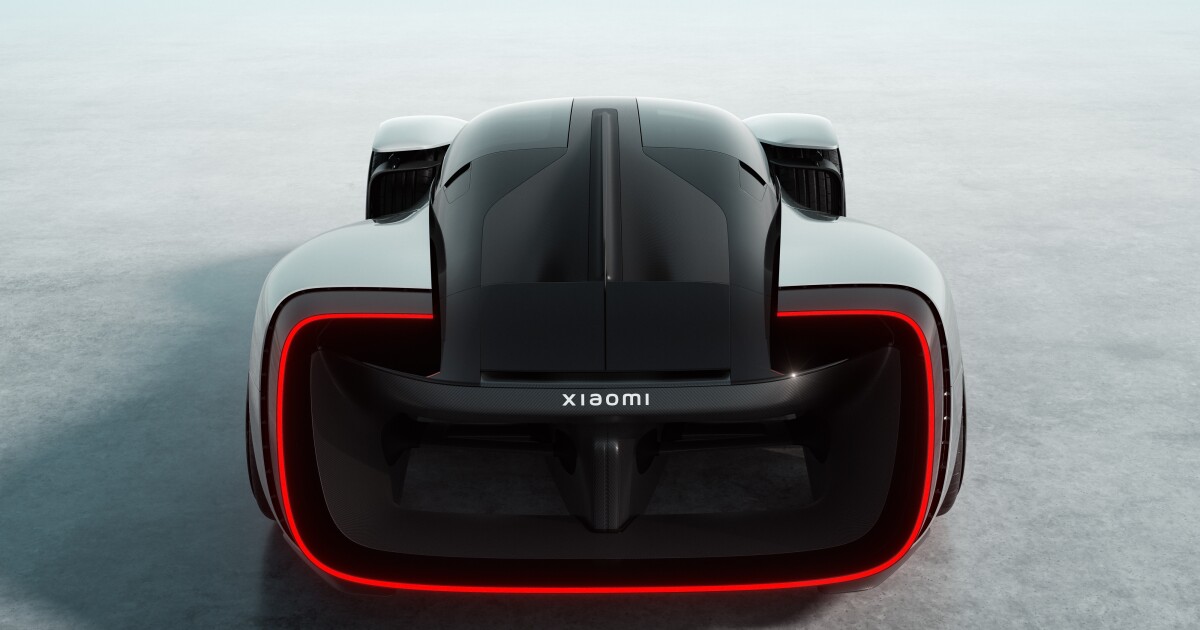
Now, the company has pulled the covers off a 1,900-hp electric hypercar concept called the Vision Gran Turismo. And it is breathtakingly beautiful!
Now, first things first, this is a virtual concept car that’s specifically created for the Gran Turismo franchise. It’s only meant to be driven in Gran Turismo 7, which means that it likely won’t go into production. But what it does do is put Xiaomi as the first Chinese carmaker in the same company as Ferrari, Lamborghini, and Porsche.
A real-life metal concept version debuted at the Mobile World Congress in Barcelona. It’s got a whole spec sheet and some really unique engineering tidbits that have got people talking.
Xiaomi
Starting with the design, the Vision GT is apparently “shaped by the wind.” The star of the show is its teardrop cockpit that looks like it’s floating inside a body that has been hollowed out and divided by airflow channels.
Look at it from above, and the hypercar resembles a pod racer, with white body panels encircling the cockpit and a roof that’s made entirely of dark-tinted glass. The two doors open dramatically in a scissor pattern – quite fittingly, to be honest.
Tianyuan Li, Xiaomi’s head of design, says the hypercar was constructed using a “less is more” philosophy in which the body directs airflow. As opposed to slapping a host of aerodynamic elements on there, Xiaomi’s designers integrated the aerodynamics into the car’s shape itself.

Xiaomi
Take the cross headlights, for instance. Not only do they look insanely cool, but they also aid in directing airflow. Or the large rear air vent that houses the halo taillight. Beneath it, you’ll see ducts and channels with an Active Wake Control System, and what Xiaomi refers to as “Accretion Rims.”
These wheel covers have a vortex form and fit flush with the tire surface. The semi-transparent cover hides turbine fins that actively draw air to cool the brakes.
The idea is pretty simple: There’s a magnetic mechanism underneath that keeps the wheel covers perfectly still as the wheels spin beneath them. This produces a beautiful floating impression and removes the aerodynamic drag brought on by revolving wheel surfaces.
The Vision GT has an aerodynamic efficiency rating of 4.1, a downforce figure of -1.2, and a drag coefficient of only 0.29. Now, for reference, the McLaren Speedtail produces a drag coefficient of 0.278, and Xiamoi’s own SU7 is even lower at 0.195. But that’s not the whole story.

Xiaomi
Rather, it is the ratio of downforce to drag that matters the most. You see, most electric hypercars either target high downforce for cornering or a minimal drag for top speed. Here, Xiaomi claims it concentrated on striking a balance between the two. For a company that has produced barely two road-going models until now, that’s some massive technical prowess on show.
Inside, you see what Xiaomi calls the “Sofa Racer” concept, abandoning the conventional hypercar bucket seat layout. The seats, door panels, and dashboard all flow into a single, continuous ring-shaped structure that envelops the driver in a cocoon.
3D-knitted natural fabric is used for the seats. Elsewhere, there’s an aircraft-style throttle shifter and an infinite-shaped steer-by-wire wheel. At the center of it all is Xiaomi Pulse, a 360-degree intelligent assistant integrated into the dashboard that continuously monitors the driver’s inputs. To complement it, you get Xiaomi HyperVision, which modifies the display interface according to driving mode.

Xiaomi
Regardless of what Xiaomi has put together here, the Vision GT is essentially a video game car. And until we see something similar planned for the mass market, I wouldn’t be getting too carried away.
But here’s the thing: Barely three years ago, Xiaomi made zero cars. Fast forward to 2026, and the company has already put its name to a Nurburgring record, while targeting over 550,000 units for the year. Who’s stopping them from bringing this to production?
Source: Xiaomi

