


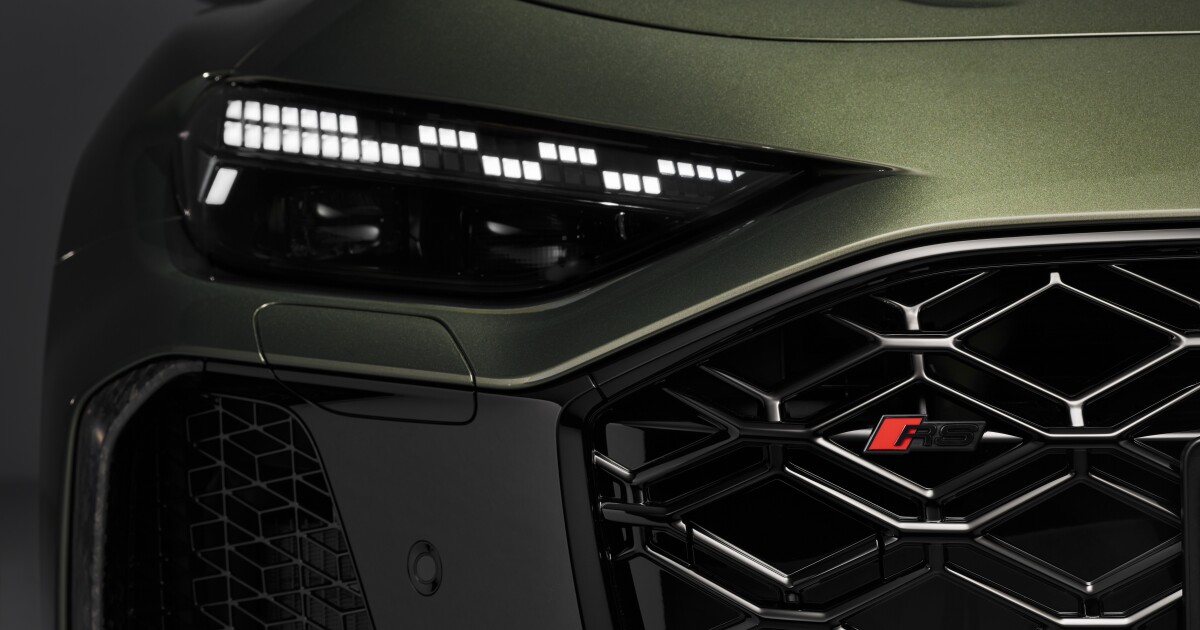
The new Audi RS 5 is such a technological showcase it should come with the iconic ‘Vorsprung durch Technik’ advertising slogan plastered all over it. That marketing phrase meant “progress through technology” and, because it was in German and we didn’t quite understand it, the slogan came to imply Teutonic efficiency, expertise, innovation and premium quality.
Okay, in recent years it has become less central to Audi‘s output. It doesn’t seem to fit an ad for an economical A1 hatchback or Q3 family SUV so well. But Audi has just unveiled a new and very worthy Vorsprung durch Technik candidate to the world.
Its latest version of the RS 5 is the brand’s first ever high-performance plug-in hybrid but, more importantly for the wider motoring world, it features some state-of-the-art Audi-style motoring tech.
Audi
First the basic headlines about the car: it’s the latest generation of Audi’s hot rod four-wheel-drive station wagon (Avant) or sedan (at present only the sedan is announced for the US, both seem likely elsewhere). The 630 hp of power comes from a 2.9-liter petrol V6 plus a 130-kW electric motor with a 25.9-kWh battery under the trunk and an eight-speed Tiptronic gearbox.
We’ve reported on different generational improvements for the RS 5 extensively over the years. This time it’s enough to say that the car looks like an angry monster in either wagon or sedan form. It’s jammed with high-end kit and is pretty much what you’d expect from a German brand’s top of the range premium sports sedan or wagon.
But it’s the tech behind the rear transaxle system that’s exciting the world’s auto engineers. It promises handling on a new level. The pioneering system is worth highlighting but will take a little explaining. But it’s worth it to grasp the science. Hold tight, here goes…

Audi
The Dynamic Torque Control in the 2026 Audi RS 5 is the culmination of over 45 years of Audi’s ‘quattro’ all-wheel drive development. It marks a significant shift from purely mechanical parts to high-speed electronics to solve one of Audi’s longest-standing handling criticisms: understeer.
This is the problem: in a normal car, the engine sends power equally to both wheels on any axle. On a tight corner the wheels need to turn at different speeds but can’t, so that causes problems like wheelspin or understeer. It’s like if you are rowing a boat. If you want to turn right, you row harder on the left side, without differential torque you can’t do that.
Managing torque means pushing more power to the wheel that needs it most, to help the car turn corners more efficiently. The RS 5 is the first to do this electro-mechanically, sending extra power to the outside wheel during a corner to “push” the car into the turn, making it feel lighter and sharper. That principle is not new. But because the RS 5 uses a computer-controlled electric motor to shift that power (instead of waiting for mechanical parts to move), it happens almost instantly – faster than you can blink.
Previous systems were reactive, fixing a slide after it starts. This electrical system is proactive because it calculates what the car needs – 200 times every second – to prevent sliding or understeering before it happens. It’s a world first in any production car and aims to make the heavy, powerful RS 5 (approx. 2.5 tons) handle like a small, nimble go-kart.

Audi
Audi has always been a leader in torque tech. Its early systems used a manual switch to lock the rear wheels together for traction in snow. Next Audi used ABS to “pinch” the brakes on the inside wheel during a turn, tricking the differential into sending more power to the outside. The Sport Differential of 2008 used hydraulic clutches and gears to push torque to the outside wheel under load. This new system replaces those clutches with an 8-kW electric motor removing the delay of hydraulic pressure building up, allowing instant torque shifts.
This is all significant in engineering terms: Audi designed it to address the tendency of previous RS models to push wide in corners. By shifting up to 2,000 Nm (1,475 lb.ft) of torque between wheels, it can now literally force the car to rotate as required. Unlike mechanical systems that need you to be on the accelerator to work, this electric system can vector torque even while you are braking or coasting.
For the first time, it allows a drift mode that can send up to 100% of the rear drive to a single outer wheel, allowing for controlled, tire-smoking slides that were previously impossible for quattro systems.
Its rivals, the BMW M3 or Mercedes-AMG C63 rely on slower mechanical drift modes. The M3’s system is about traditional purist rear-wheel-drive, relying on the driver’s skill to balance the throttle and steering. The C63 is more brutal, making it easy to start a slide – but more challenging to manage the heavy sports sedan once you’re hurtling sideways.
Source: Audi

