


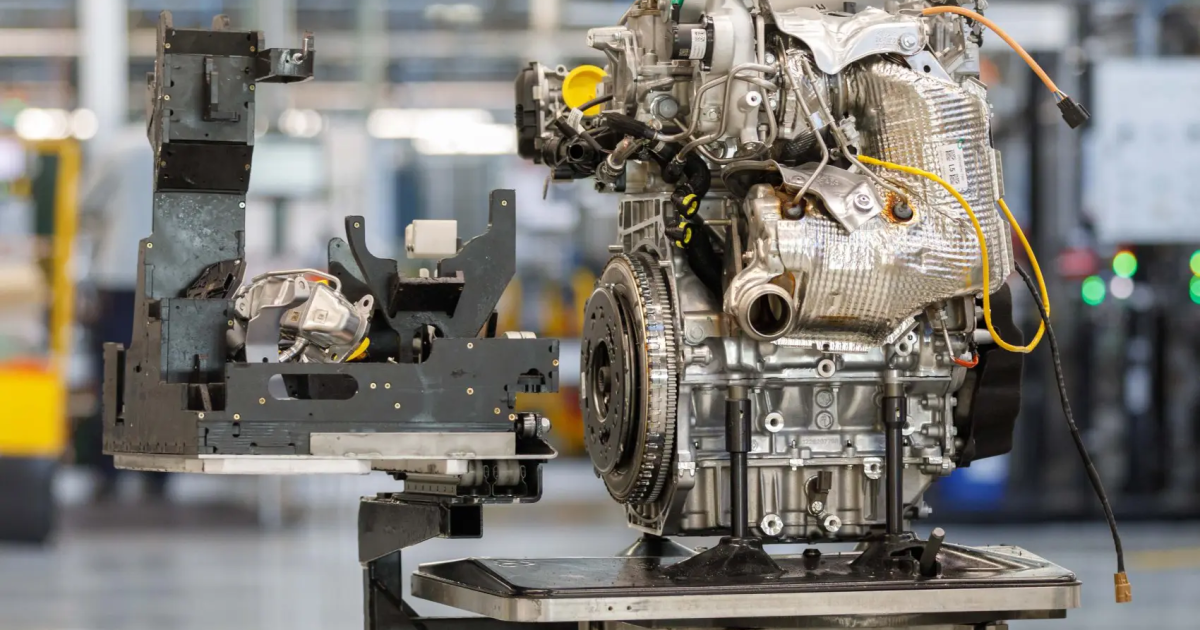
A fast-rising name in the hybrid vehicle market, Horse Powertrain has spent the past three years transitioning into one of the world’s leading engine manufacturers while developing a portfolio of electric motors, hybrid powertrains and other net-zero-supporting technologies. Now it’s looking ahead into the future, showing an early concept version of a next-generation hybrid engine system powered by 100% renewable fuel. The company says the new prototype can boost fuel economy by 40% while slashing literal tons of CO2 emissions.
It’s no secret in our modern world that any major technological shift naturally creates winners and losers. And so do all the little obstacles and pitfalls along the way.
Horse initially looked like a counterintuitive move when it was spun out from a Geely-Renault joint venture as a hybrid and combustion engine specialist in 2023. The EU still had a hard, non-embattled 2035 zero-emissions engine mandate in place. The United States still had a federal EV tax credit worth up to $7,500. And automakers worldwide were scrambling over each other to grab the microphone and make proclamations about their grand EV master plans and latest all-electric products.
At that point, governments and industry execs were not yet backtracking, weakening regulations, re-engining trucks, canceling battery deals or bringing back big, thirsty V8s. Electric was the direction everything was moving, so why would the market need a new brand dedicated to ICE tech?
Three short years later and all that has changed, with consumer EV demand becoming a shaky uncertainty. It’s certainly no time to weep for Tesla, CATL or other huge beneficiaries of the original push toward all-electric power, but it is an ideal time for a different type of company to step up, a young spinoff brand (or longtime supplier) specializing in hybrid combustion-engine products as an interim emissions-cutting solution.
Horse’s hybrid-focused brief really started looking like a very smart play by early 2025, and as Reuters reported later in the year, the company had started playing a critical role in helping automakers quickly backfill vehicle lineups with more hybrid options. Automakers are able to focus development dollars on all-electric platforms while powering current-gen hybrids with off-the-shelf units from Horse, without the need to divert much investment to ground-up PHEV engineering or manufacturing. CEO Matias Giannini told Reuters at the time that it was already the world’s third largest engine manufacturer, on the way to its target of becoming the largest of them all by 2035.
Horse didn’t exactly start from scratch, jumpstarted by a wealth of manufacturing infrastructure (and engine demand) from its parent companies. It now operates 17 manufacturing plants and five R&D centers, supplying major global auto brands like Volvo, Nissan and Mitsubishi, as well as Renault and Geely themselves.
Repsol
For its latest piece of propulsion technology, Horse teamed up with Spanish multi-energy supplier Repsol to develop what they’re calling the H12 Concept engine. The new powerplant is an evolution of the turbocharged 1.2-liter HR12 three-cylinder engine Horse has been producing since 2024. The concept unit has been running on 100% renewable fuel supplied by Repsol, taking a bite out of carbon footprint from the get-go.
“The Horse H12 Concept is an example of how highly efficient engines and renewable fuels can reduce emissions today, without waiting for future solutions,” Horse COO Patrice Haettel said. “As a company, we believe that relying on a single technology is not the fastest way to cut emissions. This is why we advocate a technology neutral approach that enables innovation across all solutions – electric, hybrid, range extenders and low-carbon fuels.”
Horse states that by using a 17:1 compression ratio, optimizing the H12 turbocharger, installing a new exhaust gas recirculation system, tweaking the hybrid gearbox for improved energy management, and adding in a high-energy ignition system, it’s able to achieve a 44.2% peak brake thermal efficiency (BTE), a measurement that compares useful crankshaft power output versus fuel energy input. Expounding upon that figure, it estimates consumption levels lower than 3.3 km/100 L (71 mpg).
Horse says that figure represents a 40% reduction in fuel consumption, which gels with EU data showing the average consumption across all European combustion engine-driven cars ranged between 5 and 6 L/100 km in 2023. A 2.2 L/100 km improvement over that average of 5.5 L/100 km is exactly 40%.
In terms of emissions cut, Horse and Repsol estimate the H12 Concept’s potential to slash up to 1.77 tons of CO2 annually when equipped in a midsize vehicle. That’s compared to the same vehicle with a traditional ICE powertrain running non-renewable fuel averaging the same 12,500 km (7,767 miles) per year.

Repsol
Repsol notes the fuel used for the H12 project is 95-octane gasoline sourced from 100% renewable material. Called “Nexa 95 gasoline of 100% renewable origin,” the fuel is compatible with all existing gas ICE vehicles, without any modifications necessary. Repsol estimates it’s capable of cutting CO2 emissions by more than 70% as compared to traditional gasoline.
In October, Repsol achieved a technological milestone in producing pure-renewable Nexa 95 gasoline at industrial scale.
Renewable fuels are produced from sustainable, renewable, non-fossilized organic materials instead of non-renewable petroleum. Repsol says its renewable fuels are made from organic materials, including agricultural and forestry waste and used cooking oils.

Repsol
Horse and Repsol have developed two prototype H12 engines and plan to reveal a demonstrator vehicle using the engine in the coming weeks.
Sources: Horse Powertrain, Repsol

