


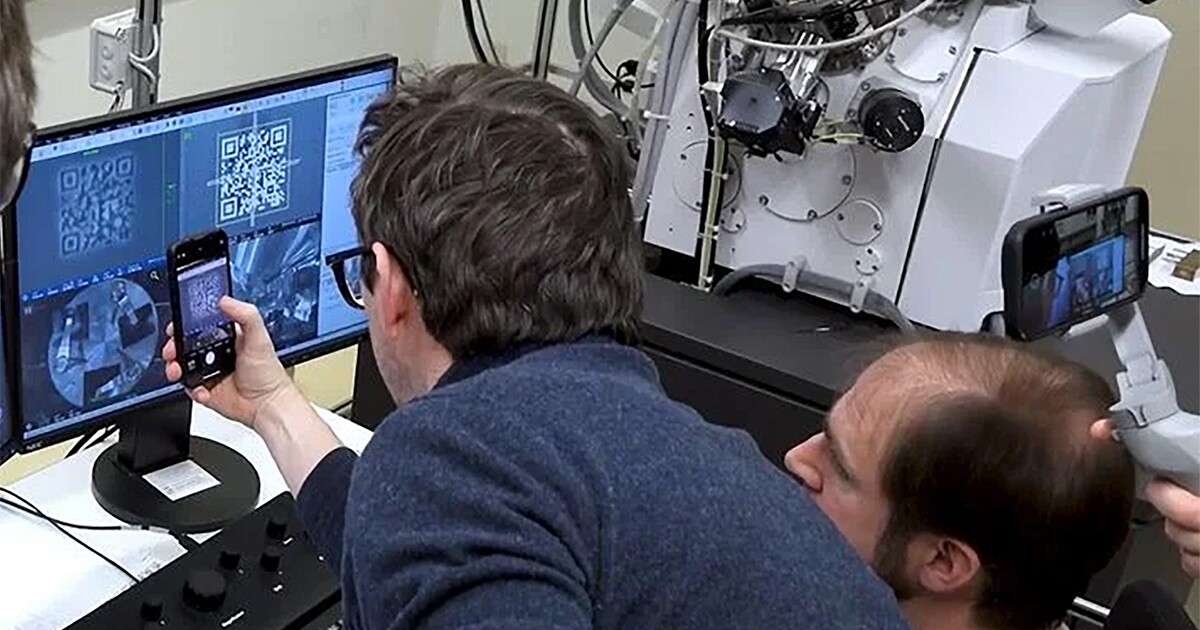
For those of us who weren’t paying attention, over the last few years, scientists around the world have been one-upping each other in a bid to create the smallest QR code that can be reliably read. Now, Austria-based researchers have set the bar real high with a QR code so tiny, you’ll need an electron microscope to see it.
Material scientists from the TU Wien public research university in Vienna have shrunk the specialized barcode down to an area of 1.98 square micrometers, which is smaller than many bacteria, and is invisible to optical microscopes. It’s officially earned the team a place in the Guinness World Records.
“Structures on the micrometer scale are nothing unusual today – it is even possible to fabricate patterns made of individual atoms,” said Professor Paul Mayrhofer from TU Wien’s Institute of Materials Science and Technology. “However, that alone does not result in a stable, readable code.”
TU Wien
Indeed, the previous record for the smallest QR code was set by a Germany-based team at the University of Münster, fitting a pattern into an area of just 5.38 square micrometers – many times smaller than a human red blood cell. So an advancement in this niche wasn’t just about shaving off a few micrometers this way and that, but also about ensuring the QR code was usable over a long period of time in that tiny encoding area.
The team collaborated with German startup Cerabyte, which specializes in long-term data storage technology, and chose to use a thin ceramic film as the medium. The idea here was that this material remains stable across conditions over extended periods, so the code etched onto it would be repeatedly readable.

TU Wien
The researchers used focused ion beams to mill the QR code onto the ceramic film, with individual pixels measuring just 49 nanometers each. At the size, those pixels are about 10 times smaller than the wavelength of visible light – which means you couldn’t ever see this detailed code with visible light. Instead, it can only be viewed using an electron microscope.
That makes the TU Wien team’s QR code nearly three times smaller than the previous record-setter. But more importantly, it advances work in developing a durable, high-density data storage technology for the world’s growing information archival needs. The researchers note that an A4 paper sheet-sized ceramic film could hold more than 2 TB of data.

TU Wien
Of course, there’s a lot more work to be done in developing it. The scientists aim to advance their research by exploring other data structures beyond QR codes to write data, as well as other materials for reliable, energy-efficient, long-term storage. They also intend to look into how it can be made available outside of lab settings.
The ceramic tech could go up against alternative data store technologies that are currently being investigated, including the use of DNA suspended in amber, a special magnetic molecule that allows small drives to store vast amounts of data, an entirely new form of magnetism for next-gen hard drives, and Microsoft’s approach to etching data into glass using lasers.
Source: TU Wien

