


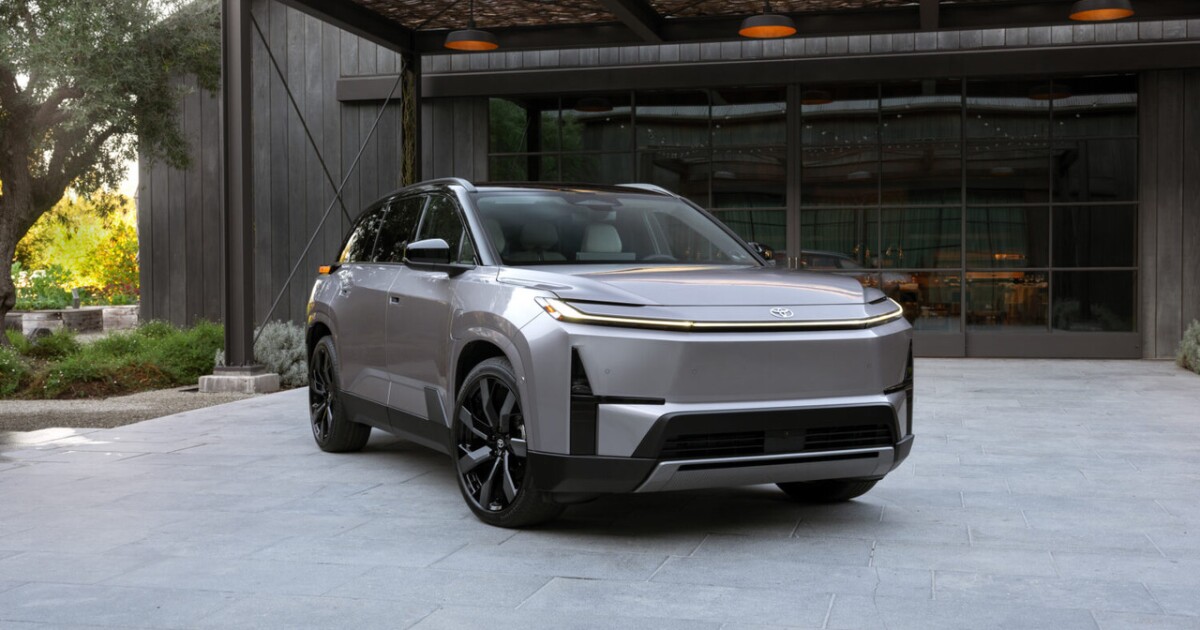
In many ways, the new Toyota Highlander is a landmark model: the company’s first three-row electric SUV in the US and the first to use batteries from the new Toyota plant in North Carolina.
It’s Toyota’s first fully battery-electric vehicle assembled in the US, its first electric seven-seater worldwide, and the brand’s biggest battery pack to date. It even has Toyota’s largest panoramic glass roof.
But despite all these breakthroughs, the big, smart electric SUV is roughly what everyone has expected. As The Autopian summed it up, there’s nothing earth-shattering – technologically speaking – here. It’s a typically conservative, mainstream update from the world’s largest automaker.
Toyota
Trimming away all the marketing hype (“a BEV that fits customers’ lives”), here are the basics about the 2027 Highlander:
- It’s bigger, roomier, and more powerful.
- The new look follows contemporary all-electric design trends, including slim front LED units, flush door handles, broad fenders, flared arches, and a tapered mid-body waist.
- Width increases by 2.3 inches to 78.3 inches (1,988 mm), and the wheelbase grows almost eight inches to 120.1 inches (3,050.5 mm). Huge figures for European roads, fairly average for the US.
- Two battery options: 77 kWh/270 miles or 95.8 kWh/320 miles. Both charge from 10% to 80% in a minimum of about 30 minutes. Power outputs are about what you’d expect for a vehicle of this size.
- Two trim levels plus a choice of front-wheel drive or all-wheel drive.
- Three-row seating, in 2-2-2 or 2-3-2 configurations.
- Plenty of onboard tech, including a customizable large touchscreen, separate driver display, and optional head-up display. USB ports throughout, a 64-color ambient lighting system, advanced infotainment and connectivity, and a built-in drive-recorder video system.
- All the latest active driver-assistance systems to annoy most drivers but satisfy safety box-tickers.
Performance, towing capacity, payload, pricing, and launches into other markets haven’t been announced yet, but again, the industry doesn’t expect surprises. Interestingly, in a declining US electric vehicle (EV) market, there’s also no word on variants using other powertrains.
It all goes to show: Toyota hasn’t become world number one by surprising buyers, but by being safely mainstream, carefully thought-out, predictable, and reliable.

Toyota
There are a few neat touches we do like about the new Highlander though: it’s comfortable and roomy even in the third row, there are plenty of storage slots for tablets and phones, and the charge-assist feature can maximize charging during low-rate periods.
There’s also a tech feature with the new US-built battery pack that’s hardly been mentioned. The new Highlander can serve as a mobile power source, a first for any Toyota model sold in the United States. This technology can power external appliances, such as at a tailgate party or for mobile work equipment. Most intriguing of all, it can even provide your home with backup power in the event of an outage.
The Highlander has clearly moved upmarket since it was first revealed at the New York Auto Show in 2000. The first-generation Highlander was a rugged 4×4 that used a modified version of the Camry’s platform. The brand launched a hybrid Highlander in 2005 as its first hybrid after the Prius.
The second-generation US-built Highlander was a more refined crossover SUV. The third generation, launched in 2013, brought a catalog of active safety technologies and advanced driver-assistance features. The fourth generation of 2019 was more spacious and stylish., and the Grand Highlander upsized the nameplate again. The 2027 model kicks off the latest generation with further gains in style, comfort, and efficiency. But it’s competing in a tough market dominated by Ford’s Explorer.

Toyota
In the United States, two-row compact and midsize SUVs dominate sales (leaders are Toyota RAV4, Honda CR-V, and Nissan Rogue), but three-row SUVs are currently growing in popularity. It’s a trend driven by demand for family vehicles that replace traditional minivans. The three-row midsize segment is booming. While still low, sales of electric three-row SUVs are expected to quadruple from under 100,000 in 2024 to around 400,000 by 2029.
That said, Explorer sales are soaring, with 2025 its best year since 2020 at 222,706 units. Highlander sales have been shrinking at the same time, down to just 51,782 last year, although Toyota is competing with itself to some extent. Its larger Grand Highlander appears to be stealing Highlander sales – last year the big sister sold 125,140 units.
Source: Toyota

